Department of Clinical Sciences Malmö, Medical Radiology, Diagnostic Centre of Imaging and Functional Medicine, Skåne University Hospital, SE-20502 Malmö, Sweden.
BMC Med Imaging. 2012 Feb 15;12:3. doi: 10.1186/1471-2342-12-3.
Video capsule enteroscopy (VCE) has revolutionized small bowel imaging, enabling visual examination of the mucosa of the entire small bowel, while MR enteroclysis (MRE) and CT enteroclysis (CTE) have largely replaced conventional barium enteroclysis. A new indication for MRE and CTE is the clinical suspicion of small bowel strictures, as indicated by delayed or non-delivery of a test capsule given before a VCE examination, to exclude stenosis. The aim of this study was to determine the clinical value of subsequent MRE and CTE in patients in whom a test capsule did not present itself in due time.
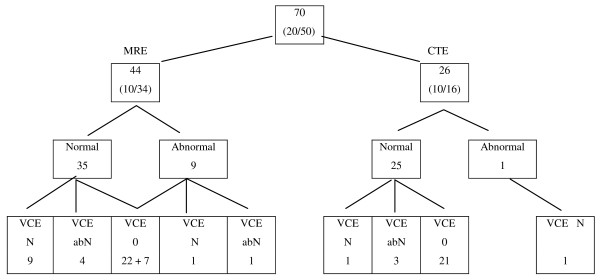
Seventy-five consecutive patients were identified with a delayed or unnoticed delivery of the test capsule. Seventy patients consented to participate and underwent MRE (44) or CTE (26). The medical records and imaging studies were retrospectively reviewed and symptoms, laboratory results and imaging findings recorded.
Lesions compatible with Crohns disease were shown by MRE in 5 patients, by CTE in one and by VCE in four, one of whom had lesions on MRE. In patients without alarm symptoms and findings (weight loss, haematochezia, anaemia, nocturnal diarrheoa, ileus, fistula, abscess and abnormal blood tests) imaging studies did not unveil any such lesion. VCE's were performed in only 20 patients, mainly younger than 50 years of age, although no stenotic lesion was shown by MRE and CTE. In the remaining 50 patients no VCE or other endoscopic intervention was performed indicating that the referring physician was content with the diagnostic information from MRE or CTE.
The diagnostic value of MRE and CTE is sufficient for clinical management of most patients with suspected small bowel disease, and thus VCE may be omitted or at least postponed for later usage.
视频胶囊内镜(VCE)彻底改变了小肠成像技术,使整个小肠的黏膜能够进行可视化检查,而磁共振肠造影(MRE)和 CT 肠造影(CTE)在很大程度上已经取代了传统的钡剂肠造影。MRE 和 CTE 的一个新适应证是怀疑小肠狭窄,这是通过在 VCE 检查前给予的测试胶囊延迟或未送达而提示狭窄的存在,以排除狭窄。本研究的目的是确定在测试胶囊未按时送达的患者中随后进行 MRE 和 CTE 的临床价值。
确定了 75 例测试胶囊延迟或未送达的连续患者。70 例患者同意参与研究,并接受了 MRE(44 例)或 CTE(26 例)检查。回顾性审查了病历和影像学研究,并记录了症状、实验室结果和影像学发现。
MRE 显示 5 例患者存在与克罗恩病相符的病变,CTE 显示 1 例,VCE 显示 4 例,其中 1 例在 MRE 上显示有病变。在没有报警症状和发现(体重减轻、血便、贫血、夜间腹泻、肠梗阻、瘘管、脓肿和异常血液检查)的患者中,影像学研究未揭示任何此类病变。仅对 20 例患者进行了 VCE 检查,这些患者主要年龄小于 50 岁,尽管 MRE 和 CTE 均未显示狭窄性病变。在其余 50 例患者中,未进行 VCE 或其他内镜干预,表明转诊医生对 MRE 或 CTE 的诊断信息满意。
MRE 和 CTE 的诊断价值足以满足大多数疑似小肠疾病患者的临床管理需求,因此可以省略或至少推迟进行 VCE。