Department of Biochemistry and Molecular Biology, Bloomberg School of Public Health, Johns Hopkins University, Baltimore, Maryland 21205, USA.
J Invest Dermatol. 2012 May;132(5):1384-91. doi: 10.1038/jid.2012.6. Epub 2012 Feb 16.
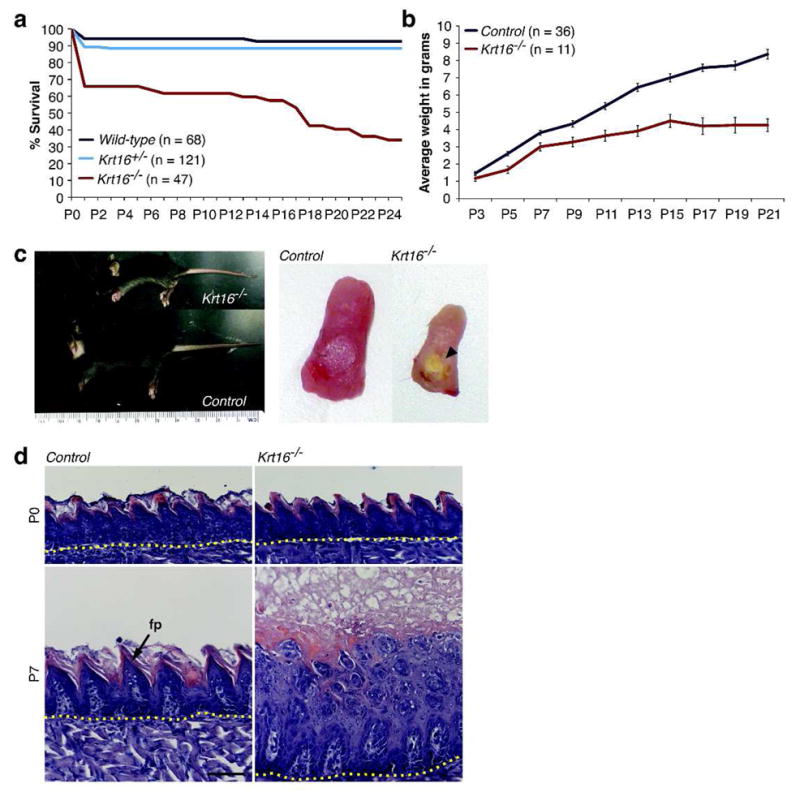
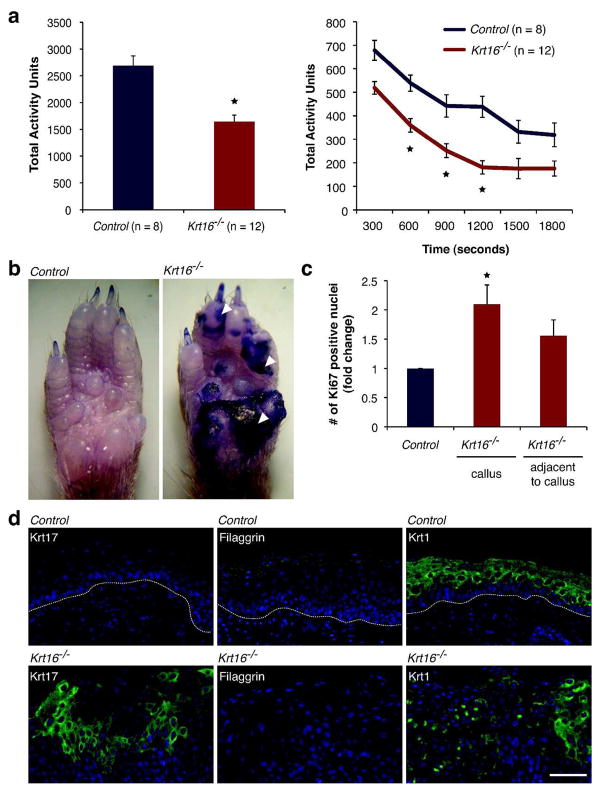
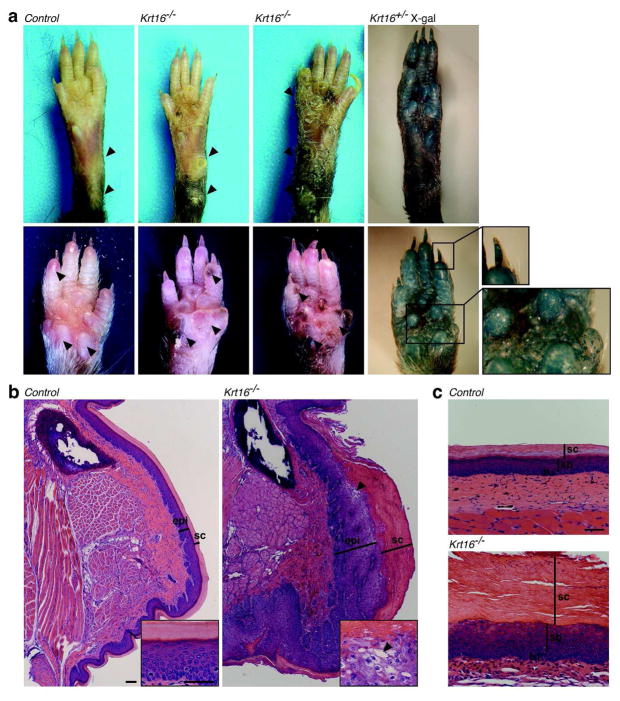
Keratin 16 (KRT16 in human, Krt16 in mouse), a type I intermediate filament protein, is constitutively expressed in epithelial appendages and is induced in the epidermis upon wounding and other stressors. Mutations altering the coding sequence of KRT16 cause pachyonychia congenita (PC), a rare autosomal dominant disorder characterized by hypertrophic nail dystrophy, oral leukokeratosis, and palmoplantar keratoderma (PPK). PPK associated with PC is extremely painful and compromises patient mobility, making it the most debilitating PC symptom. In this study, we show that, although inherited in a recessive manner, the inactivation of Krt16 in mice consistently causes oral lesions as well as PPK-like hyperkeratotic calluses on Krt16(-/-) front and hind paws, which severely compromise the animals' ability to walk. Our findings call into question the view that PC-related PPK arises exclusively as a gain-of-function on account of dominantly acting mutated keratins, and highlight the key role of modifiers in the clinical heterogeneity of PC symptoms.
角蛋白 16(人类中的 KRT16,小鼠中的 Krt16)是一种 I 型中间丝蛋白,在表皮附属物中持续表达,并在创伤和其他应激源作用下诱导表皮表达。改变 KRT16 编码序列的突变会导致先天性厚甲症(PC),这是一种罕见的常染色体显性遗传疾病,其特征是肥厚性指甲营养不良、口腔角化过度和掌跖角化过度(PPK)。与 PC 相关的 PPK 非常疼痛,并影响患者的行动能力,使其成为最具致残性的 PC 症状。在这项研究中,我们表明,尽管以隐性方式遗传,但 Krt16 在小鼠中的失活始终会导致口腔病变以及 Krt16(-/-)前爪和后爪的 PPK 样过度角化胼胝,严重影响动物的行走能力。我们的发现质疑了 PC 相关 PPK 完全是由于显性作用的突变角蛋白引起的功能获得的观点,并强调了修饰因子在 PC 症状临床异质性中的关键作用。