National Heart and Lung Institute Cardiovascular Sciences Unit, Hammersmith Hospital, Imperial College London, London W12 0NN, UK.
J Biol Chem. 2012 Apr 6;287(15):12331-42. doi: 10.1074/jbc.M112.346791. Epub 2012 Feb 15.
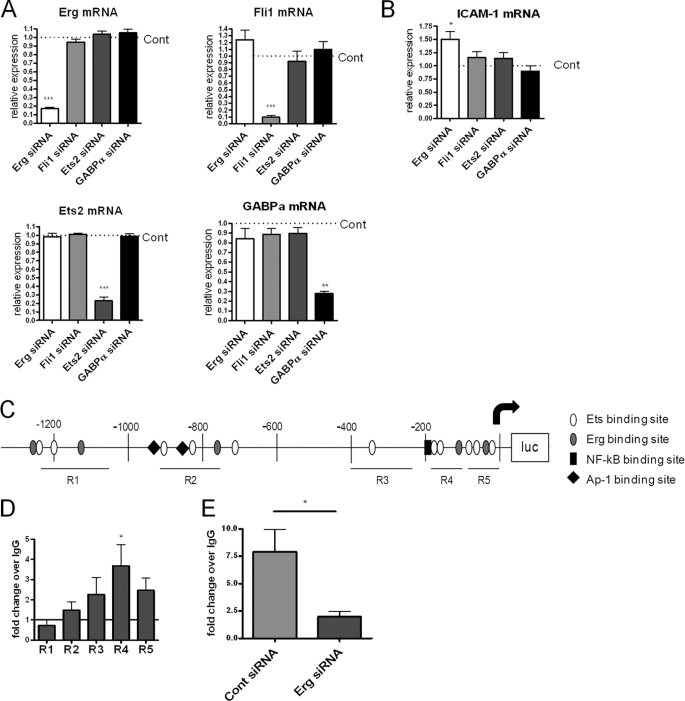
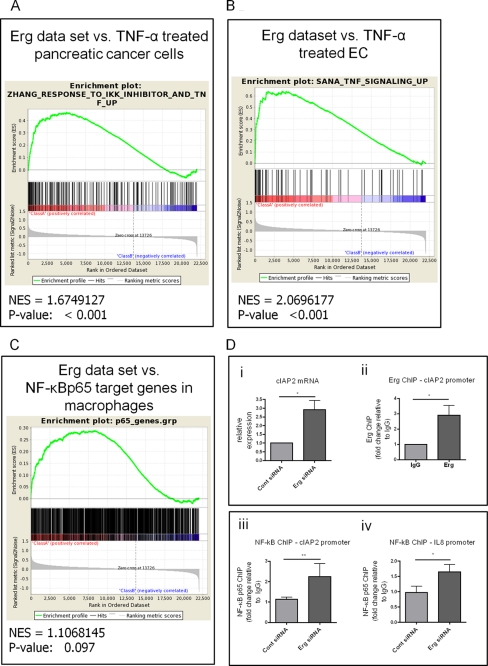
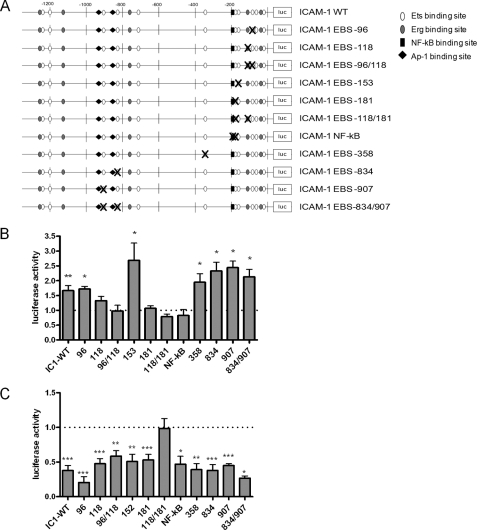
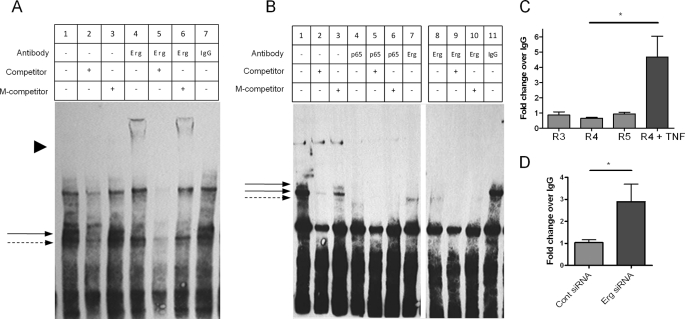
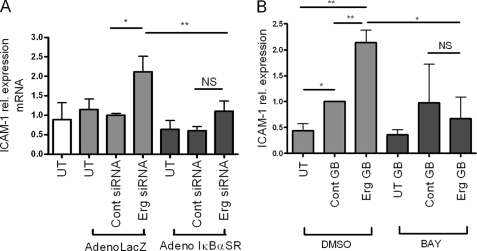
The interaction of transcription factors with specific DNA sequences is critical for activation of gene expression programs. In endothelial cells (EC), the transcription factor NF-κB is important in the switch from quiescence to activation, and is tightly controlled to avoid excessive inflammation and organ damage. Here we describe a novel mechanism that controls the activation of NF-κB in EC. The transcription factor Erg, the most highly expressed ETS member in resting EC, controls quiescence by repressing proinflammatory gene expression. Focusing on intercellular adhesion molecule 1(ICAM)-1 as a model, we identify two ETS binding sites (EBS -118 and -181) within the ICAM-1 promoter required for Erg-mediated repression. We show that Erg binds to both EBS -118 and EBS -181, the latter located within the NF-κB binding site. Interestingly, inhibition of Erg expression in quiescent EC results in increased NF-κB-dependent ICAM-1 expression, indicating that Erg represses basal NF-κB activity. Erg prevents NF-κB p65 from binding to the ICAM-1 promoter, suggesting a direct mechanism of interference. Gene set enrichment analysis of transcriptome profiles of Erg and NF-κB-dependent genes, together with chromatin immunoprecipitation (ChIP) studies, reveals that this mechanism is common to other proinflammatory genes, including cIAP-2 and IL-8. These results identify a role for Erg as a gatekeeper controlling vascular inflammation, thus providing an important barrier to protect against inappropriate endothelial activation.
转录因子与特定 DNA 序列的相互作用对于激活基因表达程序至关重要。在内皮细胞(EC)中,转录因子 NF-κB 在从静止到激活的转变中很重要,并且受到严格控制以避免过度炎症和器官损伤。在这里,我们描述了一种控制 EC 中 NF-κB 激活的新机制。转录因子 Erg 是静止 EC 中表达最丰富的 ETS 成员之一,通过抑制促炎基因的表达来控制静止状态。我们以细胞间黏附分子 1(ICAM-1)为模型,确定了 ICAM-1 启动子中两个 ETS 结合位点(EBS-118 和 -181),这些结合位点是 Erg 介导的抑制所必需的。我们表明,Erg 结合到 EBS-118 和 EBS-181 上,后者位于 NF-κB 结合位点内。有趣的是,在静止 EC 中抑制 Erg 表达会导致 NF-κB 依赖性 ICAM-1 表达增加,表明 Erg 抑制基础 NF-κB 活性。Erg 阻止 NF-κB p65 结合到 ICAM-1 启动子上,表明存在直接干扰机制。Erg 和 NF-κB 依赖性基因的转录组谱基因集富集分析以及染色质免疫沉淀(ChIP)研究表明,这种机制对于其他促炎基因(包括 cIAP-2 和 IL-8)也是常见的。这些结果确定了 Erg 作为控制血管炎症的守门员的作用,从而为防止内皮细胞不当激活提供了重要的保护屏障。