Department of Environmental Medicine, Graduate School of Medical Sciences, Kyushu University, Fukuoka, Japan.
J Epidemiol. 2012;22(3):222-9. doi: 10.2188/jea.je20110083. Epub 2012 Feb 18.
There are limited data on the prevalence and causes of disability in the elderly general population in Japan.
In a population-based cross-sectional study of 1550 Japanese aged 65 years or older, we examined the prevalence of functional disability (defined as a Barthel Index score of ≤95) and its causes.
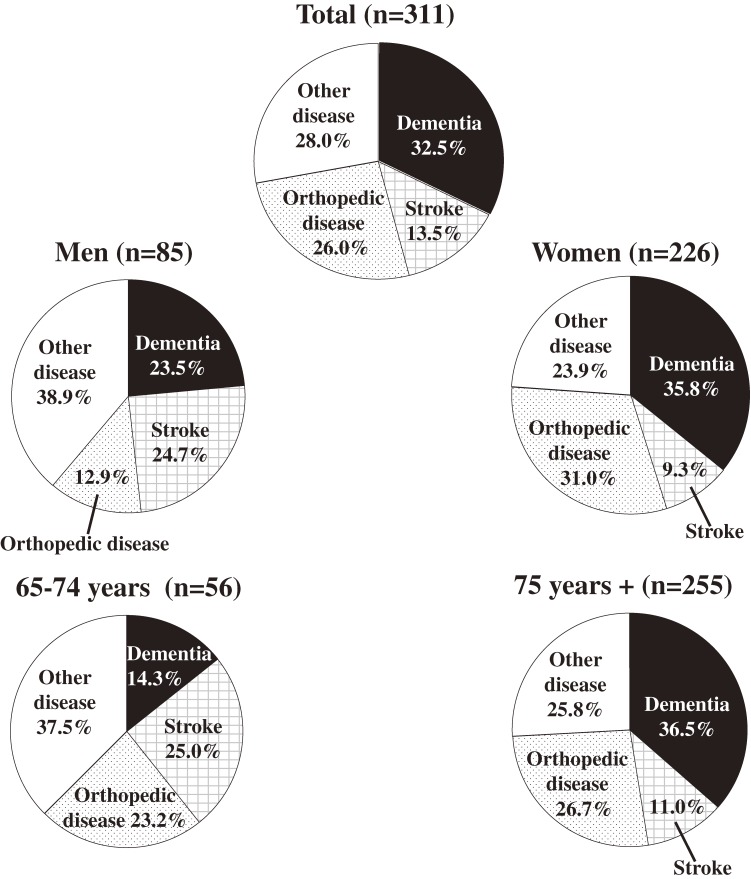
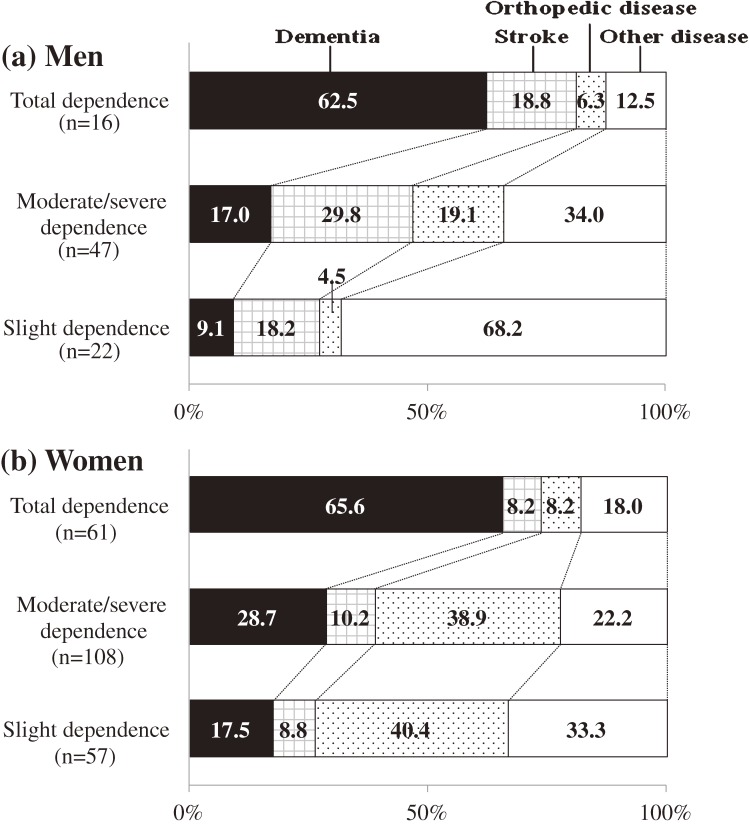
A total of 311 of the participants had a disability (prevalence 20.1%). The prevalence of disability increased with age and doubled with every 5-year increment in age. Prevalence was higher in women than in men, especially among those aged 85 years or older. With respect to the cause of functional disability, dementia accounted for 23.5%, stroke for 24.7%, orthopedic disease for 12.9%, and other disease for 38.9% of cases in men; in women, the respective values were 35.8%, 9.3%, 31.0%, and 23.9%. Regarding age, dementia was the most frequent cause of disability in subjects aged 75 years or older, whereas stroke was most common in subjects aged 65 to 74 years. Approximately two-thirds of cases of total dependence were attributed to dementia in both sexes, whereas the main cause of slight or moderate/severe dependence was stroke in men and orthopedic disease in women. Among participants with total dependence, 94.8% resided in a hospital or health care facility.
Our findings indicate that functional disability is common among Japanese elderly adults and that its major cause is stroke in men and dementia in women.
在日本,关于老年人群中残疾的患病率和原因,数据有限。
在一项针对 1550 名 65 岁或以上日本老年人的基于人群的横断面研究中,我们检查了功能残疾(定义为巴氏指数评分≤95)的患病率及其原因。
共有 311 名参与者存在残疾(患病率为 20.1%)。残疾的患病率随年龄增长而增加,每增加 5 岁患病率就会翻倍。女性的患病率高于男性,尤其是 85 岁及以上的女性。就功能残疾的原因而言,痴呆症占男性病例的 23.5%,中风占 24.7%,骨科疾病占 12.9%,其他疾病占 38.9%;在女性中,相应的值分别为 35.8%、9.3%、31.0%和 23.9%。就年龄而言,痴呆症是 75 岁及以上人群残疾的最常见原因,而中风是 65 至 74 岁人群中最常见的原因。在两性中,大约三分之二的完全依赖病例归因于痴呆症,而男性轻度或中度/重度依赖的主要原因是中风,女性则是骨科疾病。在完全依赖的参与者中,94.8%居住在医院或保健机构。
我们的研究结果表明,功能残疾在日本老年人群中很常见,其主要原因是男性中风和女性痴呆症。