Department of Anesthesiology, University of Wisconsin School of Medicine and Public Health, Madison, Wisconsin 53792-3272, USA.
Anesthesiology. 2012 Apr;116(4):816-23. doi: 10.1097/ALN.0b013e31824be0e3.
Inhibition mediated by γ-aminobutyric acid type A (GABA A) receptors has long been considered an important target for a variety of general anesthetics. In the hippocampus, two types of phasic GABA A receptor-mediated inhibition coexist: GABA A,fast, which is expressed primarily at peri-somatic sites, and GABAA,slow, which is expressed primarily in the dendrites. Their spatial segregation suggests distinct functions: GABA A,slow may control plasticity of dendritic synapses, whereas GABA A,fast controls action potential initiation at the soma. We examined modulation of GABA A,fast and GABA A,slow inhibition by isoflurane at amnesic concentrations, and compared it with modulation by behaviorally equivalent doses of the GABA A receptor-selective drug etomidate.
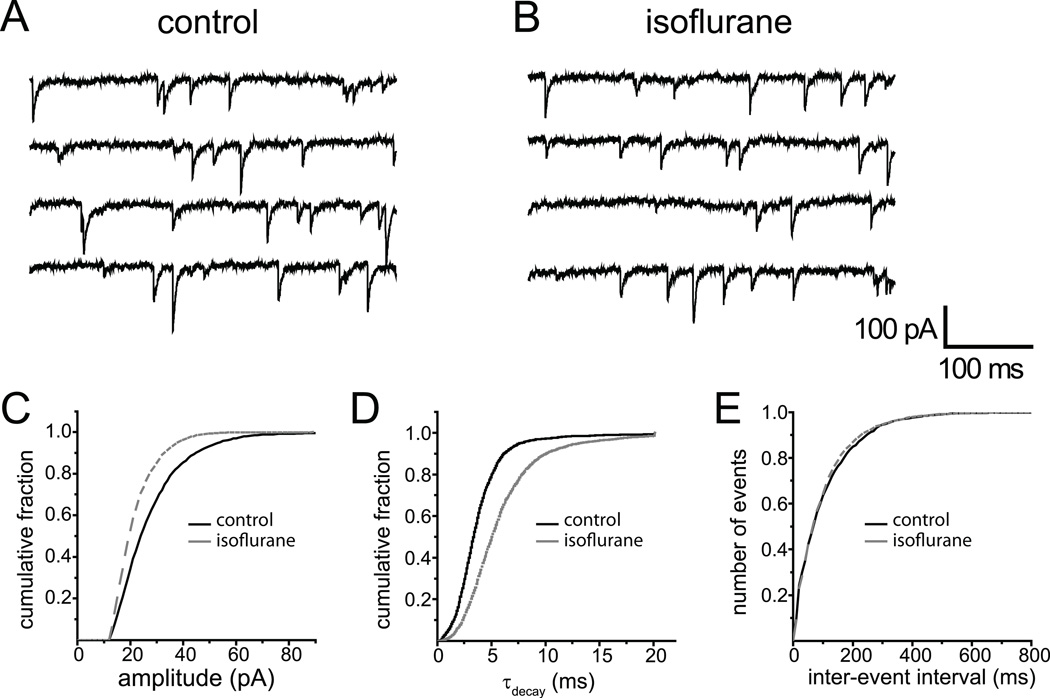
Whole cell recordings were obtained from pyramidal cells in organotypic hippocampal cultures prepared from C57BL/6 × 129/SvJ F1 hybrid mice. GABA A receptor-mediated currents were isolated using glutamate receptor antagonists. GABAA,slow currents were evoked by electrical stimulation in the stratum lacunosum-moleculare. Miniature GABA A,fast currents were recorded in the presence of tetrodotoxin.
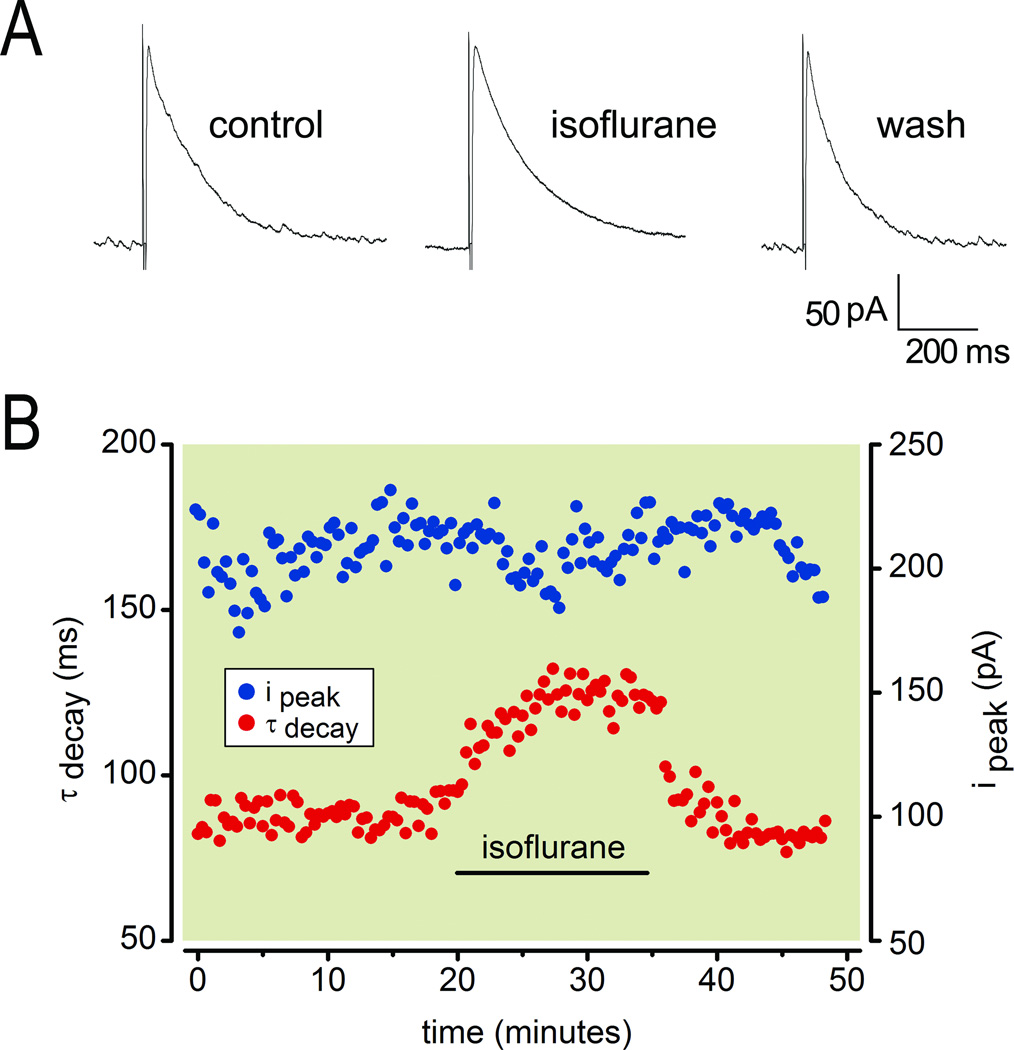
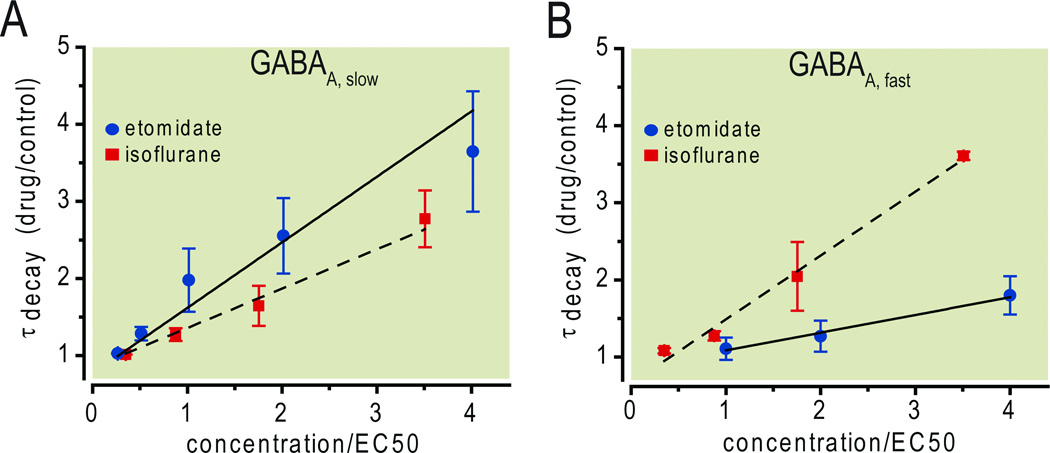
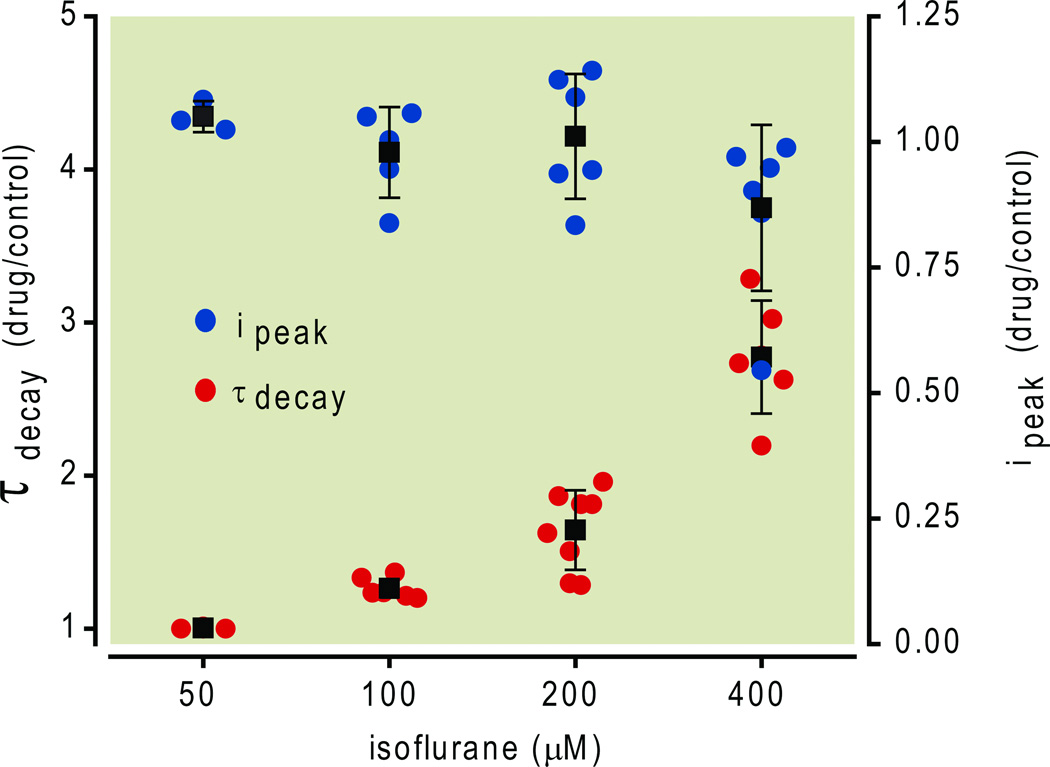
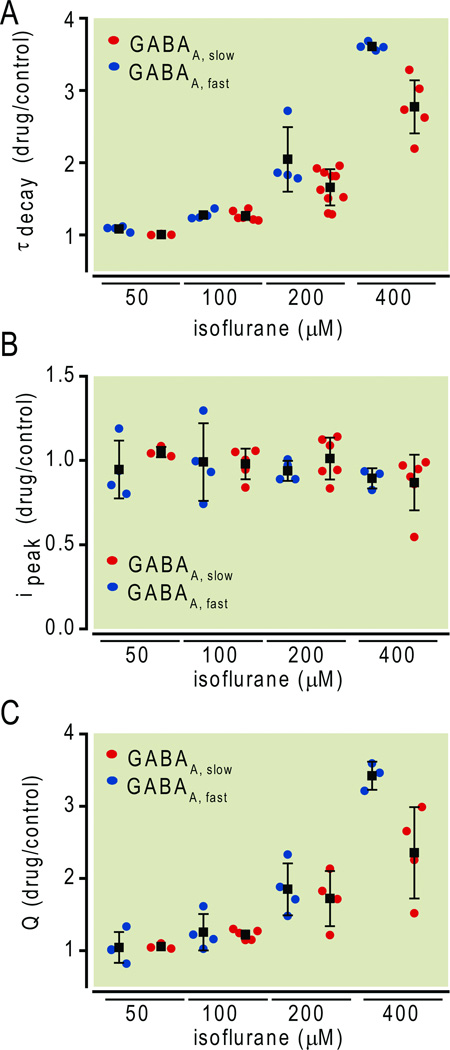
100 μM isoflurane (approximately EC50,amnesia) slowed fast- and slow-inhibitory postsynaptic current decay by approximately 25%. Higher concentrations, up to 400 μM, produced proportionally greater effects without altering current amplitudes. The effects on GABA A,slow were approximately one-half those produced by equi-amnesic concentrations of etomidate.
Isoflurane enhances both types of phasic GABA A receptor-mediated inhibition to similar degrees at amnesic concentrations. This pattern differs from etomidate, which at low concentrations selectively enhances slow inhibition. These effects of isoflurane are sufficiently large that they may contribute substantially to its suppression of hippocampal learning and memory.
γ-氨基丁酸 A 型(GABA A)受体介导的抑制作用一直被认为是各种全身麻醉剂的重要靶点。在海马体中,两种类型的相敏 GABA A 受体介导的抑制作用共存:主要表达于胞体周围部位的 GABA A,fast,和主要表达于树突的 GABA A,slow。它们的空间分离表明具有不同的功能:GABA A,slow 可能控制树突突触的可塑性,而 GABA A,fast 控制胞体处动作电位的起始。我们研究了异氟烷在健忘浓度下对 GABA A,fast 和 GABA A,slow 抑制作用的调制,并将其与 GABA A 受体选择性药物依托咪酯在行为等效剂量下的调制进行了比较。
从 C57BL/6×129/SvJ F1 杂交小鼠制备的器官型海马培养物中的锥体神经元中获得全细胞记录。使用谷氨酸受体拮抗剂分离 GABA A 受体介导的电流。通过在层状乳突状区进行电刺激来诱发 GABA A,slow 电流。在存在河豚毒素的情况下记录微小的 GABA A,fast 电流。
100 μM 异氟烷(约 EC50,健忘)使快和慢抑制性突触后电流衰减大约 25%。更高的浓度,高达 400 μM,产生了不成比例的更大影响,而没有改变电流幅度。对 GABA A,slow 的影响大约是等健忘浓度依托咪酯产生的影响的一半。
在健忘浓度下,异氟烷增强两种类型的相敏 GABA A 受体介导的抑制作用的程度相似。这种模式与依托咪酯不同,依托咪酯在低浓度下选择性增强慢抑制作用。异氟烷的这些作用足够大,可能对其抑制海马体学习和记忆有重要贡献。