Maharlooei Mohsen Khosravi, Mohammadi Ali Akbar, Farsi Ali, Ahrari Iman, Attar Armin, Monabati Ahmad
Cell and Molecular Research Affinity Group, Student Research Center, Shiraz University of Medical Sciences, Shiraz, Iran .
Indian J Dermatol. 2011 Nov;56(6):666-9. doi: 10.4103/0019-5154.91825.
Burn surgeons use autologous skin graft technique for patients, but a challenge remains for large surface wounds. Recently, a method was described which used a small piece of skin to cover a 70 times greater surface by spraying epidermal cells on injured skin. We designed a comparative study to find the best method to make an epidermal cell suspension.
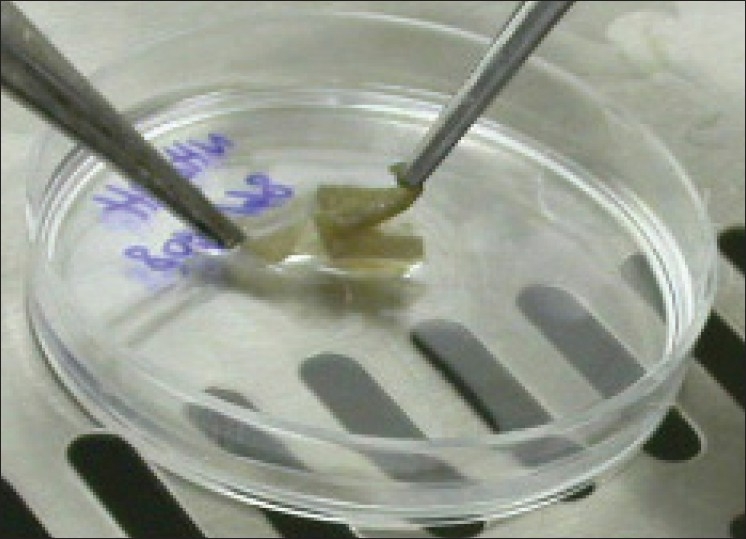
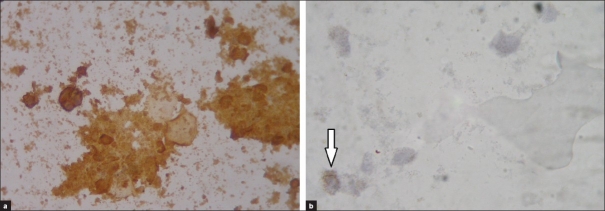
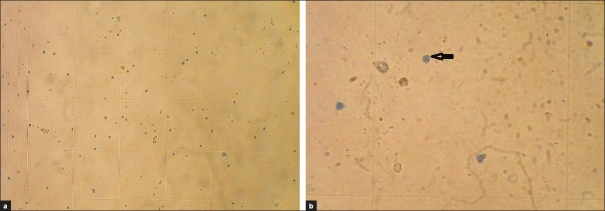
Eleven discarded skin samples were sent to our laboratory from Ghotboddin Burn Hospital, Shiraz. Each sample was sliced into four small pieces (1 cm(2)) and each piece was treated with a different chemical including sodium bromide (2N) and (4N), ammonium hydroxide (2N), and trypsin (0.05%) for 20 minutes. The epidermis and dermis were separated using forceps. Trypsin was added to all samples (except the trypsinized sample) to begin the intercellular detachment. Afterward, epidermis was sliced into small pieces followed by filtration and centrifugation. Cells were counted using hemocytometer. Identification of keratinocytes and melanocytes was made through immunocytochemical staining for cytokeratin and melanosome antigens, respectively.
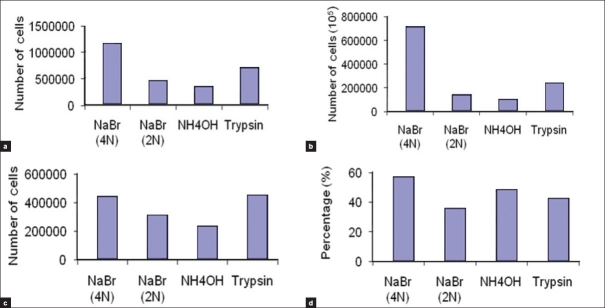
There was a significant difference in alive cell counts comparing cells obtained from NaBr (4N) method to other methods. Considering total cell count and alive cell count, NaBr (4N) yielded the most cells. Immunocytochemical staining showed that in all methods, some cells are stained positively for cytokeratin antibody and some for melanosome antibody.
Although recent papers had advised trypsin method to make a cell suspension to use for burn patients, we found that NaBr (4N) method yields more alive cells and less toxicity.
烧伤外科医生为患者采用自体皮肤移植技术,但大面积伤口仍然是一个挑战。最近,有人描述了一种方法,即通过将表皮细胞喷洒在受伤皮肤上,用一小片皮肤覆盖面积大70倍的创面。我们设计了一项对比研究,以找出制备表皮细胞悬液的最佳方法。
从设拉子的Ghotboddin烧伤医院送来11份废弃皮肤样本到我们实验室。每个样本切成4小块(1平方厘米),每块用不同化学物质处理20分钟,这些化学物质包括溴化钠(2N和4N)、氢氧化铵(2N)和胰蛋白酶(0.05%)。用镊子分离表皮和真皮。向所有样本(除已用胰蛋白酶处理的样本外)加入胰蛋白酶以开始细胞间分离。然后,将表皮切成小块,接着进行过滤和离心。使用血细胞计数器对细胞进行计数。分别通过细胞角蛋白和黑素小体抗原的免疫细胞化学染色来鉴定角质形成细胞和黑素细胞。
将溴化钠(4N)法获得的细胞与其他方法获得的细胞相比,活细胞计数有显著差异。考虑到总细胞数和活细胞数,溴化钠(4N)法产生的细胞最多。免疫细胞化学染色显示,在所有方法中,一些细胞对角蛋白抗体呈阳性染色,一些细胞对黑素小体抗体呈阳性染色。
尽管最近的论文建议采用胰蛋白酶法制备用于烧伤患者的细胞悬液,但我们发现溴化钠(4N)法产生的活细胞更多且毒性更小。