Iman Ahrari, Akbar Mohamadi Ali, Mohsen Khosravi Maharlooei, Ali Farsi, Armin Attar, Sajjad Ahrari, Ahmad Monabati, Ghavipisheh Mahsa, Leila Rahnama
Student Research Committee, Cell and Molecular Research Affinity Group, Shiraz University of Medical Sciences, Shiraz, Iran.
Indian J Dermatol. 2013 May;58(3):240. doi: 10.4103/0019-5154.110844.
One of the most important complications after burning is hypo/depigmentation. This study was designed to compare two methods of cell spray and intradermal injection of epidermal cell suspension for treatment of burn induced hypopigmentation.
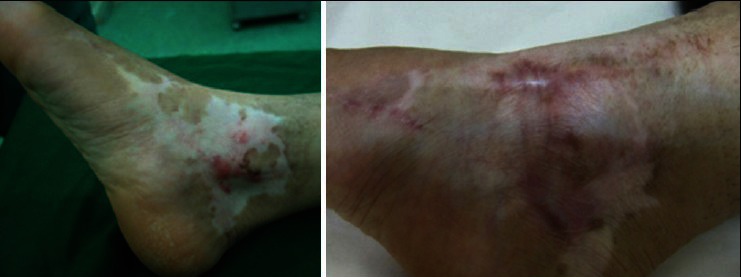
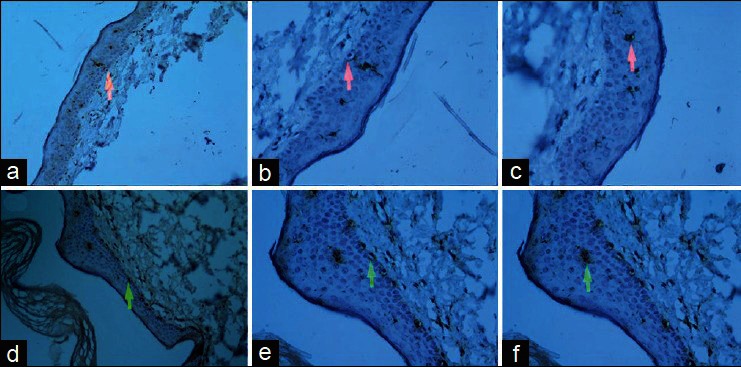
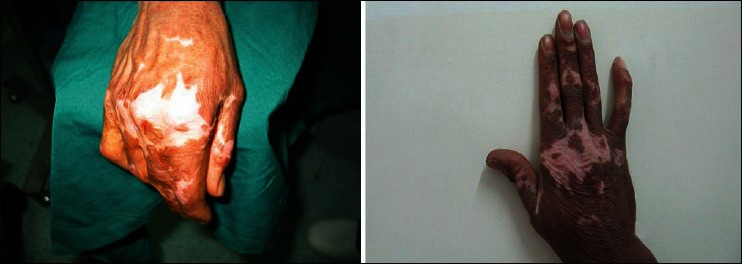
In this study, 28 patients with post burn hypo/depigmentation were selected and divided in 2 groups. A small skin biopsy was taken from normal skin of patients in operation room and epidermal cell suspension was prepared using NaBr 4N and trypsin. In the first group, the epidermal cell suspension was sprayed on the wound surface and then the area was dressed with amniotic membrane and gauze. In the second group, the cell suspension was injected in intradermal manner in the hypopigmented area. The patients were followed up and to evaluate the effect of the cells, photos were taken from the area before operation and also at follow-up. Clinical evaluation was done by the surgeon and a clinical score between "0" to "4" was used to demonstrate the clinical status from poor to excellent pigmentation. Skin biopsies were taken from depigmented area before and after interventions. Melanocytes were stained using anti S100 antibody and were counted in ×400 magnification fields.
Eighteen patients were in cell spray and 10 were in cell injection groups. Mean change of pigmentation in two group showed that there was no statistical significant differences in pigmentation between two groups, (P value = 0.52) although a limited improvement in pigmentation status was observed in both groups. Regarding melanocyte numbers per field, there was not a significant difference between two groups and also before and after interventions, but melanocyte number increased after treatment in both groups.
We did not find noticeable differences between cell spray and intradermal injection methods. Although both methods showed a limited effect on pigmentation of depigmented skin, the clinical results were not satisfactorily for both patients and clinicians.
烧伤后最重要的并发症之一是色素减退/脱失。本研究旨在比较细胞喷雾法和真皮内注射表皮细胞悬液两种方法治疗烧伤后色素减退的效果。
本研究选取28例烧伤后色素减退/脱失患者,分为两组。在手术室从患者正常皮肤取小块皮肤活检组织,用4N溴化钠和胰蛋白酶制备表皮细胞悬液。第一组将表皮细胞悬液喷洒在创面,然后用羊膜和纱布包扎该区域。第二组将细胞悬液以真皮内注射的方式注入色素减退区域。对患者进行随访,为评估细胞的效果,在手术前及随访时对该区域拍照。由外科医生进行临床评估,使用“0”至“4”的临床评分来表明色素沉着状况从差到优。在干预前后从色素脱失区域取皮肤活检组织。用抗S100抗体对黑素细胞进行染色,并在×400放大倍数视野下计数。
细胞喷雾组有18例患者,细胞注射组有10例患者。两组色素沉着的平均变化表明,两组之间色素沉着无统计学显著差异(P值 = 0.52),尽管两组色素沉着状况均有有限改善。关于每视野黑素细胞数量,两组之间以及干预前后均无显著差异,但两组治疗后黑素细胞数量均增加。
我们未发现细胞喷雾法和真皮内注射法之间有明显差异。虽然两种方法对色素脱失皮肤的色素沉着均显示出有限的效果,但对患者和临床医生而言,临床结果均不令人满意。