Proske J Henning, Wittmann Marco, Galizia C Giovanni
Department of Neurobiology, University of Konstanz Konstanz, Germany.
Front Neuroeng. 2012 Feb 8;5:2. doi: 10.3389/fneng.2012.00002. eCollection 2012.
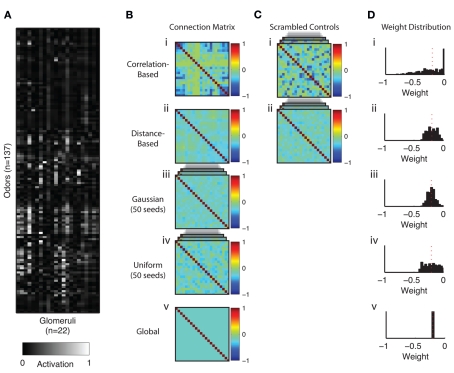
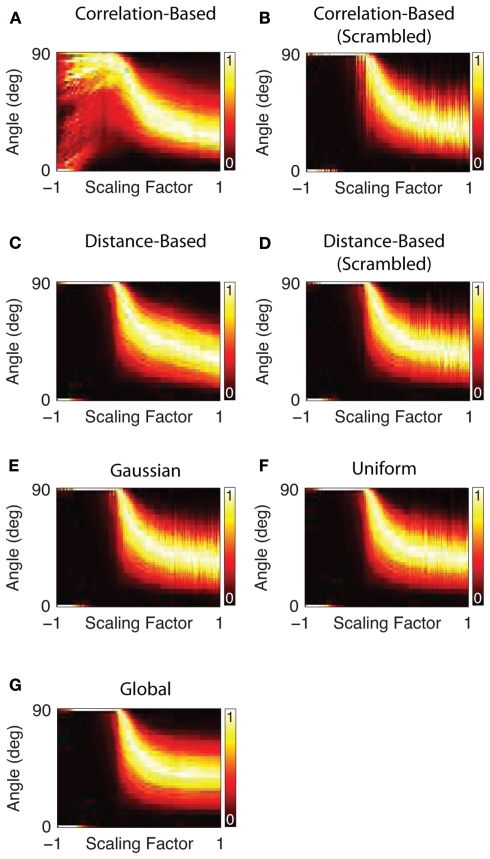
The insect olfactory system can be a model for artificial olfactory devices. In particular, Drosophila melanogaster due to its genetic tractability has yielded much information about the design and function of such systems in biology. In this study we investigate possible network topologies to separate representations of odors in the primary olfactory neuropil, the antennal lobe. In particular we compare networks based on stochastic and homogeneous connection weight distributions to connectivities that are based on the input correlations between the glomeruli in the antennal lobe. We show that moderate homogeneous inhibition implements a soft winner-take-all mechanism when paired with realistic input from a large meta-database of odor responses in receptor cells (DoOR database). The sparseness of representations increases with stronger inhibition. Excitation, on the other hand, pushes the representation of odors closer together thus making them harder to distinguish. We further analyze the relationship between different inhibitory network topologies and the properties of the receptor responses to different odors. We show that realistic input from the DoOR database has a relatively high entropy of activation values over all odors and receptors compared to the theoretical maximum. Furthermore, under conditions in which the information in the input is artificially decreased, networks with heterogeneous topologies based on the similarity of glomerular response profiles perform best. These results indicate that in order to arrive at the most beneficial representation for odor discrimination it is important to finely tune the strength of inhibition in combination with taking into account the properties of the available sensors.
昆虫嗅觉系统可作为人工嗅觉装置的模型。特别是黑腹果蝇,由于其遗传易处理性,已产生了许多关于此类系统在生物学中的设计和功能的信息。在本研究中,我们研究了在初级嗅觉神经纤维束即触角叶中分离气味表征的可能网络拓扑结构。特别是,我们将基于随机和均匀连接权重分布的网络与基于触角叶中肾小球输入相关性的连接性进行了比较。我们表明,当与来自受体细胞气味反应的大型元数据库(DoOR数据库)的真实输入配对时,适度的均匀抑制实现了一种软胜者全得机制。表征的稀疏性随着抑制作用的增强而增加。另一方面,兴奋会使气味的表征更接近,从而使它们更难区分。我们进一步分析了不同抑制性网络拓扑结构与受体对不同气味反应特性之间的关系。我们表明,与理论最大值相比,来自DoOR数据库的真实输入在所有气味和受体上具有相对较高的激活值熵。此外,在人为降低输入信息的条件下,基于肾小球反应谱相似性的异质拓扑网络表现最佳。这些结果表明,为了获得最有利于气味辨别的表征,结合考虑可用传感器的特性来精细调整抑制强度很重要。