Departamento de Ingeniería Genética, Centro de Investigación y de Estudios Avanzados, Irapuato, Guanajuato, México.
PLoS One. 2012;7(2):e30537. doi: 10.1371/journal.pone.0030537. Epub 2012 Feb 9.
Animal-derived elicitors can be used by plants to detect herbivory but they function only in specific insect-plant interactions. How can plants generally perceive damage caused by herbivores? Damaged-self recognition occurs when plants perceive molecular signals of damage: degraded plant molecules or molecules localized outside their original compartment.
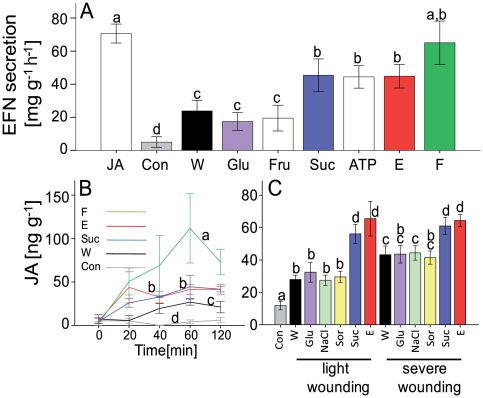
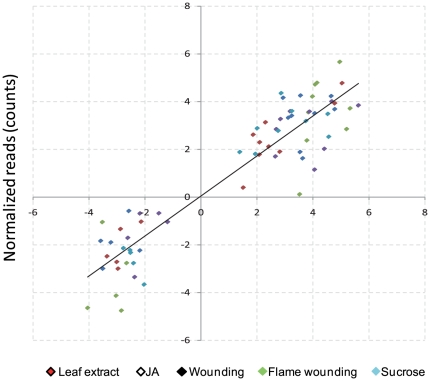
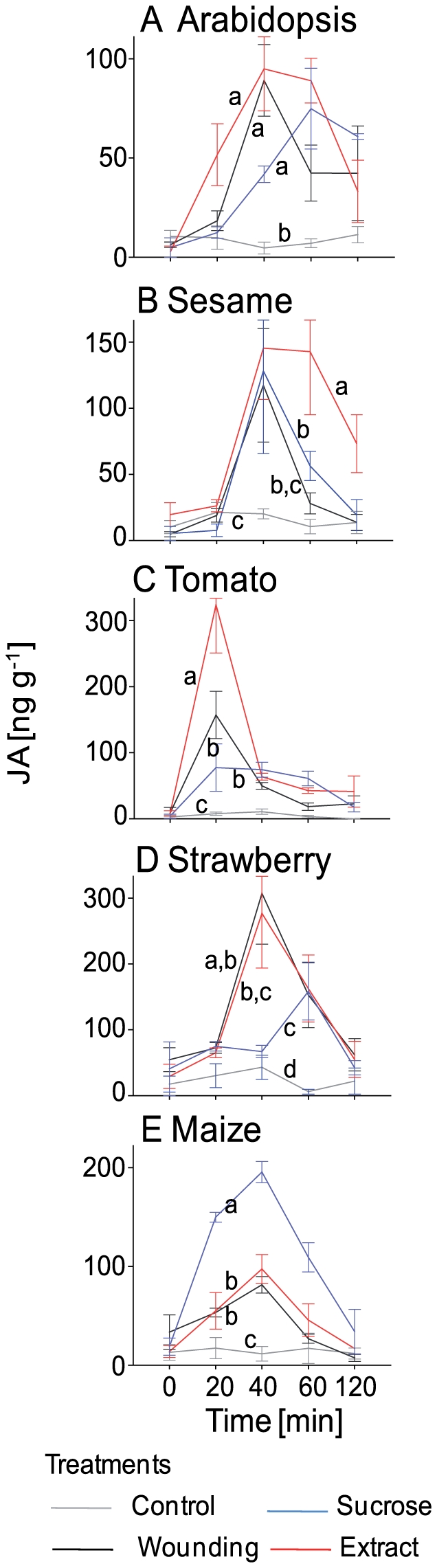
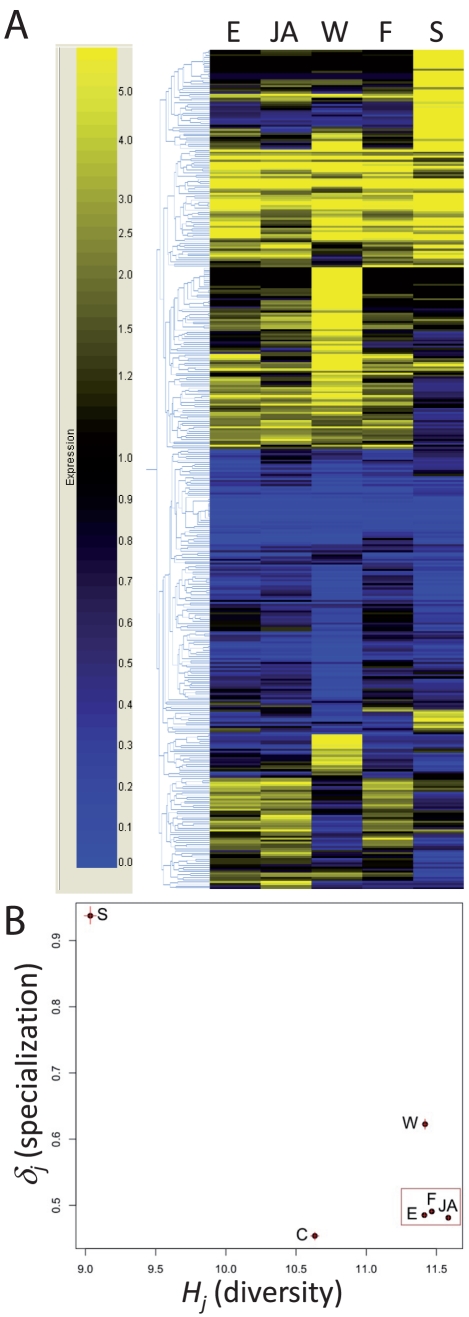
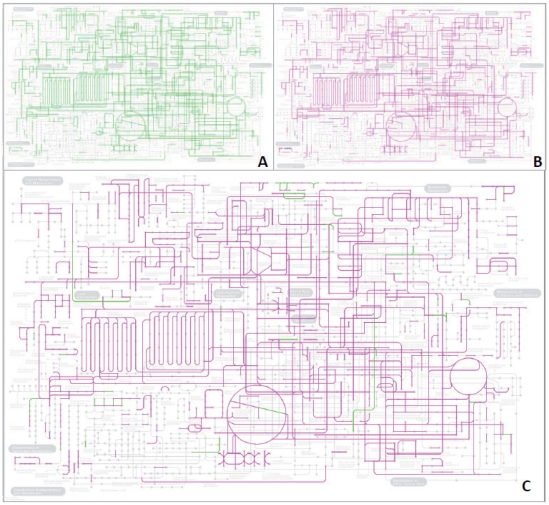
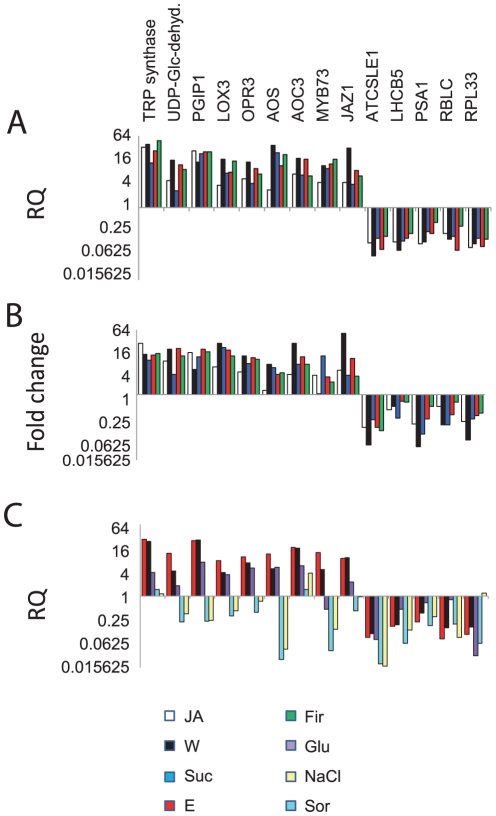
METHODOLOGY/PRINCIPAL FINDINGS: Flame wounding or applying leaf extract or solutions of sucrose or ATP to slightly wounded lima bean (Phaseolus lunatus) leaves induced the secretion of extrafloral nectar, an indirect defense mechanism. Chemically related molecules that would not be released in high concentrations from damaged plant cells (glucose, fructose, salt, and sorbitol) did not elicit a detectable response, excluding osmotic shock as an alternative explanation. Treatments inducing extrafloral nectar secretion also enhanced endogenous concentrations of the defense hormone jasmonic acid (JA). Endogenous JA was also induced by mechanically damaging leaves of lima bean, Arabidopsis, maize, strawberry, sesame and tomato. In lima bean, tomato and sesame, the application of leaf extract further increased endogenous JA content, indicating that damaged-self recognition is taxonomically widely distributed. Transcriptomic patterns obtained with untargeted 454 pyrosequencing of lima bean in response to flame wounding or the application of leaf extract or JA were highly similar to each other, but differed from the response to mere mechanical damage. We conclude that the amount or concentration of damaged-self signals can quantitatively determine the intensity of the wound response and that the full damaged-self response requires the disruption of many cells.
CONCLUSIONS/SIGNIFICANCE: Numerous compounds function as JA-inducing elicitors in different plant species. Most of them are, contain, or release, plant-derived molecular motifs. Damaged-self recognition represents a taxonomically widespread mechanism that contributes to the perception of herbivore feeding by plants. This strategy is independent of insect-derived elicitors and, therefore, allows plants to maintain evolutionary control over their interaction with herbivores.
植物可以利用动物来源的激发子来检测食草性,但这些激发子仅在特定的昆虫-植物互作中起作用。那么植物如何普遍感知食草动物造成的损害呢?当植物感知到损伤的分子信号:降解的植物分子或位于其原始隔室之外的分子时,就会发生自我损伤识别。
方法/主要发现:用火焰灼伤或向轻度受伤的利马豆(Phaseolus lunatus)叶片涂抹叶提取物或蔗糖或 ATP 溶液,可诱导分泌额外的花蜜,这是一种间接防御机制。与化学上相关但不会从受损植物细胞中以高浓度释放的分子(葡萄糖、果糖、盐和山梨糖醇)不会引起可检测的反应,排除了渗透压休克作为替代解释。诱导分泌额外花蜜的处理还增强了防御激素茉莉酸(JA)的内源性浓度。机械损伤利马豆、拟南芥、玉米、草莓、芝麻和番茄叶片也会诱导内源性 JA。在利马豆、番茄和芝麻中,叶提取物的应用进一步增加了内源性 JA 含量,表明自我损伤识别在分类学上广泛分布。利马豆对火焰灼伤或叶提取物或 JA 应用的无靶向 454 焦磷酸测序获得的转录组图谱彼此高度相似,但与单纯机械损伤的反应不同。我们得出的结论是,自我损伤信号的数量或浓度可以定量决定伤口反应的强度,并且完整的自我损伤反应需要破坏许多细胞。
结论/意义:许多化合物在不同的植物物种中作为诱导 JA 的激发子发挥作用。它们中的大多数包含、含有或释放植物衍生的分子基序。自我损伤识别代表一种广泛存在于分类学中的机制,有助于植物感知食草动物的取食。这种策略独立于昆虫来源的激发子,因此,植物可以保持对其与食草动物相互作用的进化控制。