Dipartimento di Biologia e Biotecnologie L Spallanzani, Università degli Studi di Pavia, Pavia, Italy.
PLoS One. 2012;7(2):e32065. doi: 10.1371/journal.pone.0032065. Epub 2012 Feb 14.
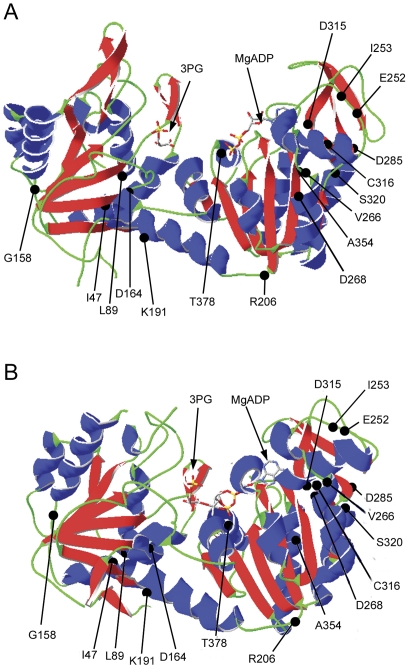
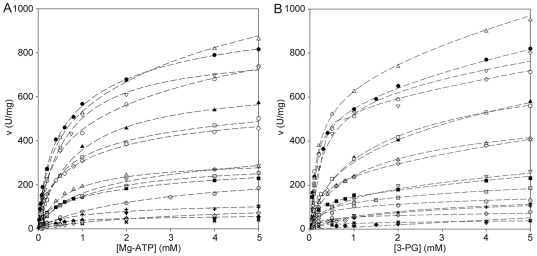
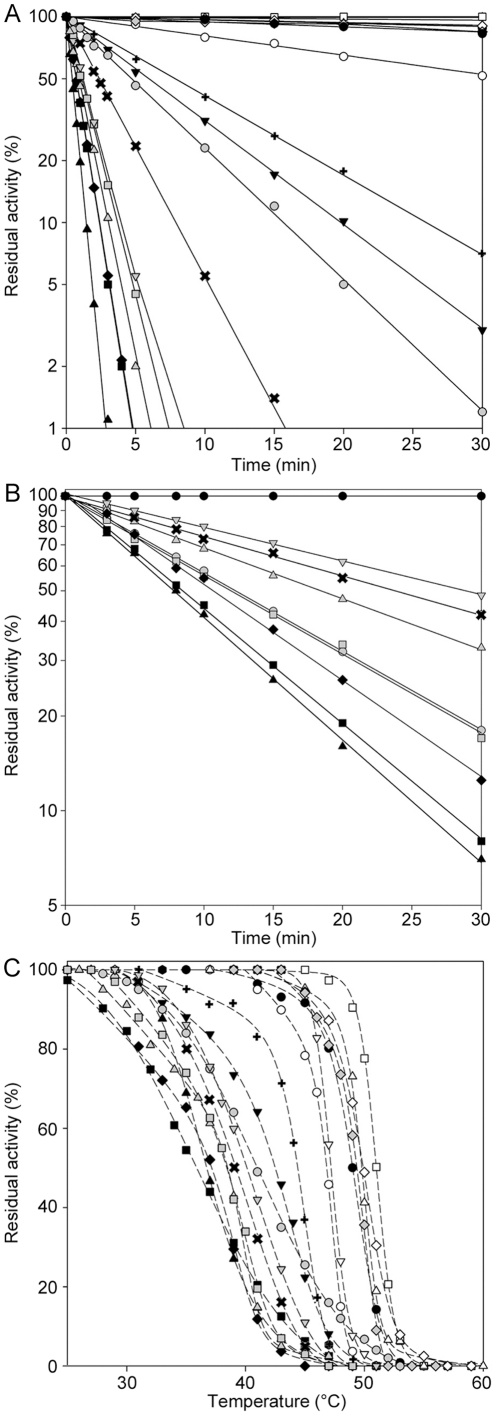
Phosphoglycerate kinase (PGK) catalyzes an important ATP-generating step in glycolysis. PGK1 deficiency is an uncommon X-linked inherited disorder, generally characterized by various combinations of non-spherocytic hemolytic anemia, neurological dysfunctions, and myopathies. Patients rarely exhibit all three clinical features. To provide a molecular framework to the different pathological manifestations, all known mutations were reviewed and 16 mutant enzymes, obtained as recombinant forms, were functionally and structurally characterized. Most mutations heavily affect thermal stability and to a different extent catalytic efficiency, in line with the remarkably low PGK activity clinically observed in the patients. Mutations grossly impairing protein stability, but moderately affecting kinetic properties (p.I47N, p.L89P, p.C316R, p.S320N, and p.A354P) present the most homogeneous correlation with the clinical phenotype. Patients carrying these mutations display hemolytic anemia and neurological disorders, and,except for p.A354P variant, no myopaty. Variants highly perturbed in both catalytic efficiency (p.G158V, p.D164V, p.K191del, D285V, p.D315N, and p.T378P) and heat stability (all, but p.T378P) result to be mainly associated with myopathy alone. Finally, mutations faintly affecting molecular properties (p.R206P, p.E252A, p.I253T, p.V266M, and p.D268N) correlate with a wide spectrum of clinical symptoms. These are the first studies that correlate the clinical symptoms with the molecular properties of the mutant enzymes. All findings indicate that the different clinical manifestations associated with PGK1 deficiency chiefly depend on the distinctive type of perturbations caused by mutations in the PGK1 gene, highlighting the need for determination of the molecular properties of PGK variants to assist in prognosis and genetic counseling. However, the clinical symptoms can not be understood only on the bases of molecular properties of the mutant enzyme. Different (environmental, metabolic, genetic and/or epigenetic) intervening factors can contribute toward the expression of PGK deficient clinical phenotypes.
磷酸甘油酸激酶(PGK)催化糖酵解中一个重要的 ATP 生成步骤。PGK1 缺乏症是一种罕见的 X 连锁遗传性疾病,通常表现为非球形红细胞溶血性贫血、神经功能障碍和肌病的各种组合。患者很少表现出所有三种临床特征。为了提供不同病理表现的分子框架,回顾了所有已知的突变,并对 16 种获得的重组形式的突变酶进行了功能和结构表征。大多数突变严重影响热稳定性,并在不同程度上影响催化效率,与患者临床观察到的极低 PGK 活性相一致。严重影响蛋白质稳定性但适度影响动力学特性的突变(p.I47N、p.L89P、p.C316R、p.S320N 和 p.A354P)与临床表型相关性最一致。携带这些突变的患者表现出溶血性贫血和神经障碍,除了 p.A354P 变体外,没有肌病。在催化效率(p.G158V、p.D164V、p.K191del、D285V、p.D315N 和 p.T378P)和热稳定性(均,但 p.T378P 除外)方面受到严重干扰的变体主要与肌病有关。最后,分子特性受轻微影响的突变(p.R206P、p.E252A、p.I253T、p.V266M 和 p.D268N)与广泛的临床症状相关。这些是首次将临床症状与突变酶的分子特性相关联的研究。所有发现均表明,与 PGK1 缺乏症相关的不同临床症状主要取决于 PGK1 基因突变引起的不同类型的扰动,这突出表明需要确定 PGK 变体的分子特性以辅助预后和遗传咨询。然而,临床症状不能仅基于突变酶的分子特性来理解。不同的(环境、代谢、遗传和/或表观遗传)干预因素可能会影响 PGK 缺乏临床表型的表达。