Seaver Autism Center for Research and Treatment, Mount Sinai School of Medicine, One Gustave L Levy Place, New York, NY 10029, USA.
Mol Autism. 2012 Feb 20;3(1):1. doi: 10.1186/2040-2392-3-1.
There is interest in defining mouse neurobiological phenotypes useful for studying autism spectrum disorders (ASD) in both forward and reverse genetic approaches. A recurrent focus has been on high-order behavioral analyses, including learning and memory paradigms and social paradigms. However, well-studied mouse models, including for example Fmr1 knockout mice, do not show dramatic deficits in such high-order phenotypes, raising a question as to what constitutes useful phenotypes in ASD models.
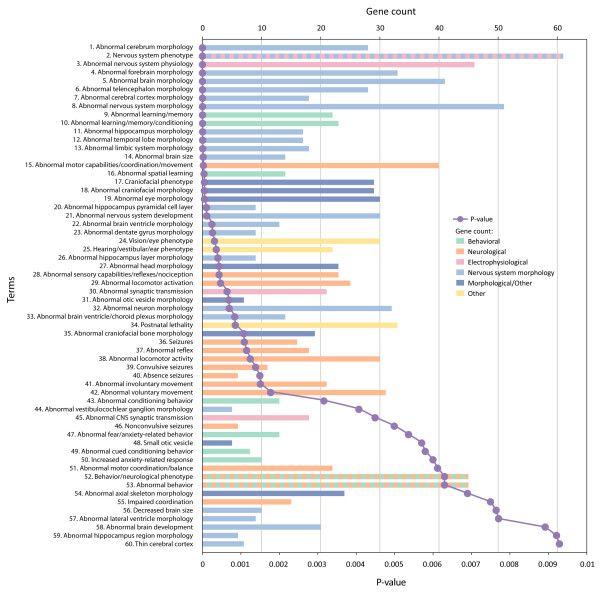
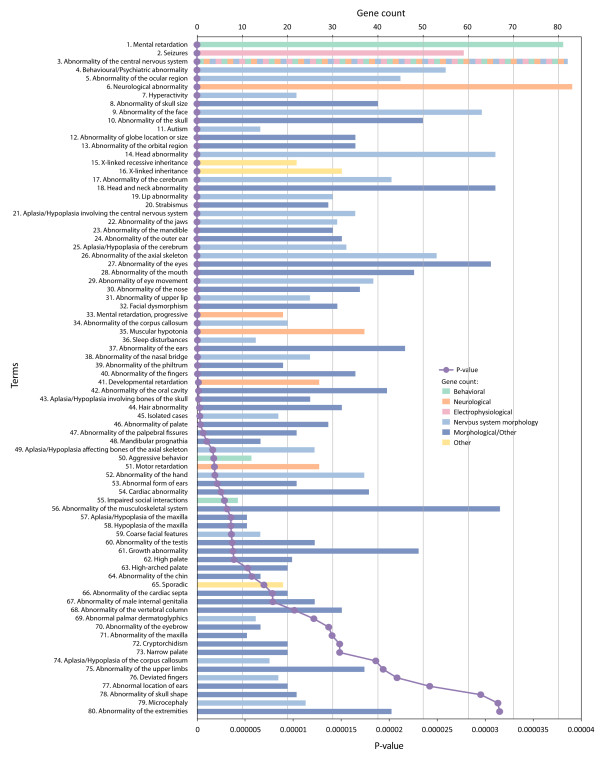
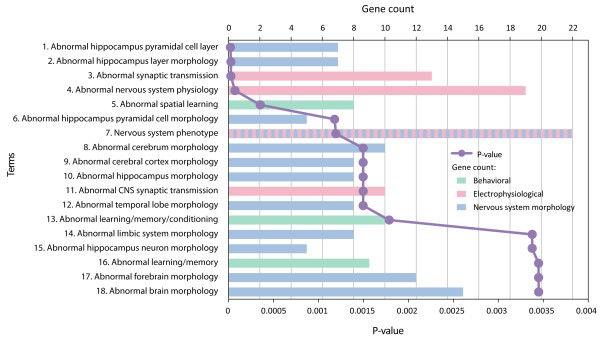
To address this, we made use of a list of 112 disease genes etiologically involved in ASD to survey, on a large scale and with unbiased methods as well as expert review, phenotypes associated with a targeted disruption of these genes in mice, using the Mammalian Phenotype Ontology database. In addition, we compared the results with similar analyses for human phenotypes.
We observed four classes of neurobiological phenotypes associated with disruption of a large proportion of ASD genes, including: (1) Changes in brain and neuronal morphology; (2) electrophysiological changes; (3) neurological changes; and (4) higher-order behavioral changes. Alterations in brain and neuronal morphology represent quantitative measures that can be more widely adopted in models of ASD to understand cellular and network changes. Interestingly, the electrophysiological changes differed across different genes, indicating that excitation/inhibition imbalance hypotheses for ASD would either have to be so non-specific as to be not falsifiable, or, if specific, would not be supported by the data. Finally, it was significant that in analyses of both mouse and human databases, many of the behavioral alterations were neurological changes, encompassing sensory alterations, motor abnormalities, and seizures, as opposed to higher-order behavioral changes in learning and memory and social behavior paradigms.
The results indicated that mutations in ASD genes result in defined groups of changes in mouse models and support a broad neurobiological approach to phenotyping rodent models for ASD, with a focus on biochemistry and molecular biology, brain and neuronal morphology, and electrophysiology, as well as both neurological and additional behavioral analyses. Analysis of human phenotypes associated with these genes reinforced these conclusions, supporting face validity for these approaches to phenotyping of ASD models. Such phenotyping is consistent with the successes in Fmr1 knockout mice, in which morphological changes recapitulated human findings and electrophysiological deficits resulted in molecular insights that have since led to clinical trials. We propose both broad domains and, based on expert review of more than 50 publications in each of the four neurobiological domains, specific tests to be applied to rodent models of ASD.
人们对用于研究自闭症谱系障碍(ASD)的正向和反向遗传方法的有用的小鼠神经生物学表型感兴趣。一个反复出现的焦点是高级行为分析,包括学习和记忆范式和社会范式。然而,经过充分研究的小鼠模型,例如 Fmr1 基因敲除小鼠,在这种高级表型中并没有表现出明显的缺陷,这就提出了一个问题,即在 ASD 模型中什么是有用的表型。
为了解决这个问题,我们利用了一份与 ASD 病因相关的 112 个疾病基因列表,使用哺乳动物表型本体数据库,大规模地、以无偏的方法和专家审查,对这些基因在小鼠中的靶向缺失所关联的表型进行了调查。此外,我们还将结果与人类表型的类似分析进行了比较。
我们观察到与一大类 ASD 基因的破坏相关的四类神经生物学表型,包括:(1)大脑和神经元形态的变化;(2) 电生理变化;(3)神经变化;(4)高级行为变化。大脑和神经元形态的改变代表了可以更广泛地应用于 ASD 模型以了解细胞和网络变化的定量测量。有趣的是,电生理变化在不同的基因之间存在差异,这表明 ASD 的兴奋/抑制失衡假说要么过于非特异性而无法被证伪,要么如果是特异性的,也不会得到数据的支持。最后,重要的是,在对小鼠和人类数据库的分析中,许多行为改变都是神经变化,包括感觉改变、运动异常和癫痫发作,而不是学习和记忆以及社会行为范式中的高级行为变化。
结果表明,ASD 基因的突变导致在小鼠模型中出现了一系列明确的变化,并支持了广泛的神经生物学方法来对 ASD 啮齿动物模型进行表型分析,重点是生物化学和分子生物学、大脑和神经元形态以及电生理学,以及神经和其他行为分析。与这些基因相关的人类表型的分析强化了这些结论,支持了这些 ASD 表型分析方法的表面效度。这种表型分析与 Fmr1 基因敲除小鼠的成功是一致的,在 Fmr1 基因敲除小鼠中,形态变化重现了人类的发现,电生理学缺陷导致了分子上的见解,这些见解随后导致了临床试验。我们提出了广泛的领域,以及基于对四个神经生物学领域中的每一个领域的 50 多篇出版物的专家审查,将应用于 ASD 啮齿动物模型的具体测试。