Department of Pediatrics, School of Medicine and Biomedical Sciences, University at Buffalo, Buffalo, New York 14214-3000, USA.
Int J Behav Nutr Phys Act. 2012 Feb 21;9:16. doi: 10.1186/1479-5868-9-16.
Choice promotes the experience of autonomy, which enhances intrinsic motivation. Providing a greater choice of traditional active toys may increase children's activity time. Mastery also increases intrinsic motivation and is designed into exergames, which may increase play time of a single exergame, reducing the need for choice to motivate activity compared to traditional active toys. Providing both choice and mastery could be most efficacious at increasing activity time. The energy expenditure (EE) of an active play session is dependent on the duration of play and the rate of EE during play. The rate of EE of exergames and the same game played in traditional fashion is not known. The purpose was to test the basic parameters of choice and mastery on children's physical activity time, activity intensity, and energy expenditure.
44 children were assigned to low (1 toy) or high (3 toys) choice groups. Children completed 60 min sessions with access to traditional active toys on one visit and exergame versions of the same active toys on another visit.
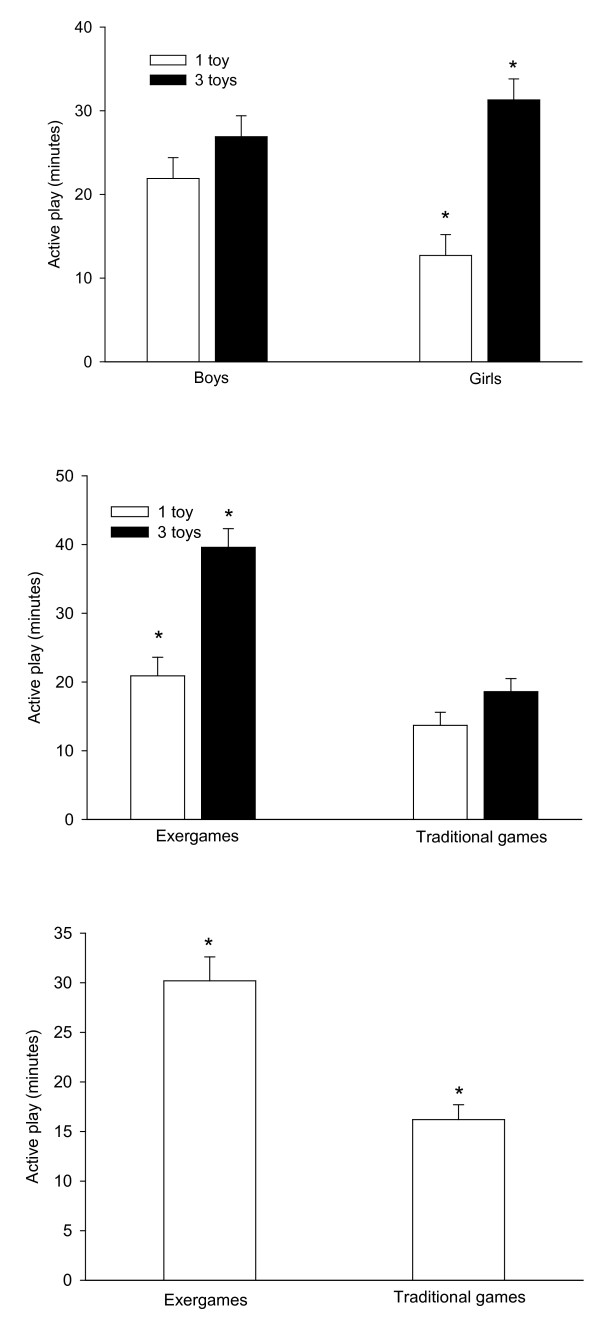
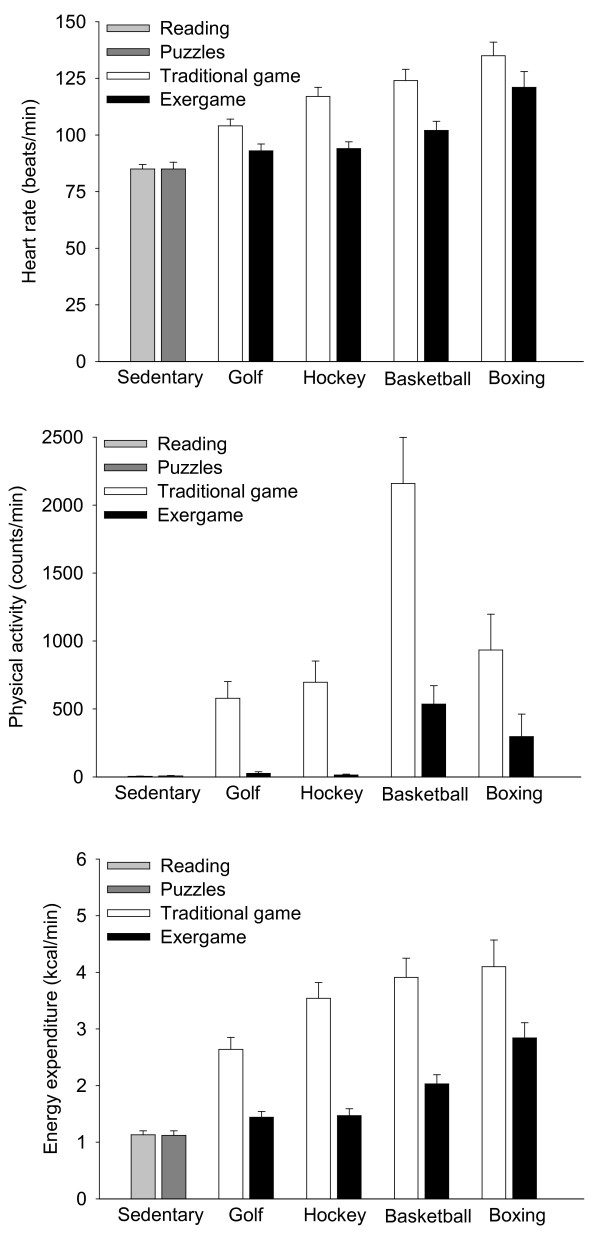
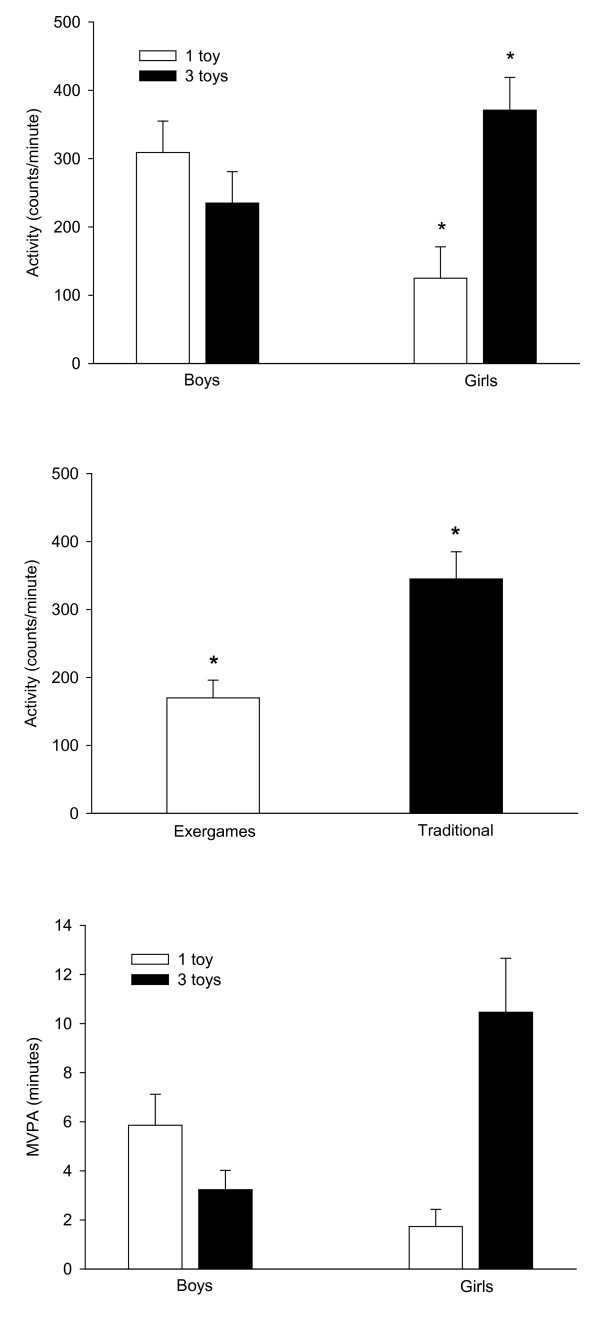
Choice had a greater effect on increasing girls' (146%) than boys' (23%) activity time and on girls' (230%) than boys' (minus 24%) activity intensity. When provided choice, girls' activity time and intensity were no longer lower than boys' activity time and intensity. The combination of choice and mastery by providing access to 3 exergames produced greater increases in physical activity time (1 toy 22.5 min, 3 toys 41.4 min) than choice alone via access to 3 traditional games (1 toy 13.6 min, 3 toys 19.5 min). Energy expenditure was 83% greater when engaging in traditional games than exergames.
Boys and girls differ in their behavioral responses to autonomy supportive environments. By providing girls with greater autonomy they can be motivated to engage in physical activity equal to boys. An environment that provides both autonomy and mastery is most efficacious at increasing physical activity time. Though children play exergames 87% longer than traditional games, the rate of energy expenditure is 83% lower for exergames than traditional indoor versions of the same games.
选择可以增强自主性体验,从而提高内在动机。提供更多传统主动玩具的选择可能会增加儿童的活动时间。掌握技能也会增加内在动机,并且被设计到健身游戏中,这可能会增加单个健身游戏的游戏时间,从而减少与传统主动玩具相比通过选择来激励活动的需求。提供选择和掌握技能可能是增加活动时间最有效的方法。一次主动游戏的能量消耗(EE)取决于游戏的持续时间和游戏过程中的 EE 率。健身游戏和以传统方式玩相同游戏的 EE 率尚不清楚。目的是测试选择和掌握技能对儿童体育活动时间、活动强度和能量消耗的基本参数的影响。
44 名儿童被分配到低(1 个玩具)或高(3 个玩具)选择组。孩子们在一次访问中使用传统主动玩具完成 60 分钟的游戏,在另一次访问中使用同一主动玩具的健身游戏版本进行游戏。
选择对增加女孩(146%)的活动时间的影响大于男孩(23%),对女孩(230%)的活动强度的影响大于男孩(负 24%)。当提供选择时,女孩的活动时间和强度不再低于男孩的活动时间和强度。通过提供 3 个健身游戏提供选择和掌握技能的组合比通过提供 3 个传统游戏仅提供选择(1 个玩具 22.5 分钟,3 个玩具 19.5 分钟)产生更大的身体活动时间增加(1 个玩具 22.5 分钟,3 个玩具 41.4 分钟)。进行传统游戏的能量消耗比健身游戏高 83%。
男孩和女孩在对自主支持环境的行为反应上存在差异。通过为女孩提供更大的自主权,可以激励她们与男孩一样积极参与体育活动。提供自主和掌握技能的环境最能有效地增加体育活动时间。尽管儿童玩健身游戏的时间比传统游戏长 87%,但健身游戏的能量消耗率比传统室内游戏低 83%。