Laboratory of Cellular Therapy, Children's University Hospital, Universitätsklinikum Erlangen, Friedrich-Alexander-Universität Erlangen-Nürnberg, Erlangen, Germany.
PLoS One. 2012;7(2):e31210. doi: 10.1371/journal.pone.0031210. Epub 2012 Feb 15.
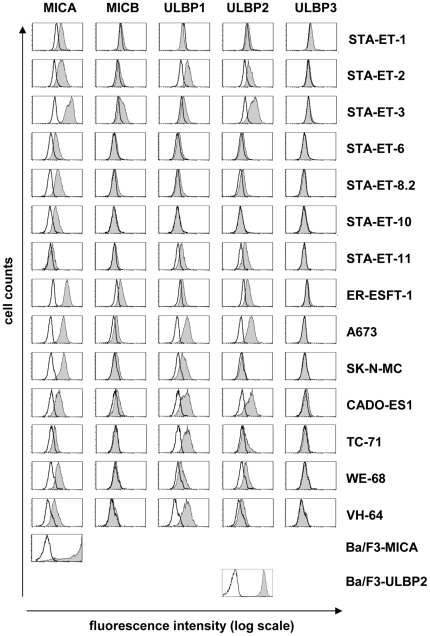
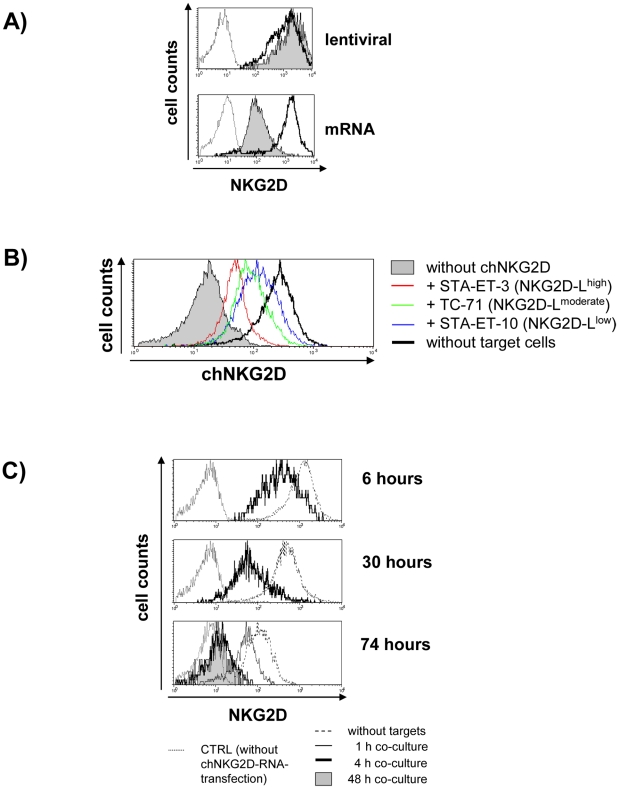
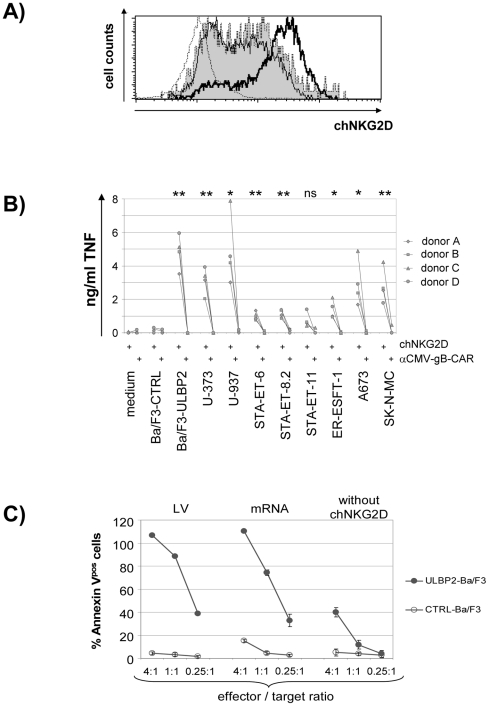
We explored the possibility to target Ewing's sarcoma family of tumors (ESFT) by redirecting T cells. To this aim, we considered NKG2D-ligands (NKG2D-Ls) as possible target antigens. Detailed analysis of the expression of MICA, MICB, ULBP-1, -2, and -3 in fourteen ESFT cell lines revealed consistent expression of at least one NKG2D-L. Thus, for redirecting T cells, we fused a CD3ζ/CD28-derived signaling domain to the ectodomain of NKG2D, however, opposite transmembrane orientation of this signaling domain and NKG2D required inverse orientation fusion of either of them. We hypothesized that the particularly located C-terminus of the NKG2D ectodomain should allow reengineering of the membrane anchoring from a native N-terminal to an artificial C-terminal linkage. Indeed, the resulting chimeric NKG2D receptor (chNKG2D) was functional and efficiently mediated ESFT cell death triggered by activated T cells. Notably, ESFT cells with even low NKG2D-L expression were killed by CD8(pos) and also CD4(pos) cells. Both, mRNA transfection and lentiviral transduction resulted in high level surface expression of chNKG2D. However, upon target-cell recognition receptor surface levels were maintained by tranfected RNA only during the first couple of hours after transfection. Later, target-cell contact resulted in strong and irreversible receptor down-modulation, whereas lentivirally mediated expression of chNKG2D remained constant under these conditions. Together, our study defines NKG2D-Ls as targets for a CAR-mediated T cell based immunotherapy of ESFT. A comparison of two different methods of gene transfer reveals strong differences in the susceptibility to ligand-induced receptor down-modulation with possible implications for the applicability of RNA transfection.
我们探讨了通过重定向 T 细胞来靶向尤文氏肉瘤家族肿瘤(ESFT)的可能性。为此,我们考虑了 NKG2D 配体(NKG2D-Ls)作为可能的靶抗原。对 14 种 ESFT 细胞系中 MICA、MICB、ULBP-1、-2 和 -3 的表达进行详细分析显示,至少有一种 NKG2D-L 持续表达。因此,为了重定向 T 细胞,我们将 CD3ζ/CD28 衍生的信号结构域融合到 NKG2D 的胞外结构域上,然而,该信号结构域的相反跨膜取向和 NKG2D 需要它们中的任何一个的反向融合。我们假设 NKG2D 胞外结构域的特别定位的 C 末端应该允许从天然的 N 末端到人工 C 末端连接重新设计膜锚定。事实上,所得嵌合 NKG2D 受体(chNKG2D)是功能性的,并且能够有效地介导由激活的 T 细胞触发的 ESFT 细胞死亡。值得注意的是,即使低表达 NKG2D-L 的 ESFT 细胞也可被 CD8(pos)和 CD4(pos)细胞杀死。mRNA 转染和慢病毒转导均导致 chNKG2D 的高水平表面表达。然而,在靶细胞识别受体表面水平仅在转染后最初几个小时内通过转染 RNA 维持。之后,靶细胞接触导致强烈且不可逆的受体下调,而在这些条件下,慢病毒介导的 chNKG2D 表达保持恒定。总之,我们的研究将 NKG2D-Ls 定义为基于 CAR 的 T 细胞免疫治疗 ESFT 的靶标。两种不同基因转移方法的比较显示,在配体诱导的受体下调的易感性方面存在显著差异,这可能对 RNA 转染的适用性具有影响。