Department of Experimental Medicine, University of Perugia, Via Del Giochetto, 06126 Perugia, Italy.
Sci Rep. 2011;1:39. doi: 10.1038/srep00039. Epub 2011 Jul 18.
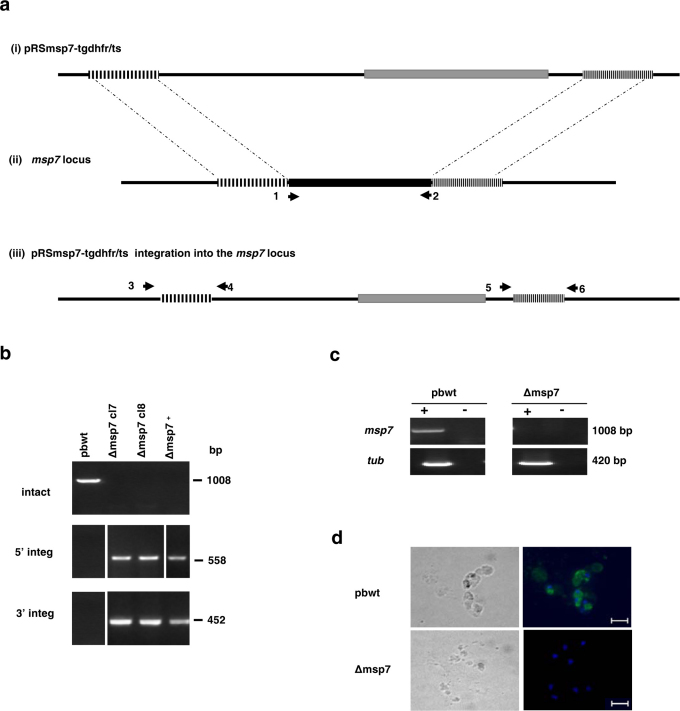
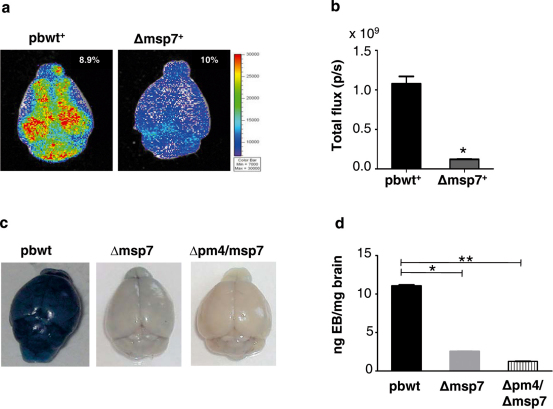
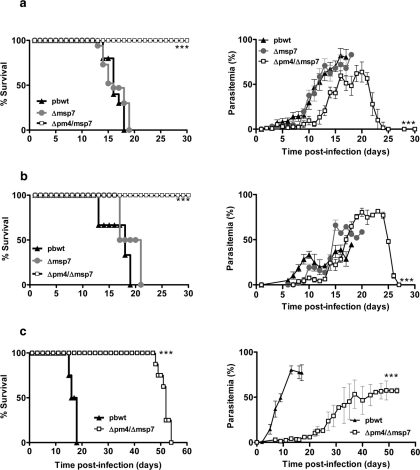
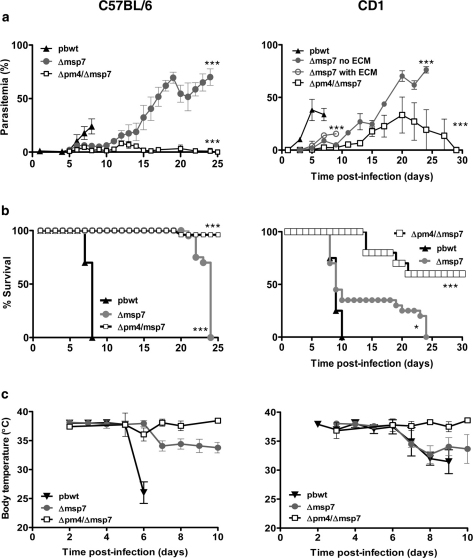
Blood stage malaria parasites causing a mild and self limited infection in mice have been obtained with either radiation or chemical mutagenesis showing the possibility of developing an attenuated malaria vaccine. Targeted disruption of plasmepsin-4 (pm4) or the merozoite surface protein-7 (msp7) genes also induces a virulence-attenuated phenotype in terms of absence of experimental cerebral malaria (ECM), delayed increase of parasitemia and reduced mortality rate. The decrease in virulence in parasites lacking either pm4 or msp7 is however incomplete and dependent on the parasite and mouse strain combination. The sequential disruption of both genes induced remarkable virulence-attenuated blood-stage parasites characterized by a self-resolving infection with low levels of parasitemia and no ECM. Furthermore, convalescent mice were protected against the challenge with P. berghei or P. yoelii parasites for several months. These observations provide a proof-of-concept step for the development of human malaria vaccines based on genetically attenuated blood-stage parasites.
已经通过辐射或化学诱变获得了在小鼠中引起轻度和自限性感染的血期疟原虫,这表明开发减毒疟疾疫苗是可能的。靶向敲除质膜蛋白酶 4(pm4)或裂殖子表面蛋白 7(msp7)基因也会导致实验性脑疟疾(ECM)缺失、寄生虫血症升高延迟和死亡率降低的毒力减弱表型。然而,缺乏 pm4 或 msp7 的寄生虫的毒力降低并不完全,并且取决于寄生虫和小鼠品系的组合。这两个基因的连续敲除诱导了显著的毒力减弱的血期寄生虫,其特征是感染自行缓解,寄生虫血症水平低,无 ECM。此外,恢复期小鼠对伯氏疟原虫或约氏疟原虫的攻击可保护数月。这些观察结果为基于遗传减毒血期寄生虫的人类疟疾疫苗的开发提供了概念验证步骤。