ISSP, University of Tokyo, Kashiwa-no-ha, Kashiwa, Chiba 277-8581, Japan.
Sci Rep. 2011;1:64. doi: 10.1038/srep00064. Epub 2011 Aug 19.
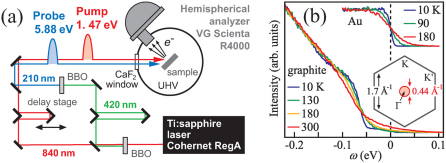
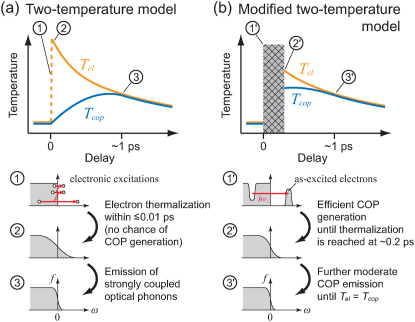
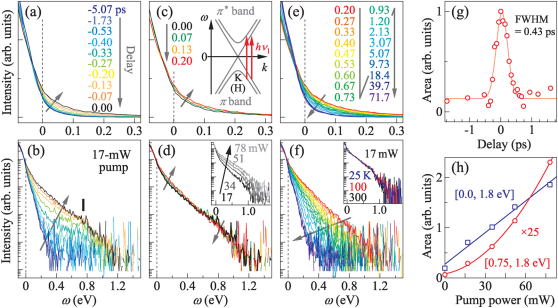
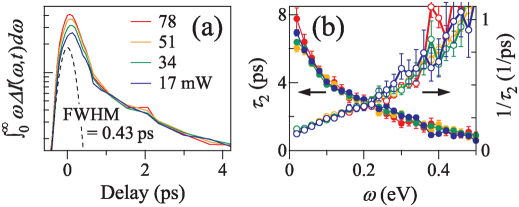
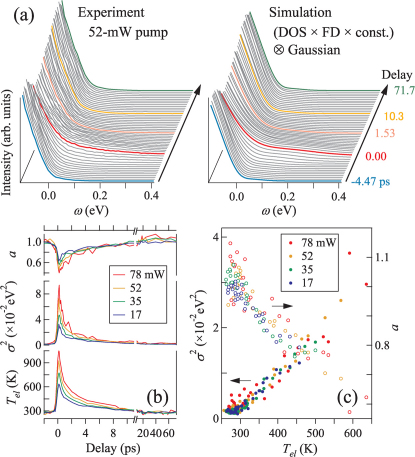
Investigation of the non-equilibrium dynamics after an impulsive impact provides insights into couplings among various excitations. A two-temperature model (TTM) is often a starting point to understand the coupled dynamics of electrons and lattice vibrations: the optical pulse primarily raises the electronic temperature T(el) while leaving the lattice temperature T(l) low; subsequently the hot electrons heat up the lattice until T(el) = T(l) is reached. This temporal hierarchy owes to the assumption that the electron-electron scattering rate is much larger than the electron-phonon scattering rate. We report herein that the TTM scheme is seriously invalidated in semimetal graphite. Time-resolved photoemission spectroscopy (TrPES) of graphite reveals that fingerprints of coupled optical phonons (COPs) occur from the initial moments where T(el) is still not definable. Our study shows that ultrafast-and-efficient phonon generations occur beyond the TTM scheme, presumably associated to the long duration of the non-thermal electrons in graphite.
冲击后的非平衡动力学研究提供了对各种激发之间耦合的深入了解。双温模型(TTM)通常是理解电子和晶格振动耦合动力学的起点:光脉冲主要提高电子温度 T(el),而使晶格温度 T(l)保持较低;随后,热电子加热晶格,直到达到 T(el)= T(l)。这种时间层次结构归因于电子-电子散射率远大于电子-声子散射率的假设。本文报道称,在半金属石墨中,TTM 方案严重失效。石墨的时间分辨光发射光谱(TrPES)表明,在电子温度 T(el)仍无法确定的初始时刻,就出现了耦合光学声子(COPs)的特征。我们的研究表明,超快和高效的声子产生发生在 TTM 方案之外,可能与石墨中非热电子的持续时间较长有关。