Department of Psychology, The University of Western Ontario, London, ON, Canada, N6A 5C2.
Sci Rep. 2011;1:130. doi: 10.1038/srep00130. Epub 2011 Oct 26.
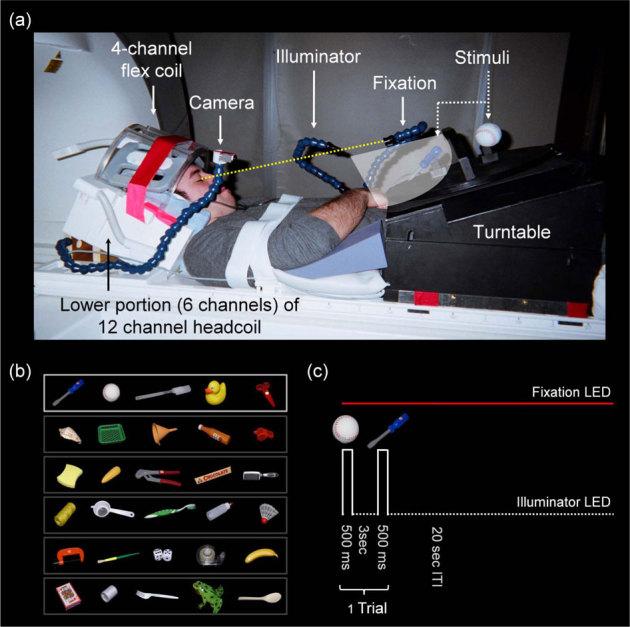
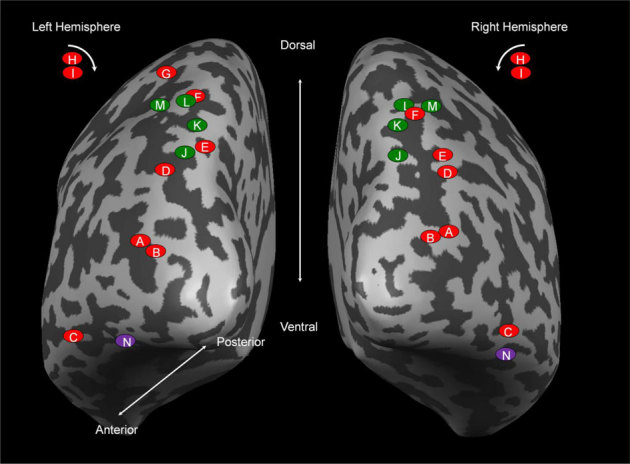
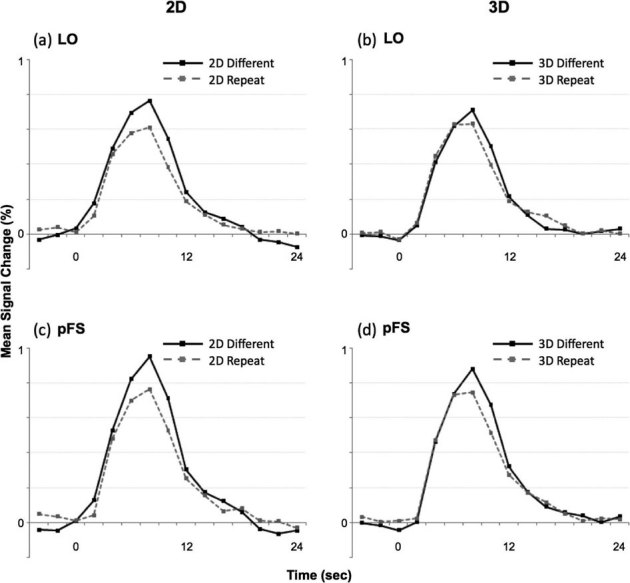
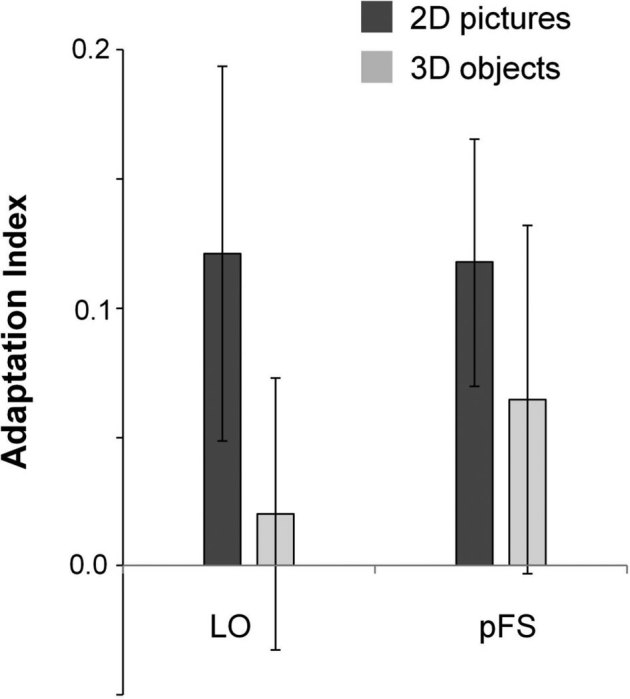
Our understanding of the neural underpinnings of perception is largely built upon studies employing 2-dimensional (2D) planar images. Here we used slow event-related functional imaging in humans to examine whether neural populations show a characteristic repetition-related change in haemodynamic response for real-world 3-dimensional (3D) objects, an effect commonly observed using 2D images. As expected, trials involving 2D pictures of objects produced robust repetition effects within classic object-selective cortical regions along the ventral and dorsal visual processing streams. Surprisingly, however, repetition effects were weak, if not absent on trials involving the 3D objects. These results suggest that the neural mechanisms involved in processing real objects may therefore be distinct from those that arise when we encounter a 2D representation of the same items. These preliminary results suggest the need for further research with ecologically valid stimuli in other imaging designs to broaden our understanding of the neural mechanisms underlying human vision.
我们对感知神经基础的理解在很大程度上是建立在使用二维(2D)平面图像的研究基础上的。在这里,我们使用人类缓慢的事件相关功能成像来研究神经群体是否表现出对真实 3 维(3D)物体的血流动力学反应的特征重复相关变化,这是使用 2D 图像通常观察到的效果。不出所料,涉及物体的 2D 图片的试验在沿着腹侧和背侧视觉处理流的经典物体选择性皮质区域内产生了强大的重复效应。然而,令人惊讶的是,涉及 3D 物体的试验中,重复效应较弱,如果不是不存在的话。这些结果表明,处理真实物体的神经机制可能与我们遇到相同物品的 2D 表示时所产生的机制不同。这些初步结果表明,需要在其他成像设计中使用具有生态有效性的刺激进行进一步研究,以扩大我们对人类视觉背后的神经机制的理解。