Marine Biology Research Division, Scripps Institution of Oceanography, University of California San Diego, La Jolla, CA, USA.
Sci Rep. 2012;2:240. doi: 10.1038/srep00240. Epub 2012 Feb 2.
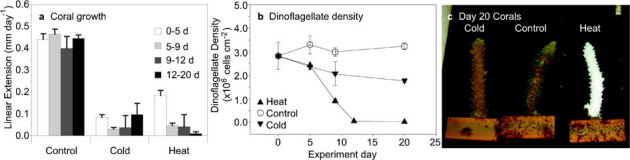
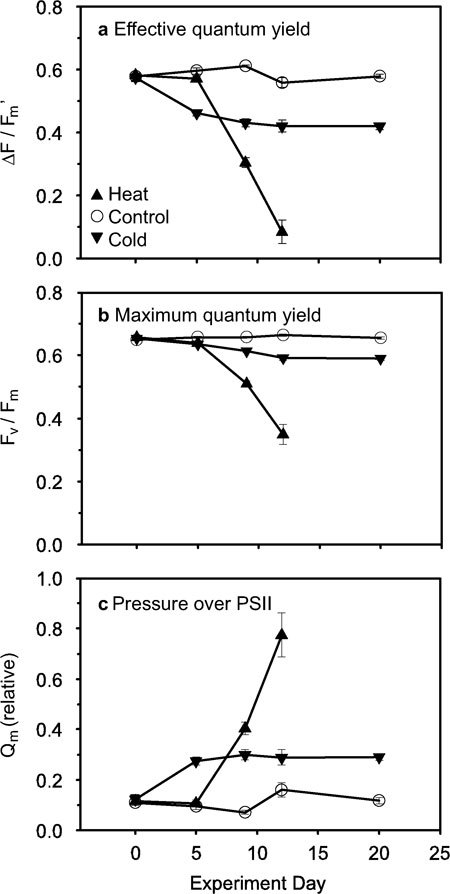
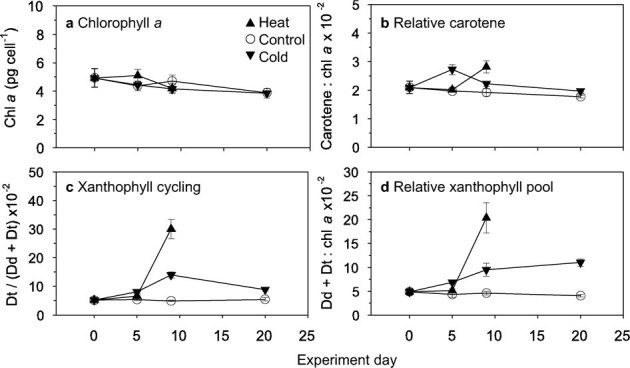
Climate change driven increases in intensity and frequency of both hot and cold extreme events contribute to coral reef decline by causing widespread coral bleaching and mortality. Here, we show that hot and cold temperature changes cause distinct physiological responses on different time scales in reef-building corals. We exposed the branching coral Acropora yongei in individual aquaria to a ± 5°C temperature change. Compared to heat-treated corals, cold-treated corals initially show greater declines in growth and increases in photosynthetic pressure. However, after 2-3 weeks, cold-treated corals acclimate and show improvements in physiological state. In contrast, heat did not initially harm photochemical efficiency, but after a delay, photosynthetic pressure increased rapidly and corals experienced severe bleaching and cessation of growth. These results suggest that short-term cold temperature is more damaging for branching corals than short-term warm temperature, whereas long-term elevated temperature is more harmful than long-term depressed temperature.
气候变化导致的冷热极端事件强度和频率的增加,通过引起广泛的珊瑚白化和死亡,导致珊瑚礁衰退。在这里,我们表明,冷热温度变化在不同的时间尺度上对造礁珊瑚产生不同的生理反应。我们将分枝珊瑚 Acropora yongei 暴露在单独的水族箱中,温度变化为±5°C。与热处理的珊瑚相比,冷处理的珊瑚最初表现出更大的生长下降和光合压力增加。然而,2-3 周后,冷处理的珊瑚适应并改善生理状态。相比之下,热最初不会损害光化学效率,但延迟后,光合压力迅速增加,珊瑚经历严重白化和生长停止。这些结果表明,短期低温对分枝珊瑚的破坏性大于短期高温,而长期高温比长期低温更有害。