Kim Sunduk, Yang Ji-Yeon, Kim Ho-Hyun, Yeo In-Young, Shin Dong-Chun, Lim Young-Wook
Institute for Environmental Research, Yonsei University, Seoul, Korea.
Environ Health Toxicol. 2012;27:e2012005. doi: 10.5620/eht.2012.27.e2012005. Epub 2012 Feb 2.
The purpose of this study was to assess the risk of ingestion exposure of lead by particle sizes of crumb rubber in artificial turf filling material with consideration of bioavailability.
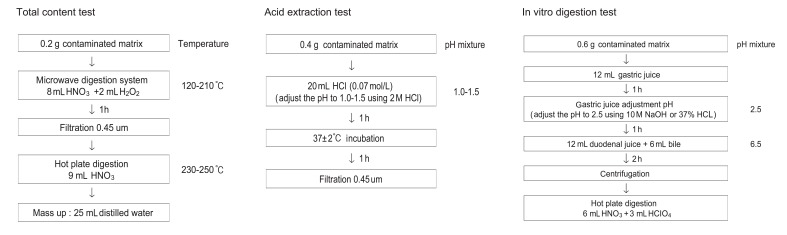
This study estimated the ingestion exposure by particle sizes (more than 250 um or less than 250 um) focusing on recyclable ethylene propylene diene monomer crumb rubber being used as artificial turf filling. Analysis on crumb rubber was conducted using body ingestion exposure estimate method in which total content test method, acid extraction method and digestion extraction method are reflected. Bioavailability which is a calibrating factor was reflected in ingestion exposure estimate method and applied in exposure assessment and risk assessment. Two methods using acid extraction and digestion extraction concentration were compared and evaluated.
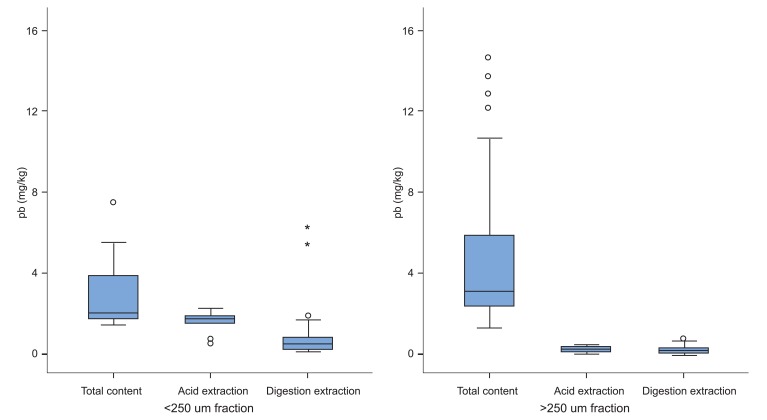
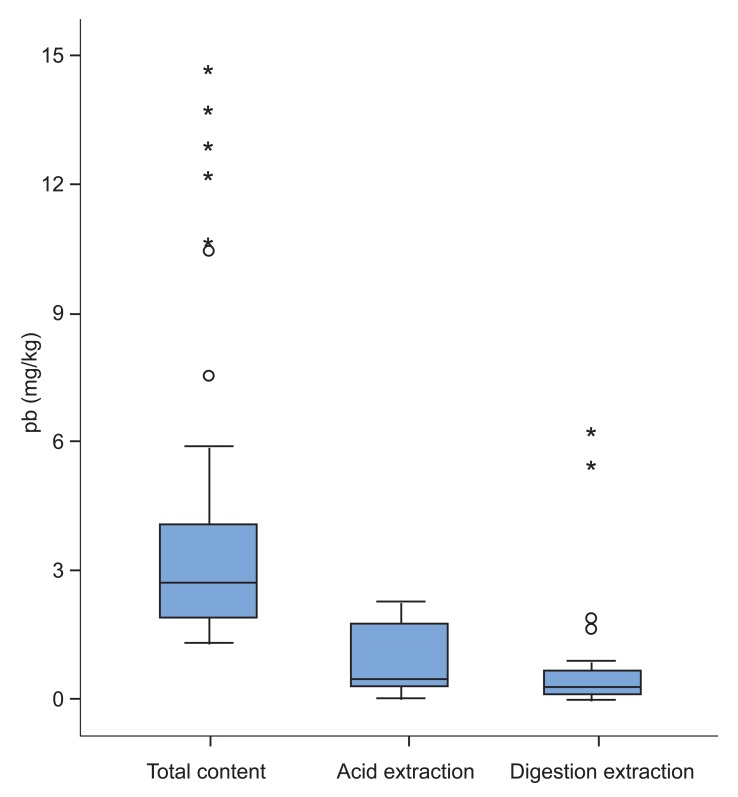
As a result of the ingestion exposure of crumb rubber material, the average lead exposure amount to the digestion extraction result among crumb rubber was calculated to be 1.56×10(-4) mg/kg-day for low grade elementary school students and 4.87×10(-5) mg/kg-day for middle and high school students in 250 um or less particle size, and that to the acid extraction result was higher than the digestion extraction result. Results of digestion extraction and acid extraction showed that the hazard quotient was estimated by about over 2 times more in particle size of lower than 250 um than in higher than 250 um. There was a case of an elementary school student in which the hazard quotient exceeded 0.1.
Results of this study confirm that the exposure of lead ingestion and risk level increases as the particle size of crumb rubber gets smaller.
本研究旨在评估人造草皮填充材料中碎橡胶颗粒大小导致的铅摄入暴露风险,并考虑生物利用度。
本研究通过关注用作人造草皮填充材料的可回收乙丙二烯单体碎橡胶,按颗粒大小(大于250微米或小于250微米)估算摄入暴露量。使用反映总含量测试法、酸提取法和消解提取法的人体摄入暴露估算方法对碎橡胶进行分析。作为校准因子的生物利用度被纳入摄入暴露估算方法,并应用于暴露评估和风险评估。对使用酸提取浓度和消解提取浓度的两种方法进行了比较和评估。
对于碎橡胶材料的摄入暴露,在250微米及以下粒径的碎橡胶中,低龄小学生通过消解提取结果计算的平均铅暴露量为1.56×10⁻⁴毫克/千克·天,中学生和高中生为4.87×10⁻⁵毫克/千克·天,且酸提取结果高于消解提取结果。消解提取和酸提取结果表明,粒径低于250微米的危害商估计比高于250微米的危害商高出约2倍多。有一名小学生的危害商超过了0.1。
本研究结果证实,随着碎橡胶粒径变小,铅摄入暴露和风险水平会增加。