Department of Human Genetics, Radboud University Nijmegen Medical Centre, Nijmegen, The Netherlands.
PLoS Genet. 2012;8(2):e1002533. doi: 10.1371/journal.pgen.1002533. Epub 2012 Feb 16.
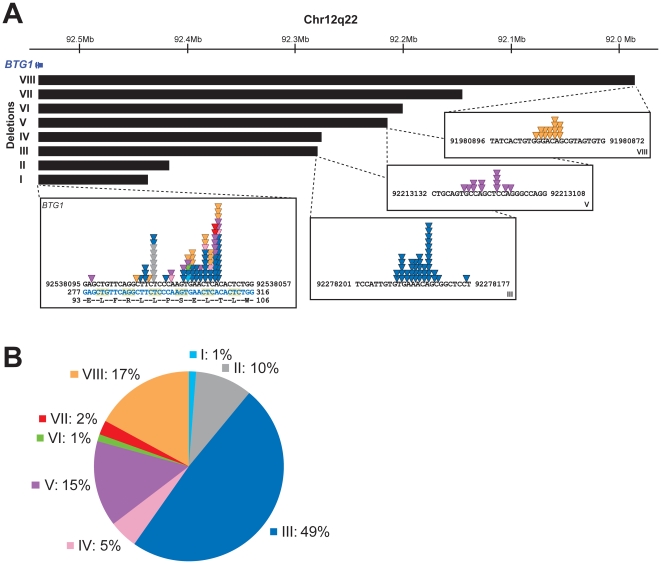
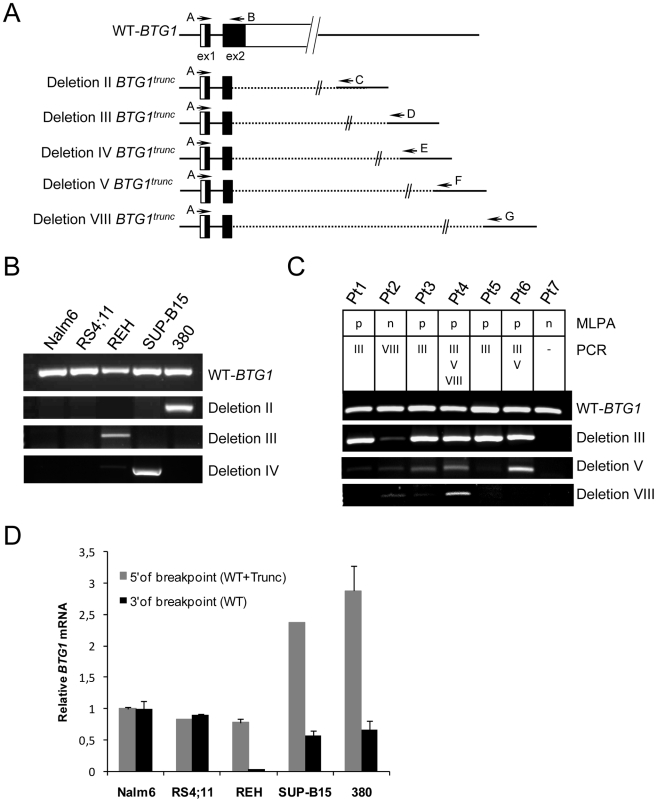
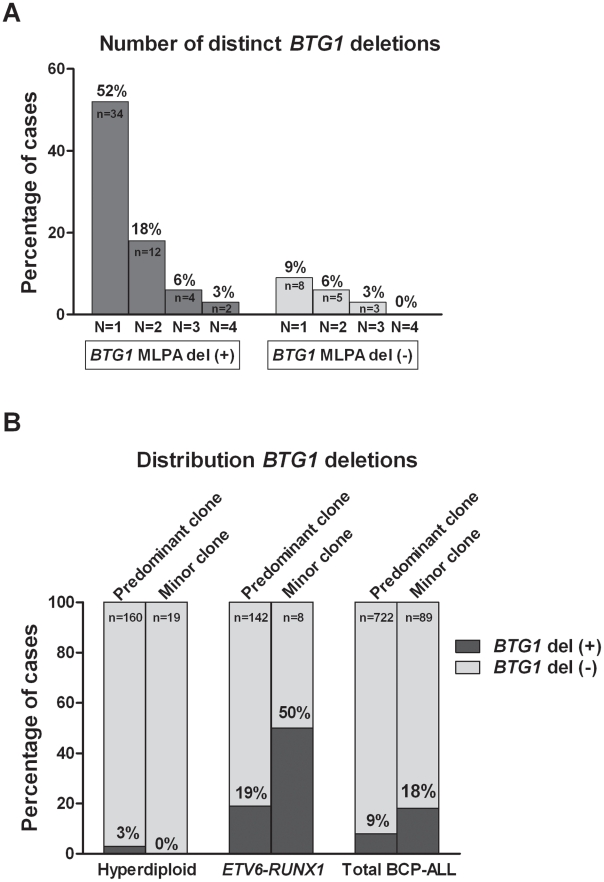
Recurrent submicroscopic deletions in genes affecting key cellular pathways are a hallmark of pediatric acute lymphoblastic leukemia (ALL). To gain more insight into the mechanism underlying these deletions, we have studied the occurrence and nature of abnormalities in one of these genes, the B-cell translocation gene 1 (BTG1), in a large cohort of pediatric ALL cases. BTG1 was found to be exclusively affected by genomic deletions, which were detected in 65 out of 722 B-cell precursor ALL (BCP-ALL) patient samples (9%), but not in 109 T-ALL cases. Eight different deletion sizes were identified, which all clustered at the telomeric site in a hotspot region within the second (and last) exon of the BTG1 gene, resulting in the expression of truncated BTG1 read-through transcripts. The presence of V(D)J recombination signal sequences at both sites of virtually all deletions strongly suggests illegitimate RAG1/RAG2-mediated recombination as the responsible mechanism. Moreover, high levels of histone H3 lysine 4 trimethylation (H3K4me3), which is known to tether the RAG enzyme complex to DNA, were found within the BTG1 gene body in BCP-ALL cells, but not T-ALL cells. BTG1 deletions were rarely found in hyperdiploid BCP-ALLs, but were predominant in other cytogenetic subgroups, including the ETV6-RUNX1 and BCR-ABL1 positive BCP-ALL subgroups. Through sensitive PCR-based screening, we identified multiple additional BTG1 deletions at the subclonal level in BCP-ALL, with equal cytogenetic distribution which, in some cases, grew out into the major clone at relapse. Taken together, our results indicate that BTG1 deletions may act as "drivers" of leukemogenesis in specific BCP-ALL subgroups, in which they can arise independently in multiple subclones at sites that are prone to aberrant RAG1/RAG2-mediated recombination events. These findings provide further evidence for a complex and multiclonal evolution of ALL.
基因的反复亚微观缺失影响关键细胞途径,是小儿急性淋巴细胞白血病(ALL)的标志之一。为了更深入地了解这些缺失的机制,我们研究了其中一个基因 B 细胞易位基因 1(BTG1)在一大群小儿 ALL 病例中的异常发生和性质。发现 BTG1 仅受基因组缺失影响,在 722 例 B 细胞前体 ALL(BCP-ALL)患者样本中检测到 65 例(9%),而在 109 例 T-ALL 病例中未检测到。确定了 8 种不同的缺失大小,它们都聚集在 BTG1 基因第二个(也是最后一个)外显子的端粒部位热点区域,导致截断的 BTG1 通读转录本的表达。几乎所有缺失的两个位点都存在 V(D)J 重组信号序列,强烈表明非法 RAG1/RAG2 介导的重组是负责的机制。此外,在 BCP-ALL 细胞中,BTG1 基因体内发现高水平的组蛋白 H3 赖氨酸 4 三甲基化(H3K4me3),已知该组蛋白将 RAG 酶复合物固定在 DNA 上,但在 T-ALL 细胞中未发现。BTG1 缺失在超二倍体 BCP-ALL 中很少发现,但在其他细胞遗传学亚组中占主导地位,包括 ETV6-RUNX1 和 BCR-ABL1 阳性 BCP-ALL 亚组。通过敏感的基于 PCR 的筛选,我们在 BCP-ALL 中在亚克隆水平上鉴定了多个额外的 BTG1 缺失,具有相同的细胞遗传学分布,在某些情况下,这些缺失在复发时发展为主要克隆。总之,我们的结果表明,BTG1 缺失可能在特定 BCP-ALL 亚组中作为白血病发生的“驱动因素”,在这些亚组中,它们可以在易发生异常 RAG1/RAG2 介导的重组事件的多个亚克隆中独立出现。这些发现为 ALL 的复杂和多克隆进化提供了进一步的证据。