Research Institute Children's Cancer Center Hamburg, Hamburg, Germany.
Department of Pediatric Hematology and Oncology, and.
Blood Adv. 2021 Mar 9;5(5):1209-1223. doi: 10.1182/bloodadvances.2020001844.
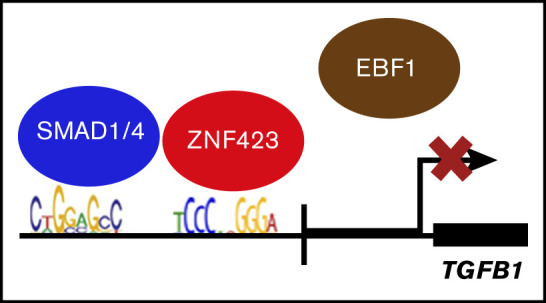
Aberrant expression of the transcriptional modulator and early B-cell factor 1 (EBF1) antagonist ZNF423 has been implicated in B-cell leukemogenesis, but its impact on transcriptional circuitries in lymphopoiesis has not been elucidated in a comprehensive manner. Herein, in silico analyses of multiple expression data sets on 1354 acute leukemia samples revealed a widespread presence of ZNF423 in various subtypes of acute lymphoblastic leukemia (ALL). Average expression of ZNF423 was highest in ETV6-RUNX1, B-other, and TCF3-PBX1 ALL followed by BCR-ABL, hyperdiploid ALL, and KMT2A-rearranged ALL. In a KMT2A-AFF1 pro-B ALL model, a CRISPR-Cas9-mediated genetic ablation of ZNF423 decreased cell viability and significantly prolonged survival of mice upon xenotransplantation. For the first time, we characterized the genome-wide binding pattern of ZNF423, its impact on the chromatin landscape, and differential gene activities in a B-lineage context. In general, chromatin-bound ZNF423 was associated with a depletion of activating histone marks. At the transcriptional level, EBF1-dependent transactivation was disrupted by ZNF423, whereas repressive and pioneering activities of EBF1 were not discernibly impeded. Unexpectedly, we identified an enrichment of ZNF423 at canonical EBF1-binding sites also in the absence of EBF1, which was indicative of intrinsic EBF1-independent ZNF423 activities. A genome-wide motif search at EBF1 target gene loci revealed that EBF1 and ZNF423 co-regulated genes often contain SMAD1/SMAD4-binding motifs as exemplified by the TGFB1 promoter, which was repressed by ZNF423 outcompeting EBF1 by depending on its ability to bind EBF1 consensus sites and to interact with EBF1 or SMADs. Overall, these findings underscore the wide scope of ZNF423 activities that interfere with B-cell lymphopoiesis and contribute to leukemogenesis.
转录调节剂和早期 B 细胞因子 1(EBF1)拮抗剂 ZNF423 的异常表达已被牵连到 B 细胞白血病的发生中,但它对淋巴发生中的转录电路的影响尚未被全面阐明。在此,对 1354 个急性白血病样本的多个表达数据集进行了计算机分析,结果显示 ZNF423 在各种类型的急性淋巴细胞白血病(ALL)中广泛存在。ZNF423 的平均表达水平在 ETV6-RUNX1、B-其他和 TCF3-PBX1 ALL 中最高,其次是 BCR-ABL、高倍体 ALL 和 KMT2A 重排 ALL。在 KMT2A-AFF1 前 B 细胞 ALL 模型中,CRISPR-Cas9 介导的 ZNF423 基因缺失降低了细胞活力,并显著延长了异种移植小鼠的存活时间。我们首次对 ZNF423 的全基因组结合模式、对染色质景观的影响以及在 B 谱系背景下的差异基因活性进行了表征。一般来说,染色质结合的 ZNF423 与激活组蛋白标记的耗竭有关。在转录水平上,ZNF423 破坏了 EBF1 依赖性的转录激活,而 EBF1 的抑制和开拓活性则没有明显受到阻碍。出乎意料的是,我们发现即使在没有 EBF1 的情况下,ZNF423 也会富集在典型的 EBF1 结合位点上,这表明 ZNF423 具有内在的 EBF1 独立活性。在 EBF1 靶基因座的全基因组 motif 搜索中发现,EBF1 和 ZNF423 共同调节的基因通常含有 SMAD1/SMAD4 结合基序,例如 TGFB1 启动子,该启动子被 ZNF423 抑制,因为它依赖于结合 EBF1 保守基序和与 EBF1 或 SMADs 相互作用的能力来竞争 EBF1。总的来说,这些发现强调了 ZNF423 干扰 B 细胞淋巴发生并导致白血病发生的广泛活动范围。