Institut für Statistik, Ludwig-Maximilians-Universität München, München, Germany.
PLoS One. 2012;7(2):e29510. doi: 10.1371/journal.pone.0029510. Epub 2012 Feb 16.
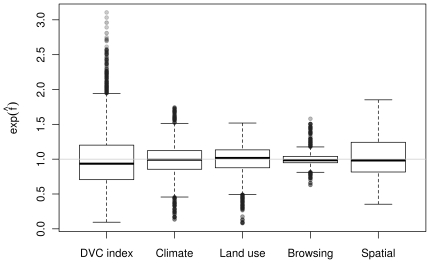
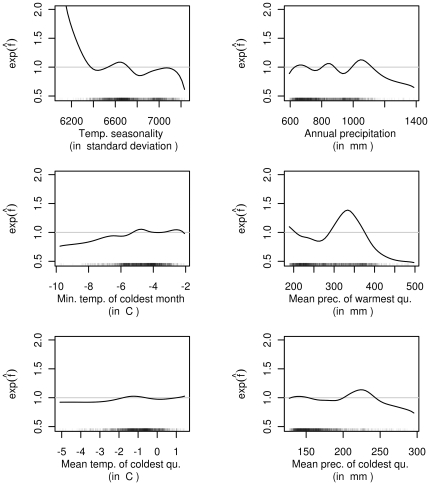
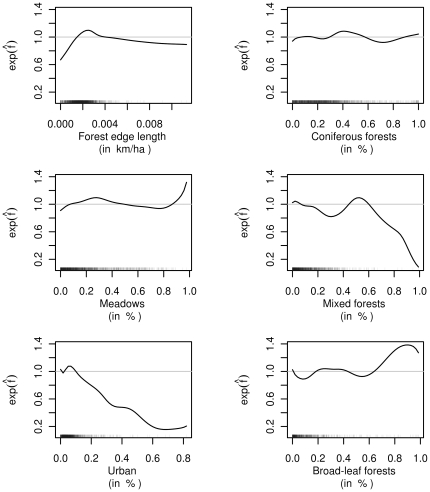
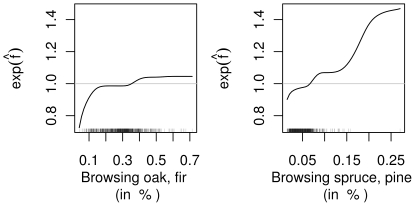
Ungulates, in particular the Central European roe deer Capreolus capreolus and the North American white-tailed deer Odocoileus virginianus, are economically and ecologically important. The two species are risk factors for deer-vehicle collisions and as browsers of palatable trees have implications for forest regeneration. However, no large-scale management systems for ungulates have been implemented, mainly because of the high efforts and costs associated with attempts to estimate population sizes of free-living ungulates living in a complex landscape. Attempts to directly estimate population sizes of deer are problematic owing to poor data quality and lack of spatial representation on larger scales. We used data on >74,000 deer-vehicle collisions observed in 2006 and 2009 in Bavaria, Germany, to model the local risk of deer-vehicle collisions and to investigate the relationship between deer-vehicle collisions and both environmental conditions and browsing intensities. An innovative modelling approach for the number of deer-vehicle collisions, which allows nonlinear environment-deer relationships and assessment of spatial heterogeneity, was the basis for estimating the local risk of collisions for specific road types on the scale of Bavarian municipalities. Based on this risk model, we propose a new "deer-vehicle collision index" for deer management. We show that the risk of deer-vehicle collisions is positively correlated to browsing intensity and to harvest numbers. Overall, our results demonstrate that the number of deer-vehicle collisions can be predicted with high precision on the scale of municipalities. In the densely populated and intensively used landscapes of Central Europe and North America, a model-based risk assessment for deer-vehicle collisions provides a cost-efficient instrument for deer management on the landscape scale. The measures derived from our model provide valuable information for planning road protection and defining hunting quota. Open-source software implementing the model can be used to transfer our modelling approach to wildlife-vehicle collisions elsewhere.
有蹄类动物,特别是中欧的狍 Capreolus capreolus 和北美的白尾鹿 Odocoileus virginianus,具有重要的经济和生态意义。这两个物种是鹿与车辆碰撞的风险因素,而且作为可食用树木的食草动物,它们对森林更新有影响。然而,由于尝试估计生活在复杂景观中的自由放养有蹄类动物的种群数量与高投入和高成本相关,因此没有实施大型有蹄类动物管理系统。由于数据质量差且缺乏大尺度的空间代表性,直接估计鹿的种群数量存在问题。我们利用 2006 年和 2009 年在德国巴伐利亚州观察到的超过 74,000 起鹿与车辆碰撞的数据,来模拟鹿与车辆碰撞的局部风险,并研究鹿与车辆碰撞与环境条件和食草强度之间的关系。一种用于估计特定道路类型在巴伐利亚市范围内的局部碰撞风险的创新的 deer-vehicle 碰撞数量建模方法,该方法允许非线性的环境-鹿关系和评估空间异质性,为估算特定道路类型的局部碰撞风险提供了基础。基于该风险模型,我们提出了一种新的 deer-vehicle 碰撞指数 deer-vehicle 管理方法。我们表明,鹿与车辆碰撞的风险与食草强度和收获数量呈正相关。总体而言,我们的结果表明,在市的范围内,可以高精度地预测 deer-vehicle 碰撞的数量。在中欧和北美的人口密集和高度使用的景观中,基于模型的 deer-vehicle 碰撞风险评估为景观尺度的 deer-vehicle 管理提供了一种具有成本效益的工具。从我们的模型中得出的措施为规划道路保护和确定狩猎配额提供了有价值的信息。实现该模型的开源软件可用于将我们的建模方法转移到其他野生动物与车辆碰撞的地方。