Moran M F, Koch C A, Anderson D, Ellis C, England L, Martin G S, Pawson T
Division of Molecular and Developmental Biology, Samuel Lunenfeld Research Institute, Mount Sinai Hospital, Toronto, ON, Canada.
Proc Natl Acad Sci U S A. 1990 Nov;87(21):8622-6. doi: 10.1073/pnas.87.21.8622.
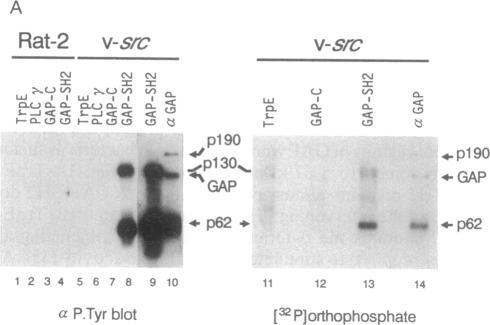
Cytoplasmic proteins that regulate signal transduction or induce cellular transformation, including cytoplasmic protein-tyrosine kinases, p21ras GTPase-activating protein (GAP), phospholipase C gamma, and the v-crk oncoprotein, possess one or two copies of a conserved noncatalytic domain, Src homology region 2 (SH2). Here we provide direct evidence that SH2 domains can mediate the interactions of these diverse signaling proteins with a related set of phosphotyrosine ligands, including the epidermal growth factor (EGF) receptor. In src-transformed cells GAP forms heteromeric complexes, notably with a highly tyrosine phosphorylated 62-kDa protein (p62). The stable association between GAP and p62 can be specifically reconstituted in vitro by using a bacterial polypeptide containing only the N-terminal GAP SH2 domain. The efficient phosphorylation of p62 by the v-Src or v-Fps tyrosine kinases depends, in turn, on their SH2 domains and correlates with their transforming activity. In lysates of EGF-stimulated cells, the N-terminal GAP SH2 domain binds to both the EGF receptor and p62. Fusion proteins containing GAP or v-Crk SH2 domains complex with similar phosphotyrosine proteins from src-transformed or EGF-stimulated cells but with different efficiencies. SH2 sequences, therefore, form autonomous domains that direct signaling proteins, such as GAP, to bind specific phosphotyrosine-containing polypeptides. By promoting the formation of these complexes, SH2 domains are ideally suited to regulate the activation of intracellular signaling pathways by growth factors.
调节信号转导或诱导细胞转化的细胞质蛋白,包括细胞质蛋白酪氨酸激酶、p21ras GTP酶激活蛋白(GAP)、磷脂酶Cγ和v-crk癌蛋白,都拥有一个或两个保守的非催化结构域,即Src同源区2(SH2)。我们在此提供直接证据,表明SH2结构域可介导这些不同的信号蛋白与一组相关的磷酸酪氨酸配体相互作用,其中包括表皮生长因子(EGF)受体。在src转化细胞中,GAP形成异源复合物,特别是与一种高度酪氨酸磷酸化的62 kDa蛋白(p62)。GAP与p62之间的稳定结合可以在体外通过使用仅包含N端GAP SH2结构域的细菌多肽特异性重建。v-Src或v-Fps酪氨酸激酶对p62的有效磷酸化反过来又取决于它们的SH2结构域,并与它们的转化活性相关。在EGF刺激的细胞裂解物中,N端GAP SH2结构域与EGF受体和p62都结合。含有GAP或v-Crk SH2结构域的融合蛋白与来自src转化或EGF刺激细胞的类似磷酸酪氨酸蛋白形成复合物,但效率不同。因此,SH2序列形成自主结构域,可引导信号蛋白如GAP结合特定的含磷酸酪氨酸多肽。通过促进这些复合物的形成,SH2结构域非常适合调节生长因子对细胞内信号通路的激活。