Moniot Sébastien, Weyand Michael, Steegborn Clemens
Department of Biochemistry, University of Bayreuth Bayreuth, Germany.
Front Pharmacol. 2012 Feb 9;3:16. doi: 10.3389/fphar.2012.00016. eCollection 2012.
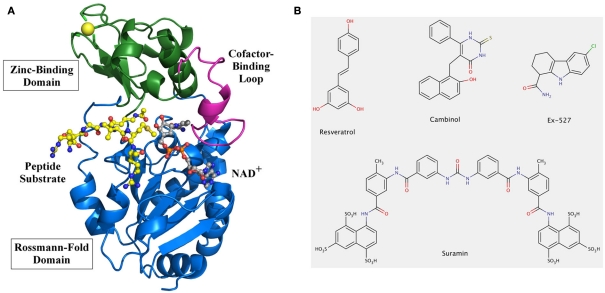
Sirtuins are NAD(+)-dependent protein deacetylases regulating metabolism, stress responses, and aging processes. Mammalia have seven Sirtuin isoforms, Sirt1-7, which differ in their substrate specificities and subcellular localizations. The physiological functions of Sirtuins make them interesting therapeutic targets, which has stimulated extensive efforts on development of small molecule Sirtuin modulators. Yet, most Sirtuin inhibitors show limited potency and/or isoform specificity, and the mechanism of Sirtuin activation by small molecules remains obscure. Accumulating information on Sirtuin substrates, structures, and regulation mechanisms offer new opportunities for the challenging task to develop potent and specific small molecule modulators for mammalian Sirtuins for in vivo studies and therapeutic applications. We therefore recapitulate advances in structural and mechanistic studies on substrate recognition and deacetylation by Sirtuins, and in the characterization of compounds and molecular mechanisms regulating their activity. We then discuss challenges and opportunities from these findings for Sirtuin-targeted drug development efforts.
沉默调节蛋白是依赖烟酰胺腺嘌呤二核苷酸(NAD⁺)的蛋白质脱乙酰酶,可调节代谢、应激反应和衰老过程。哺乳动物有七种沉默调节蛋白亚型,即Sirt1 - 7,它们在底物特异性和亚细胞定位方面存在差异。沉默调节蛋白的生理功能使其成为有趣的治疗靶点,这激发了人们在开发小分子沉默调节蛋白调节剂方面的广泛努力。然而,大多数沉默调节蛋白抑制剂的效力和/或亚型特异性有限,小分子激活沉默调节蛋白的机制仍不清楚。关于沉默调节蛋白底物、结构和调节机制的信息不断积累,为开发用于体内研究和治疗应用的强效且特异性的哺乳动物沉默调节蛋白小分子调节剂这一具有挑战性的任务提供了新机会。因此,我们总结了关于沉默调节蛋白对底物识别和脱乙酰作用的结构和机制研究进展,以及调节其活性的化合物和分子机制的表征。然后,我们讨论了这些发现给以沉默调节蛋白为靶点的药物开发工作带来的挑战和机遇。