Julius Center for Health Sciences and Primary Care, University Medical Center, Utrecht, The Netherlands.
PLoS One. 2012;7(2):e30995. doi: 10.1371/journal.pone.0030995. Epub 2012 Feb 21.
The burden of breast cancer in Asia is escalating. We evaluated the impact of ethnicity on survival after breast cancer in the multi-ethnic region of South East Asia.
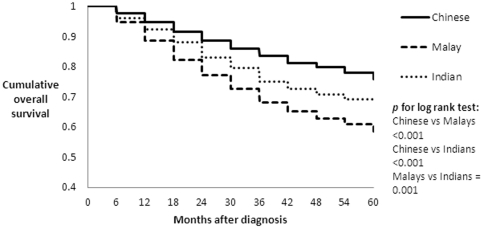
METHODOLOGY/PRINCIPAL FINDINGS: Using the Singapore-Malaysia hospital-based breast cancer registry, we analyzed the association between ethnicity and mortality following breast cancer in 5,264 patients diagnosed between 1990 and 2007 (Chinese: 71.6%, Malay: 18.4%, Indian: 10.0%). We compared survival rates between ethnic groups and calculated adjusted hazard ratios (HR) to estimate the independent effect of ethnicity on survival. Malays (n = 968) presented at a significantly younger age, with larger tumors, and at later stages than the Chinese and Indians. Malays were also more likely to have axillary lymph node metastasis at similar tumor sizes and to have hormone receptor negative and poorly differentiated tumors. Five year overall survival was highest in the Chinese women (75.8%; 95%CI: 74.4%-77.3%) followed by Indians (68.0%; 95%CI: 63.8%-72.2%), and Malays (58.5%; 95%CI: 55.2%-61.7%). Compared to the Chinese, Malay ethnicity was associated with significantly higher risk of all-cause mortality (HR: 1.34; 95%CI: 1.19-1.51), independent of age, stage, tumor characteristics and treatment. Indian ethnicity was not significantly associated with risk of mortality after breast cancer compared to the Chinese (HR: 1.14; 95%CI: 0.98-1.34).
In South East Asia, Malay ethnicity is independently associated with poorer survival after breast cancer. Research into underlying reasons, potentially including variations in tumor biology, psychosocial factors, treatment responsiveness and lifestyle after diagnosis, is warranted.
亚洲的乳腺癌负担正在加剧。我们评估了在东南亚多民族地区,种族对乳腺癌生存的影响。
方法/主要发现:利用新加坡-马来西亚医院乳腺癌登记处,我们分析了在 1990 年至 2007 年间诊断的 5264 例乳腺癌患者中,种族与乳腺癌后死亡率之间的关联(中国人:71.6%,马来人:18.4%,印度人:10.0%)。我们比较了不同种族群体的生存率,并计算了调整后的危险比(HR),以估计种族对生存的独立影响。马来人(n=968)发病年龄明显较小,肿瘤较大,分期较晚,与中国人和印度人相比。在类似肿瘤大小的情况下,马来人更容易发生腋窝淋巴结转移,并且更容易发生激素受体阴性和低分化肿瘤。中国人的 5 年总生存率最高(75.8%;95%CI:74.4%-77.3%),其次是印度人(68.0%;95%CI:63.8%-72.2%),马来人(58.5%;95%CI:55.2%-61.7%)。与中国人相比,马来种族与全因死亡率的风险显著增加相关(HR:1.34;95%CI:1.19-1.51),独立于年龄、分期、肿瘤特征和治疗。与中国人相比,印度种族与乳腺癌后死亡风险无显著相关性(HR:1.14;95%CI:0.98-1.34)。
在东南亚,马来种族与乳腺癌后生存较差独立相关。需要研究潜在的原因,包括肿瘤生物学、社会心理因素、治疗反应性和诊断后生活方式的差异。