National Key Facility for Crop Gene Resources and Genetic Improvement, Institute of Crop Science, Chinese Academy of Agricultural Sciences, Beijing, China.
PLoS One. 2012;7(2):e31249. doi: 10.1371/journal.pone.0031249. Epub 2012 Feb 17.
Grain yield is a key economic driver of successful wheat production. Due to its complex nature, little is known regarding its genetic control. The goal of this study was to identify important quantitative trait loci (QTL) directly and indirectly affecting grain yield using doubled haploid lines derived from a cross between Hanxuan 10 and Lumai 14.
METHODOLOGY/PRINCIPAL FINDINGS: Ten yield-associated traits, including yield per plant (YP), number of spikes per plant (NSP), number of grains per spike (NGS), one-thousand grain weight (TGW), total number of spikelets per spike (TNSS), number of sterile spikelets per spike (NSSS), proportion of fertile spikelets per spike (PFSS), spike length (SL), density of spikelets per spike (DSS) and plant height (PH), were assessed across 14 (for YP) to 23 (for TGW) year × location × water regime environments in China. Then, the genetic effects were partitioned into additive main effects (a), epistatic main effects (aa) and their environment interaction effects (ae and aae) by using composite interval mapping in a mixed linear model.
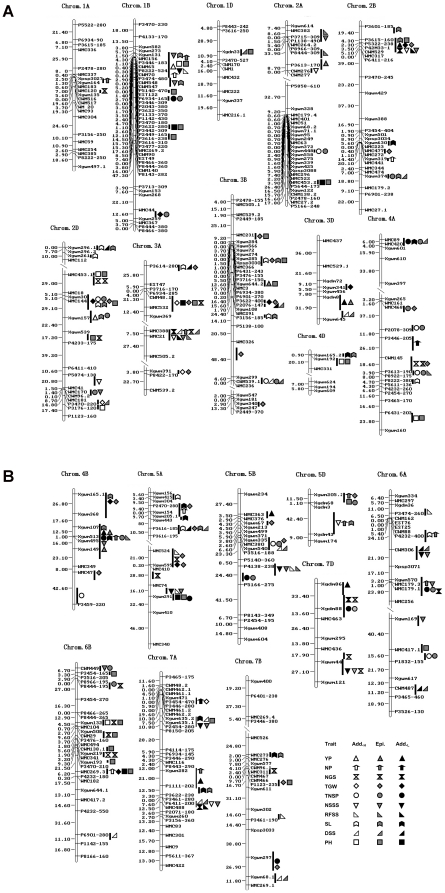
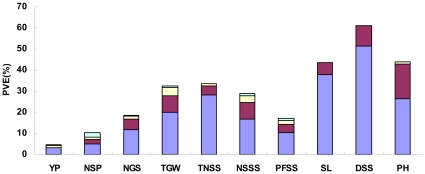
CONCLUSIONS/SIGNIFICANCE: Twelve (YP) to 33 (PH) QTLs were identified on all 21 chromosomes except 6D. QTLs were more frequently observed on chromosomes 1B, 2B, 2D, 5A and 6B, and were concentrated in a few regions on individual chromosomes, exemplified by three striking yield-related QTL clusters on chromosomes 2B, 1B and 4B that explained the correlations between YP and other traits. The additive main-effect QTLs contributed more phenotypic variation than the epistasis and environmental interaction. Consistent with agronomic analyses, a group of progeny derived by selecting TGW and NGS, with higher grain yield, had an increased frequency of QTL for high YP, NGS, TGW, TNSS, PFSS, SL, PH and fewer NSSS, when compared to low yielding progeny. This indicated that it is feasible by marker-assisted selection to facilitate wheat production.
谷物产量是小麦成功生产的关键经济驱动力。由于其复杂性,其遗传控制知之甚少。本研究的目的是使用源自 Hanxuan 10 和 Lumai 14 杂交的双单倍体系,直接和间接地鉴定对籽粒产量有重要影响的数量性状位点(QTL)。
方法/主要发现:在中国的 14 个(YP)至 23 个(TGW)年-地点-水分处理环境中,评估了 10 个与产量相关的性状,包括单株产量(YP)、每株穗数(NSP)、每穗粒数(NGS)、千粒重(TGW)、每穗小穗数(TNSS)、每穗不育小穗数(NSSS)、每穗可育小穗数(PFSS)、穗长(SL)、每穗小穗密度(DSS)和株高(PH)。然后,通过混合线性模型中的复合区间作图,将遗传效应划分为加性主效应(a)、上位性主效应(aa)及其环境互作效应(ae 和 aae)。
结论/意义:在除 6D 以外的 21 条染色体上共鉴定到 12 个(YP)至 33 个(PH)QTL。QTL 更频繁地出现在 1B、2B、2D、5A 和 6B 染色体上,并且在个别染色体上集中在少数几个区域,例如在 2B、1B 和 4B 染色体上发现的三个与产量相关的显著 QTL 簇,解释了 YP 与其他性状之间的相关性。加性主效 QTL 对表型变异的贡献大于上位性和环境互作。与农艺分析一致,一组通过选择 TGW 和 NGS 获得的、产量较高的后代,与低产后代相比,具有更高的 YP、NGS、TGW、TNSS、PFSS、SL、PH 和更少的 NSSS 的 QTL 的频率增加。这表明通过标记辅助选择促进小麦生产是可行的。