Instituto de Biomedicina de Valencia and Centro de Investigación Biomédica en Red de Enfermedades Raras, Valencia, Spain.
PLoS One. 2012;7(2):e31528. doi: 10.1371/journal.pone.0031528. Epub 2012 Feb 20.
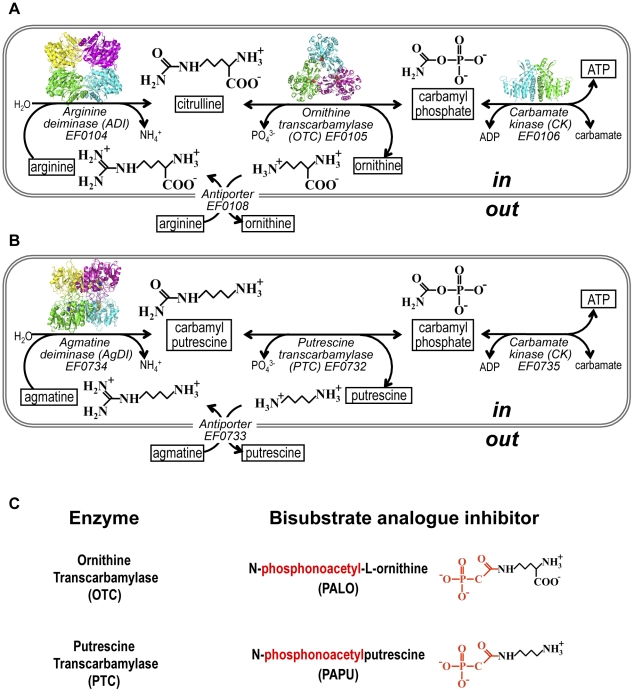
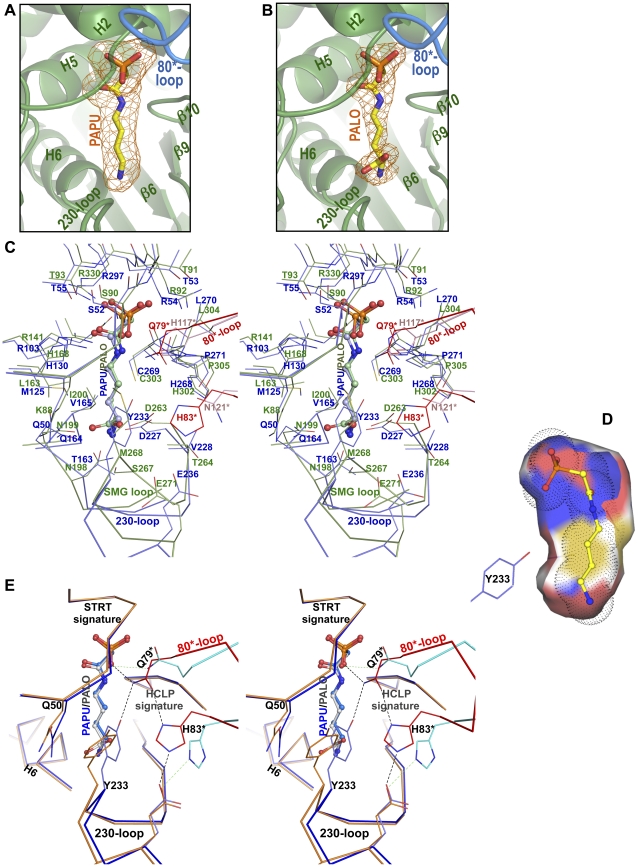
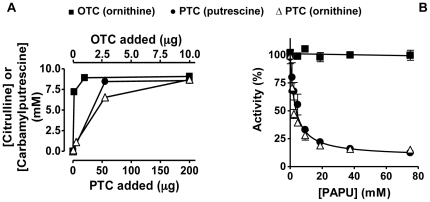
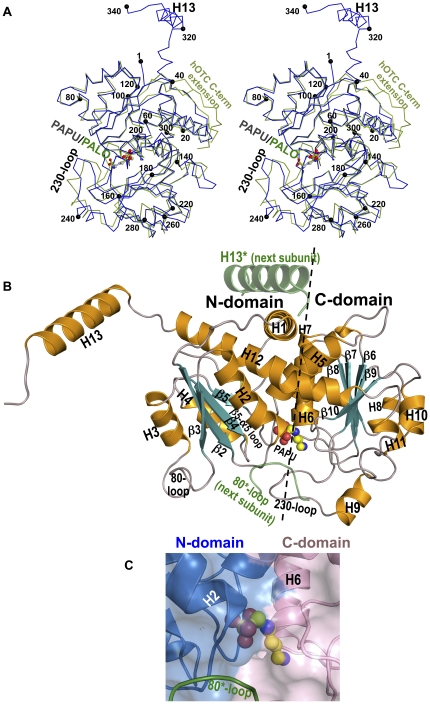
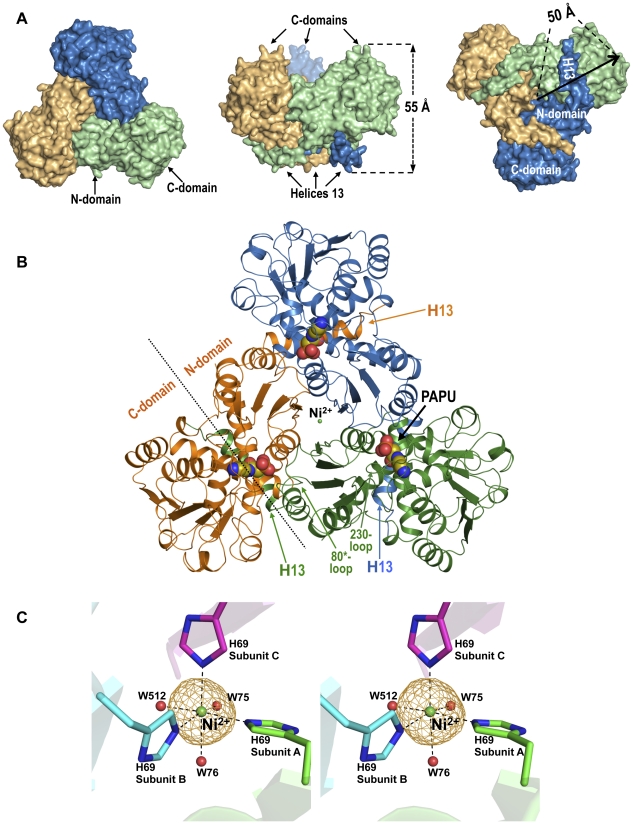
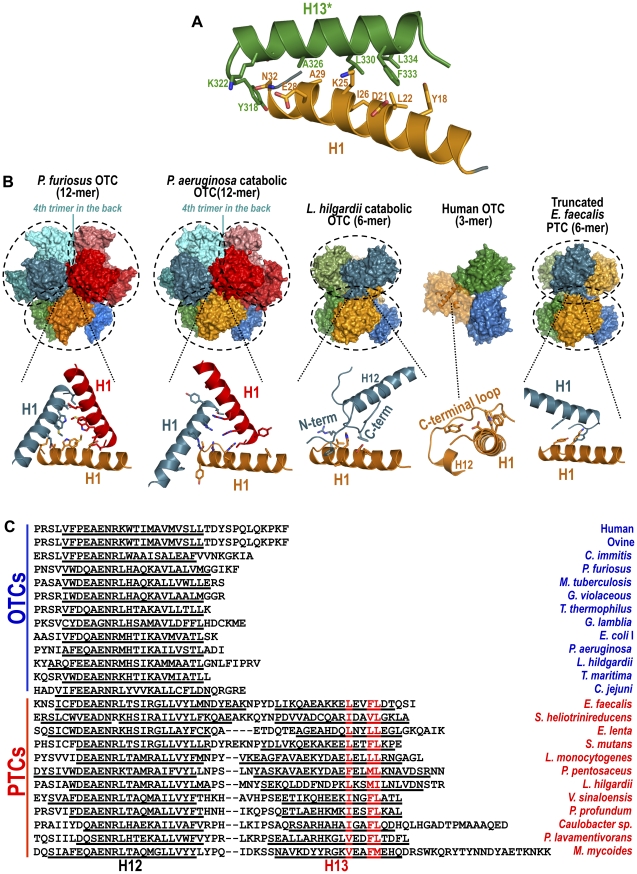
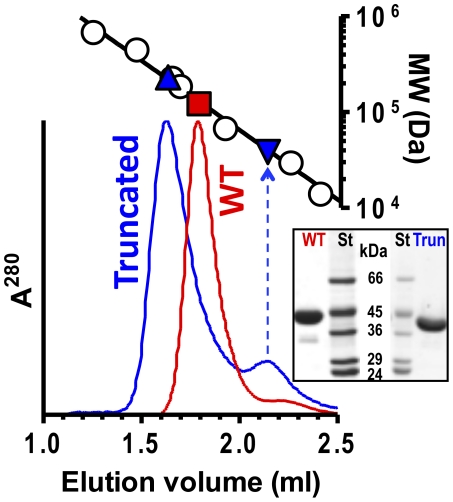
Transcarbamylases reversibly transfer a carbamyl group from carbamylphosphate (CP) to an amine. Although aspartate transcarbamylase and ornithine transcarbamylase (OTC) are well characterized, little was known about putrescine transcarbamylase (PTC), the enzyme that generates CP for ATP production in the fermentative catabolism of agmatine. We demonstrate that PTC (from Enterococcus faecalis), in addition to using putrescine, can utilize L-ornithine as a poor substrate. Crystal structures at 2.5 Å and 2.0 Å resolutions of PTC bound to its respective bisubstrate analog inhibitors for putrescine and ornithine use, N-(phosphonoacetyl)-putrescine and δ-N-(phosphonoacetyl)-L-ornithine, shed light on PTC preference for putrescine. Except for a highly prominent C-terminal helix that projects away and embraces an adjacent subunit, PTC closely resembles OTCs, suggesting recent divergence of the two enzymes. Since differences between the respective 230 and SMG loops of PTC and OTC appeared to account for the differential preference of these enzymes for putrescine and ornithine, we engineered the 230-loop of PTC to make it to resemble the SMG loop of OTCs, increasing the activity with ornithine and greatly decreasing the activity with putrescine. We also examined the role of the C-terminal helix that appears a constant and exclusive PTC trait. The enzyme lacking this helix remained active but the PTC trimer stability appeared decreased, since some of the enzyme eluted as monomers from a gel filtration column. In addition, truncated PTC tended to aggregate to hexamers, as shown both chromatographically and by X-ray crystallography. Therefore, the extra C-terminal helix plays a dual role: it stabilizes the PTC trimer and, by shielding helix 1 of an adjacent subunit, it prevents the supratrimeric oligomerizations of obscure significance observed with some OTCs. Guided by the structural data we identify signature traits that permit easy and unambiguous annotation of PTC sequences.
氨基甲酰磷酸转氨甲酰酶可将氨基甲酰基可逆地从氨基甲酰磷酸(CP)转移到胺上。尽管天冬氨酸转氨甲酰酶和鸟氨酸转氨甲酰酶(OTC)的特征得到了很好的描述,但对于腐胺转氨甲酰酶(PTC),即精氨酸发酵分解代谢中生成 CP 以产生 ATP 的酶,人们知之甚少。我们证明,PTC(来自粪肠球菌)除了可以使用腐胺作为底物外,还可以使用 L-鸟氨酸作为较差的底物。通过与各自的双底物类似物抑制剂结合的晶体结构,分辨率分别为 2.5Å 和 2.0Å,这些抑制剂分别用于腐胺和鸟氨酸的使用,即 N-(膦酰乙酰基)-腐胺和 δ-N-(膦酰乙酰基)-L-鸟氨酸,揭示了 PTC 对腐胺的偏好。除了一个非常突出的伸向并包围相邻亚基的高度突出的 C 端螺旋外,PTC 与 OTC 非常相似,这表明这两种酶是最近才分化的。由于 PTC 和 OTC 之间的各自 230 环和 SMG 环之间的差异似乎解释了这两种酶对腐胺和鸟氨酸的不同偏好,我们对 PTC 的 230 环进行了工程改造,使其类似于 OTC 的 SMG 环,从而增加了对鸟氨酸的活性,并大大降低了对腐胺的活性。我们还研究了看起来是 PTC 特有且不变的 C 端螺旋的作用。缺乏该螺旋的酶仍然具有活性,但 PTC 三聚体的稳定性似乎降低了,因为一些酶从凝胶过滤柱中洗脱为单体。此外,截短的 PTC 倾向于聚集形成六聚体,这在色谱和 X 射线晶体学中都有显示。因此,额外的 C 端螺旋起着双重作用:它稳定 PTC 三聚体,并且通过屏蔽相邻亚基的螺旋 1,它防止了与某些 OTC 观察到的具有模糊意义的超三聚体聚合。根据结构数据,我们确定了易于明确注释 PTC 序列的特征。