New York University Medical Center, New York, NY 10016, USA.
Immunity. 2012 Feb 24;36(2):166-74. doi: 10.1016/j.immuni.2012.01.011.
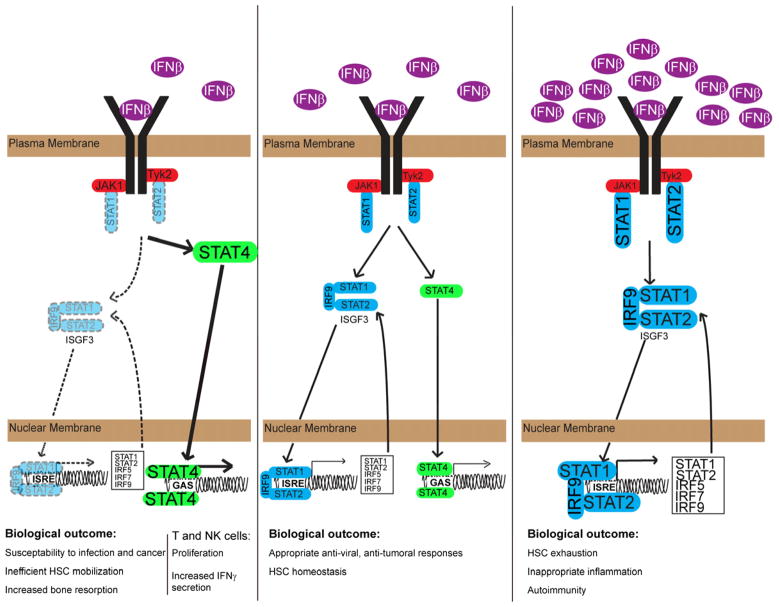
Interferons (IFNs) were discovered as cytokines induced during and protecting from viral infection. They have been documented to play essential roles in numerous physiological processes beyond antiviral and antimicrobial defense, including immunomodulation, cell cycle regulation, cell survival, and cell differentiation. Recent data have also uncovered a potentially darker side to IFN, including roles in inflammatory diseases, such as autoimmunity and diabetes. IFN can have effects in the absence of acute infection, highlighting a physiologic role for constitutive IFN. Type I IFNs are constitutively produced at vanishingly low quantities and yet exert profound effects, mediated in part through modulation of signaling intermediates required for responses to diverse cytokines. We review evidence for a yin-yang of IFN function through its role in modulating crosstalk between multiple cytokines by both feedforward and feedback regulation of common signaling intermediates and postulate a homeostatic role for IFN through tonic signaling in the absence of acute infection.
干扰素 (IFNs) 是在病毒感染过程中被发现的细胞因子,具有保护作用。除了抗病毒和抗菌防御外,它们还被证明在许多生理过程中发挥着重要作用,包括免疫调节、细胞周期调节、细胞存活和细胞分化。最近的数据还揭示了 IFN 的潜在阴暗面,包括在炎症性疾病(如自身免疫和糖尿病)中的作用。IFN 可以在没有急性感染的情况下产生影响,这突出了组成性 IFN 的生理作用。I 型 IFNs 在极低的数量下持续产生,但却发挥着深远的影响,部分通过调节对多种细胞因子反应所需的信号转导中间物来介导。我们通过共刺激信号在没有急性感染的情况下通过对共同信号转导中间物的前馈和反馈调节来调节多种细胞因子之间的串扰,以及通过 IFN 功能的阴阳来审查证据,并假设 IFN 通过在没有急性感染的情况下的紧张信号具有稳态作用。