Pawlowska Malgorzata, Pilarczyk Malgorzata, Foksinska Anna, Smukalska Ewa, Halota Waldemar
Department of Infectious Diseases and Hepatology, Collegium Medicum, n.Copernicus University, Bydgoszcz, poland.
Hepat Mon. 2011 Dec;11(12):968-74. doi: 10.5812/kowsar.1735143X.789. Epub 2011 Dec 20.
Treatment of hepatitis C virus (HCV) infection with interferon (IFN) and ribavirin (RBV) is associated with adverse events, which may affect the patient's adherence to the treatment regimen and the treatment efficacy.
The aim of this study was to assess the sustained viral response (SVR) and interdependence between the haematological characteristics (leukocyte count, platelet count, and haemoglobin levels) in patients with chronic hepatitis C (CHC) infection during treatment with IFN and RBV.
We conducted a retrospective cohort study of 170 children with CHC infection who completed treatment with IFN-α and RBV. The children were divided into 2 groups: the first group (group I, n = 119) underwent a 48-week course of treatment with recombinant IFN α-2b (Intron A) at a dosage of 3 MU 3 times a week subcutaneously and RBV at a dosage of 15 mg/kg per day orally, and the second group (group II, n = 51) was administered pegylated IFN (peg-IFN)-α-2b (PegIntron) at a dosage of 1.5 μg/kg per week subcutaneously and RBV at a dosage of 15 mg/kg per day orally for 48 weeks. The dose of IFN was not adjusted but that of ribavirin was in 2 children from group II. Hematological growth factors and erythropoietin were not used. SVR was defined as undetectable serum HCV RNA 24 weeks after the end of treatment (study week 72). Serum HCV RNA was determined by performing polymerase chain reaction, and the HCV genotypes and hematological parameters were evaluated. Serum HCV RNA levels were analysed by descriptive statistics. Means and standard deviations were calculated for values collected at the baseline, on the 12th and 48th weeks during treatment, and after 24 weeks of untreated follow-up (study week 72).
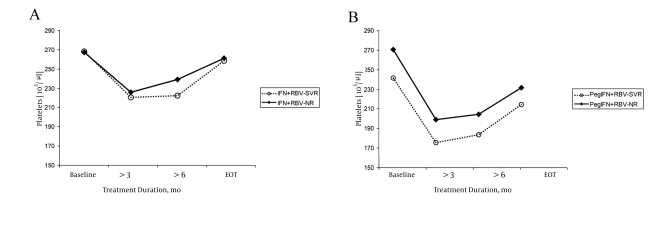
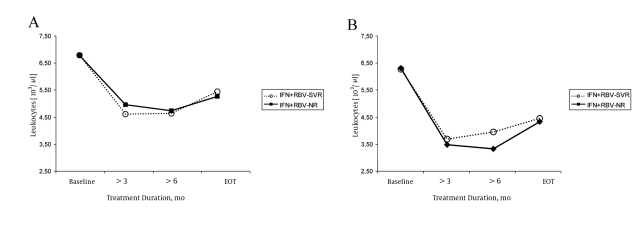
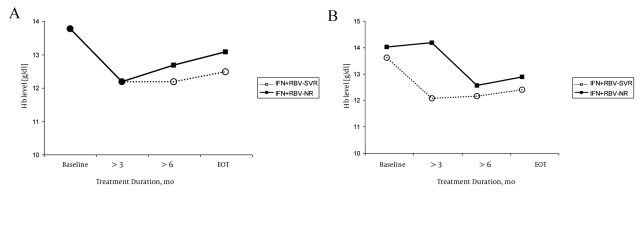
Eighty-six (50%) of the 170 patients who underwent treatment achieved SVR: 62 (51%) out of 119 children from group I and 24 (47%) out of 51 from group II. The mean serum hemoglobin levels and leukocyte and platelet counts at week 12 were significantly lower than the baseline values in both responders and non-responders from both the groups (P < 0.05). In the responders in group I, the mean levels of serum hemoglobin after 24 weeks of treatment and at the end of therapy were significantly lower than the mean levels at baseline. In the group treated with peg-IFN-α-2b and RBV (group II), the mean serum hemoglobin levels at week 12 was lower in the responders than in the non-responders (P < 0.05). The decrease in the hemoglobin levels was associated with viral response. In both the responders and non-responders from both the groups, leukocyte counts decreased during treatment, and after 12 weeks, they were more significantly lower than the baseline value. The decrease was more marked in children treated with peg-IFN-α-2b + RBV (P < 0.05). After 12 weeks of treatment, the platelet count was low in children from group II who had achieved SVR.
A mild decrease in hemoglobin levels and leukocyte and platelet counts during treatment with IFN and RBV in children with CHC infection may be factors responsible for SVR induction.
使用干扰素(IFN)和利巴韦林(RBV)治疗丙型肝炎病毒(HCV)感染会引发不良事件,这可能会影响患者对治疗方案的依从性以及治疗效果。
本研究旨在评估慢性丙型肝炎(CHC)感染患者在接受IFN和RBV治疗期间的持续病毒学应答(SVR)以及血液学特征(白细胞计数、血小板计数和血红蛋白水平)之间的相互关系。
我们对170例完成IFN-α和RBV治疗的CHC感染儿童进行了一项回顾性队列研究。这些儿童被分为两组:第一组(I组,n = 119)接受为期48周的治疗,皮下注射重组IFNα-2b(Intron A),剂量为3 MU,每周3次,口服RBV,剂量为15 mg/kg/天;第二组(II组,n = 51)皮下注射聚乙二醇化IFN(peg-IFN)-α-2b(PegIntron),剂量为1.5 μg/kg/周,口服RBV,剂量为15 mg/kg/天,持续48周。IFN剂量未调整,但II组中有2名儿童的利巴韦林剂量进行了调整。未使用血液学生长因子和促红细胞生成素。SVR定义为治疗结束后24周(研究第72周)血清HCV RNA检测不到。通过聚合酶链反应测定血清HCV RNA,并评估HCV基因型和血液学参数。采用描述性统计分析血清HCV RNA水平。计算基线、治疗第12周和48周以及未经治疗的随访24周(研究第72周)时收集的值的均值和标准差。
170例接受治疗的患者中有86例(50%)实现了SVR:I组119名儿童中有62例(51%),II组51名儿童中有24例(47%)。两组中应答者和无应答者在第12周时的平均血清血红蛋白水平、白细胞和血小板计数均显著低于基线值(P < 0.05)。在I组的应答者中,治疗24周后和治疗结束时的平均血清血红蛋白水平显著低于基线时的平均水平。在接受peg-IFN-α-2b和RBV治疗的组(II组)中,应答者在第12周时的平均血清血红蛋白水平低于无应答者(P < 0.05)。血红蛋白水平的下降与病毒应答相关。两组的应答者和无应答者在治疗期间白细胞计数均下降,12周后,白细胞计数显著低于基线值。在接受peg-IFN-α-2b + RBV治疗的儿童中下降更为明显(P < 0.05)。治疗12周后,II组中实现SVR的儿童血小板计数较低。
CHC感染儿童在接受IFN和RBV治疗期间血红蛋白水平、白细胞和血小板计数轻度下降可能是诱导SVR的因素。