Department of Cardiovascular Medicine, Kyushu University Graduate School of Medical Sciences, Fukuoka, Japan.
Clin Sci (Lond). 2012 Aug 1;123(4):241-9. doi: 10.1042/CS20110633.
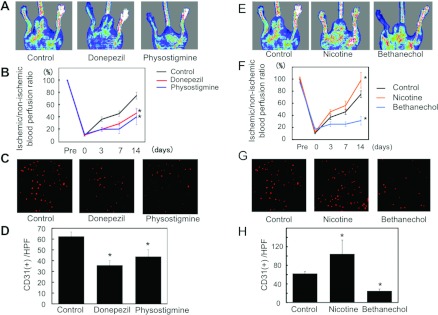
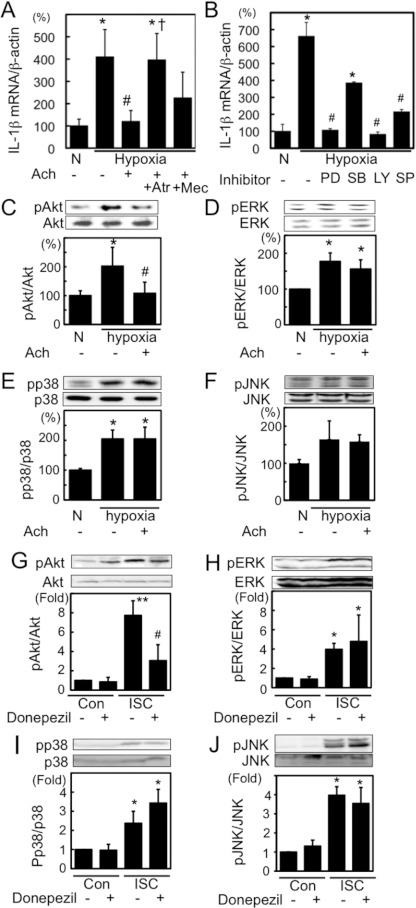
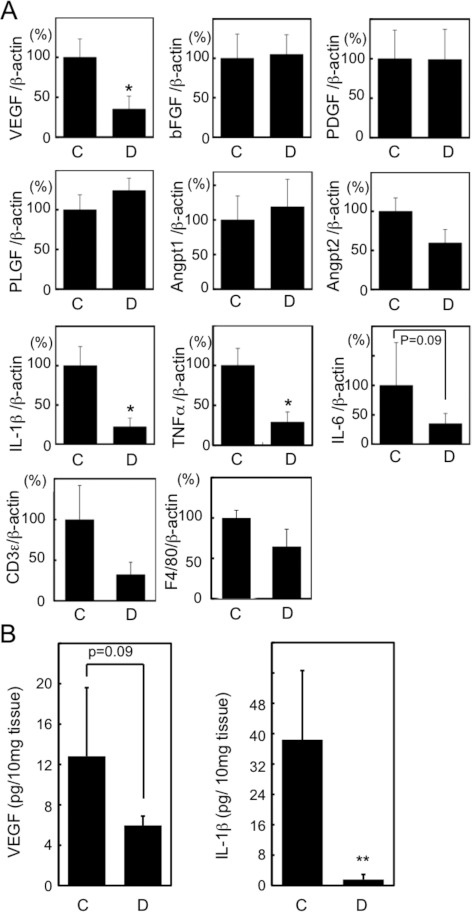
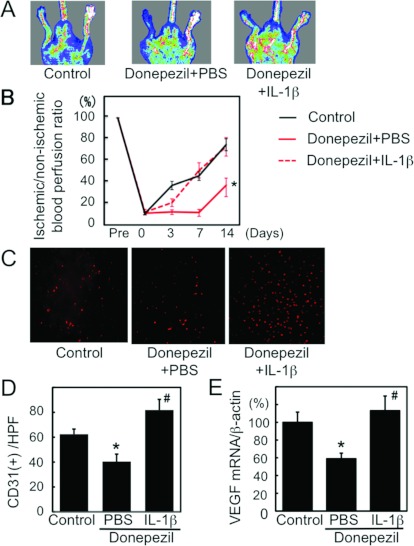
Donepezil {(RS)-2-[(1-benzyl-4-piperidyl)methyl]-5,6-dimethoxy-2,3-dihydroinden-1-one} is a reversible acetylcholinesterase inhibitor and used for treatment of patients with AD (Alzheimer's disease). Recent studies showed that treatment with donepezil reduced production of inflammatory cytokines in PBMCs (peripheral blood mononuclear cells). It was also reported that muscle-derived inflammatory cytokines play a critical role in neovascularization in a hindlimb ischaemia model. We sought to determine whether donepezil affects angiogenesis. A hindlimb ischaemia model was created by unilateral femoral artery ligation. Blood flow recovery examined by laser Doppler perfusion imaging and capillary density by immunohistochemical staining of CD31-positive cells in the ischaemic hindlimb were significantly decreased in donepezil- and physostigmine-treated mice compared with control mice after 2 weeks. Donepezil reduced expression of IL (interleukin)-1β and VEGF (vascular endothelial growth factor) in the ischaemic hindlimb. Intramuscular injections of IL-1β to the ischaemic hindlimb reversed the donepezil-induced VEGF down-regulation and the anti-angiogenic effect. Hypoxia induced IL-1β expression in C2C12 myoblast cells, which was inhibited by pre-incubation with ACh (acetylcholine) or LY294002, a PI3K (phosphoinositide 3-kinase) inhibitor. Donepezil inhibited phosphorylation of Akt [also known as PKB (protein kinase B)], a downstream kinase of PI3K, in the ischaemic hindlimb. These findings suggest that cholinergic stimulation by acetylcholinesterase inhibitors suppresses angiogenesis through inhibition of PI3K-mediated IL-1β induction, which is followed by reduction of VEGF expression. Acetylcholinesterase inhibitor may be a novel anti-angiogenic therapy.
多奈哌齐((RS)-2-[(1-苄基-4-哌啶基)甲基]-5,6-二甲氧基-2,3-二氢茚-1-酮)是一种可逆的乙酰胆碱酯酶抑制剂,用于治疗 AD(阿尔茨海默病)患者。最近的研究表明,多奈哌齐治疗可减少 PBMCs(外周血单核细胞)中炎症细胞因子的产生。据报道,肌肉来源的炎症细胞因子在下肢缺血模型中的血管新生中发挥关键作用。我们试图确定多奈哌齐是否影响血管生成。通过单侧股动脉结扎创建了下肢缺血模型。激光多普勒灌注成像检查血流恢复情况,免疫组织化学染色检测缺血后肢 CD31 阳性细胞的毛细血管密度,与对照组相比,多奈哌齐和毒扁豆碱处理的小鼠在 2 周后明显降低。多奈哌齐降低了缺血后肢中 IL(白细胞介素)-1β和 VEGF(血管内皮生长因子)的表达。向缺血后肢肌肉内注射 IL-1β可逆转多奈哌齐诱导的 VEGF 下调和抗血管生成作用。缺氧诱导 C2C12 成肌细胞中 IL-1β的表达,用 ACh(乙酰胆碱)或 PI3K(磷酸肌醇 3-激酶)抑制剂 LY294002 预先孵育可抑制其表达。多奈哌齐抑制缺血后肢中 Akt[也称为 PKB(蛋白激酶 B)]的磷酸化,Akt 是 PI3K 的下游激酶。这些发现表明,乙酰胆碱酯酶抑制剂的胆碱能刺激通过抑制 PI3K 介导的 IL-1β诱导来抑制血管生成,随后 VEGF 表达减少。乙酰胆碱酯酶抑制剂可能是一种新的抗血管生成治疗方法。