Department of Virus, Lifestyle and Genes, Danish Cancer Society Research Center, Strandboulevarden 49, DK-2100 Copenhagen, Denmark.
Gynecol Oncol. 2012 Jun;125(3):655-60. doi: 10.1016/j.ygyno.2012.02.028. Epub 2012 Feb 24.
To evaluate the prognostic significance of histologic grade on survival of ovarian serous cancer in Denmark during nearly 30 years.
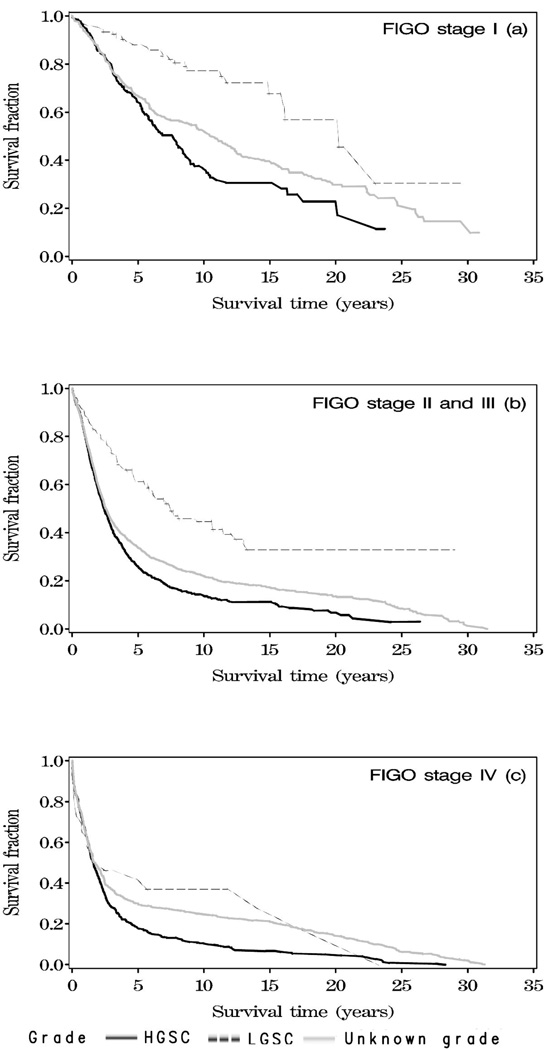
Using the nationwide Danish Pathology Data Bank, we evaluated 4317 women with ovarian serous carcinoma in 1978-2006. All pathology reports were scrutinized and tumors classified as either low-grade serous carcinomas (LGSC) or high-grade serous carcinomas (HGSC). Tumors in which the original pathology reports were described as well-differentiated were classified as LGSC, and those that were described as moderately or poorly differentiated were classified as HGSC. We obtained histologic slides from the pathology departments for women with a diagnosis of well-differentiated serous carcinoma during 1997-2006, which were then reviewed by expert gynecologic pathologists. Data were analyzed using Kaplan-Meier methods and Cox proportional hazards regression analysis with follow-up through June 2009.
Women with HGSC had a significantly increased risk of dying (HR=1.9; 95% CI: 1.6-2.3) compared with women with LGSC while adjusting for age and stage. Expert review of 171 women originally classified as well-differentiated in 1997-2006 were interpreted as LGSC in 30% of cases, whereas 12% were interpreted as HGSC and 50% as serous borderline ovarian tumors (SBT). Compared with women with confirmed LGSC, women with SBT at review had a significantly lower risk of dying (HR=0.5; 95% CI: 0.22-0.99), and women with HGSC at review had a non-significantly increased risk of dying (HR=1.6; 95% CI: 0.7-3.4).
A binary grading system is a significant predictor of survival for ovarian serous carcinoma.
评估丹麦近 30 年来组织学分级对卵巢浆液性癌生存的预后意义。
利用全国性的丹麦病理数据库,我们评估了 1978 年至 2006 年间 4317 例卵巢浆液性癌患者。所有病理报告均进行了详细审查,并将肿瘤分为低级别浆液性癌(LGSC)或高级别浆液性癌(HGSC)。原始病理报告描述为高分化的肿瘤被归类为 LGSC,而那些描述为中-低分化的肿瘤被归类为 HGSC。我们从病理学部门获得了 1997 年至 2006 年间诊断为高分化浆液性癌的女性的组织学切片,并由妇科病理专家进行了审查。使用 Kaplan-Meier 方法和 Cox 比例风险回归分析进行数据分析,并随访至 2009 年 6 月。
在调整年龄和分期后,与 LGSC 患者相比,HGSC 患者死亡风险显著增加(HR=1.9;95%CI:1.6-2.3)。对 1997 年至 2006 年间最初分类为高分化的 171 例患者进行了专家审查,其中 30%的病例被重新归类为 LGSC,12%的病例被重新归类为 HGSC,50%的病例被重新归类为浆液性交界性卵巢肿瘤(SBT)。与经确认的 LGSC 患者相比,经审查被诊断为 SBT 的患者死亡风险显著降低(HR=0.5;95%CI:0.22-0.99),而经审查被诊断为 HGSC 的患者死亡风险无显著增加(HR=1.6;95%CI:0.7-3.4)。
二元分级系统是卵巢浆液性癌生存的重要预测指标。