Schneider David F, Dobrowolsky Adrian, Shakir Irshad A, Sinacore James M, Mosier Michael J, Gamelli Richard L
Department of Surgery, Loyola University Medical Center, Maywood, Illinois 60153, USA.
J Burn Care Res. 2012 Mar-Apr;33(2):242-51. doi: 10.1097/BCR.0b013e318239cc24.
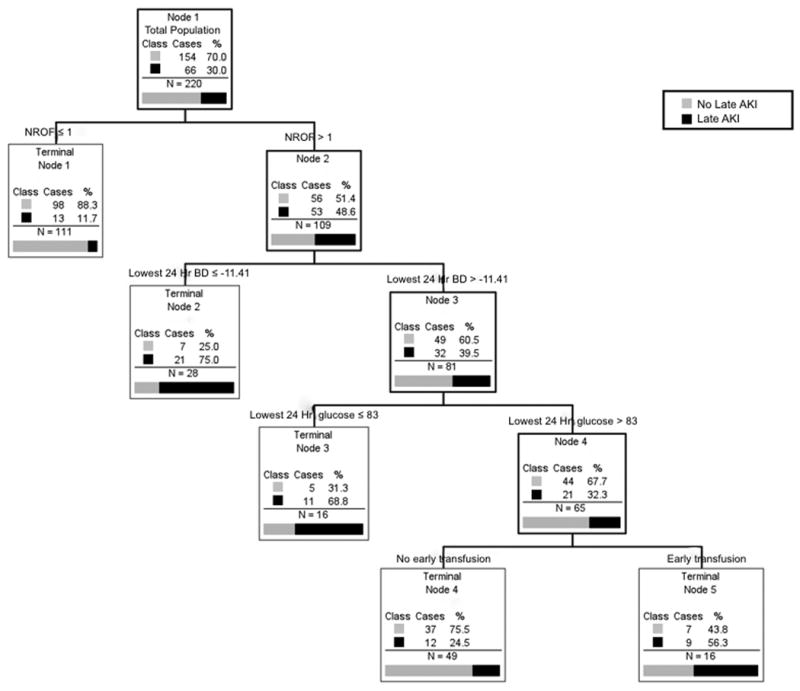
Historically, acute kidney injury (AKI) carried a deadly prognosis in the burn population. The aim of this study is to provide a modern description of AKI in the burn population and to develop a prediction tool for identifying patients at risk for late AKI. A large multi-institutional database, the Glue Grant's Trauma-Related Database, was used to characterize AKI in a cohort of critically ill burn patients. The authors defined AKI according to the RIFLE criteria and categorized AKI as early, late, or progressive. They then used Classification and Regression Tree (CART) analysis to create a decision tree with data obtained from the first 48 hours of admission to predict which subset of patients would develop late AKI. The accuracy of this decision tree was tested in a separate, single-institution cohort of burn patients who met the same criteria for entry into the Glue Grant study. Of the 220 total patients analyzed from the Glue Grant cohort, 49 (22.2%) developed early AKI, 39 (17.7%) developed late AKI, and 16 (7.2%) developed progressive AKI. The group with progressive AKI was statistically older, with more comorbidities and with the worst survival when compared with those with early or late AKI. Using CART analysis, a decision tree was developed with an overall accuracy of 80% for the development of late AKI for the Glue Grant dataset. The authors then tested this decision tree on a smaller dataset from our own institution to validate this tool and found it to be 73% accurate. AKI is common in severe burns with notable differences between early, late, and progressive AKI. In addition, CART analysis provided a predictive model for early identification of patients at highest risk for developing late AKI with proven clinical accuracy.
从历史上看,急性肾损伤(AKI)在烧伤人群中预后凶险。本研究旨在对烧伤人群中的AKI进行现代描述,并开发一种预测工具,以识别有发生晚期AKI风险的患者。利用一个大型多机构数据库——胶水基金创伤相关数据库,对一组重症烧伤患者的AKI特征进行了分析。作者根据RIFLE标准定义AKI,并将AKI分为早期、晚期或进行性。然后,他们使用分类与回归树(CART)分析,根据入院后前48小时获得的数据创建一个决策树,以预测哪些患者亚组会发生晚期AKI。在一个符合胶水基金研究入选标准的独立单机构烧伤患者队列中,对该决策树的准确性进行了测试。在从胶水基金队列分析的220例患者中,49例(22.2%)发生早期AKI,39例(17.7%)发生晚期AKI,16例(7.2%)发生进行性AKI。与早期或晚期AKI患者相比,发生进行性AKI的患者组在统计学上年龄更大,合并症更多,生存率最差。使用CART分析,为胶水基金数据集开发了一个决策树,对晚期AKI发生情况的总体预测准确率为80%。作者随后在我们自己机构的一个较小数据集中对该决策树进行测试,以验证该工具,发现其准确率为73%。AKI在严重烧伤中很常见,早期、晚期和进行性AKI之间存在显著差异。此外,CART分析提供了一个预测模型,用于早期识别发生晚期AKI风险最高的患者,其临床准确性已得到验证。