Wang Weihao, Zhu Wei, Hajagos Janos, Fochtmann Laura, Koraishy Farrukh M
Department of Applied Mathematics, Stony Brook University, Stony Brook, NY, United States of America.
Department of Biomedical Informatics, Stony Brook University, Stony Brook, NY, United States of America.
PLoS One. 2025 Jan 31;20(1):e0317558. doi: 10.1371/journal.pone.0317558. eCollection 2025.
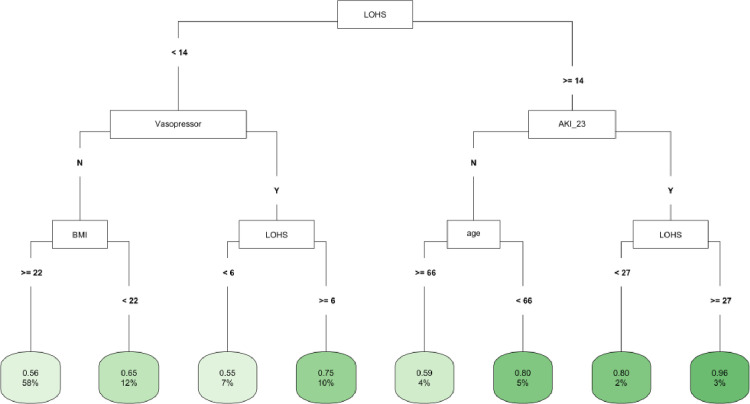
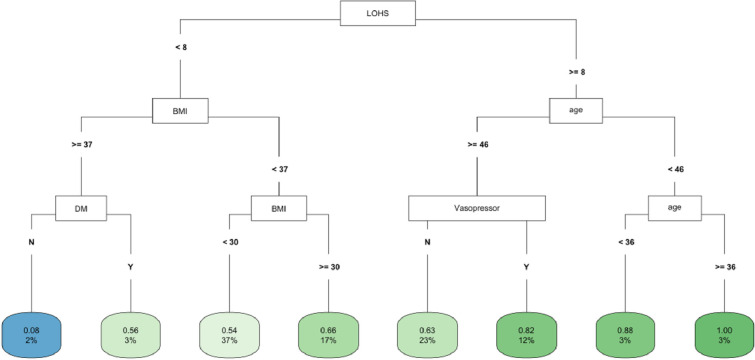
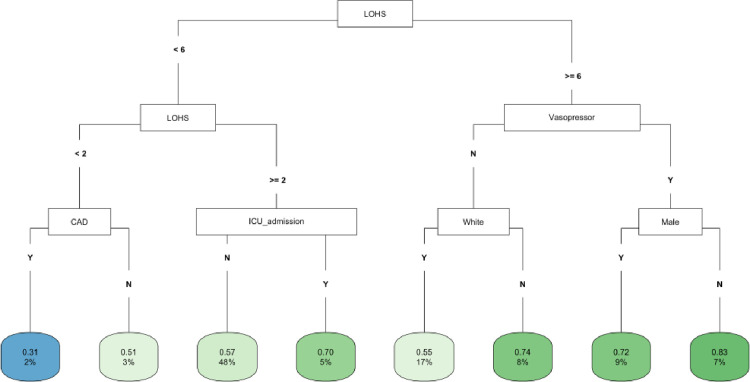
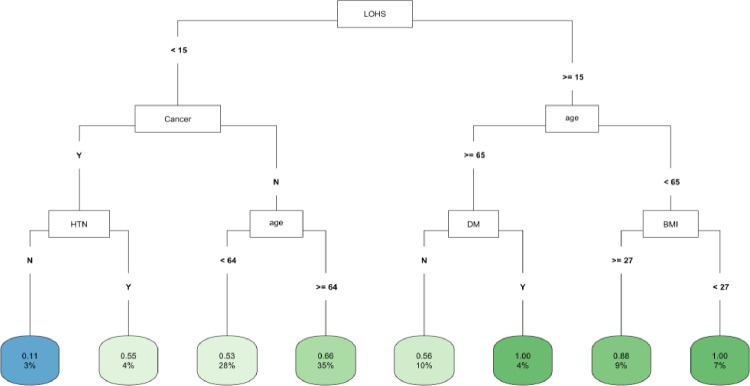
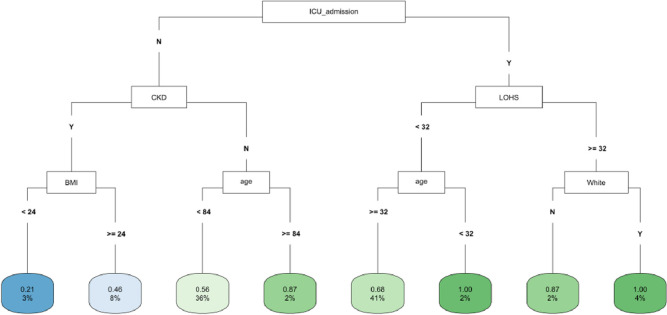
Estimated glomerular filtration rate (eGFR) decline is associated with negative health outcomes, but the use of decision tree algorithms to predict eGFR decline is underreported. Among patients hospitalized during the first year of the COVID-19 pandemic, it remains unclear which individuals are at the greatest risk of eGFR decline after discharge. We conducted a retrospective cohort study on patients hospitalized at Stony Brook University Hospital in 2020 who were followed for 36 months post discharge. Random Forest (RF) identified the top ten features associated with fast eGFR decline. Logistic regression (LR) and Classification and Regression Trees (CART) were then employed to uncover the relative importance of these top features and identify the highest risk patients. In the cohort of 1,747 hospital survivors, 61.6% experienced fast eGFR decline, which was associated with younger age, higher baseline eGFR, and acute kidney injury (AKI). Multivariate LR analysis showed that older age was associated with lower odds of fast eGFR decline whereas length of hospitalization and vasopressor use with greater odds. CART analysis identified length of hospitalization as the most important factor and that patients with AKI and hospitalization of 27 days or more were at highest risk. After grouping by ICU and COVID-19 status and propensity score matching for demographics, these risk factors of fast eGFR decline remained consistent. CART analysis can help identify patient subgroups with the highest risk of post-discharge eGFR decline. Clinicians should consider the length of hospitalization in post-discharge monitoring of kidney function.
估计肾小球滤过率(eGFR)下降与不良健康结局相关,但使用决策树算法预测eGFR下降的情况报道较少。在2019年冠状病毒病大流行第一年住院的患者中,出院后哪些个体发生eGFR下降的风险最高仍不清楚。我们对2020年在石溪大学医院住院且出院后随访36个月的患者进行了一项回顾性队列研究。随机森林(RF)确定了与eGFR快速下降相关的十大特征。然后采用逻辑回归(LR)和分类与回归树(CART)来揭示这些主要特征的相对重要性,并识别出风险最高的患者。在1747名住院幸存者队列中,61.6%的患者经历了eGFR快速下降,这与年龄较小、基线eGFR较高以及急性肾损伤(AKI)有关。多变量LR分析表明,年龄较大与eGFR快速下降的几率较低相关,而住院时间和血管升压药的使用则与较高的几率相关。CART分析确定住院时间是最重要的因素,患有AKI且住院27天或更长时间的患者风险最高。在按重症监护病房(ICU)和2019年冠状病毒病状态分组并对人口统计学进行倾向评分匹配后,这些eGFR快速下降的风险因素仍然一致。CART分析有助于识别出院后eGFR下降风险最高的患者亚组。临床医生在出院后监测肾功能时应考虑住院时间。