Morid Mohammad Amin, Sheng Olivia R Liu, Del Fiol Guilherme, Facelli Julio C, Bray Bruce E, Abdelrahman Samir
Department of Information Systems and Analytics, Leavey School of Business, Santa Clara University, Santa Clara, CA, United States.
Department of Operations and Information Systems, David Eccles School of Business, University of Utah, Salt Lake City, UT, United States.
JMIR Med Inform. 2020 Mar 17;8(3):e14272. doi: 10.2196/14272.
More than 20% of patients admitted to the intensive care unit (ICU) develop an adverse event (AE). No previous study has leveraged patients' data to extract the temporal features using their structural temporal patterns, that is, trends.
This study aimed to improve AE prediction methods by using structural temporal pattern detection that captures global and local temporal trends and to demonstrate these improvements in the detection of acute kidney injury (AKI).
Using the Medical Information Mart for Intensive Care dataset, containing 22,542 patients, we extracted both global and local trends using structural pattern detection methods to predict AKI (ie, binary prediction). Classifiers were built on 17 input features consisting of vital signs and laboratory test results using state-of-the-art models; the optimal classifier was selected for comparisons with previous approaches. The classifier with structural pattern detection features was compared with two baseline classifiers that used different temporal feature extraction approaches commonly used in the literature: (1) symbolic temporal pattern detection, which is the most common approach for multivariate time series classification; and (2) the last recorded value before the prediction point, which is the most common approach to extract temporal data in the AKI prediction literature. Moreover, we assessed the individual contribution of global and local trends. Classifier performance was measured in terms of accuracy (primary outcome), area under the curve, and F-measure. For all experiments, we employed 20-fold cross-validation.
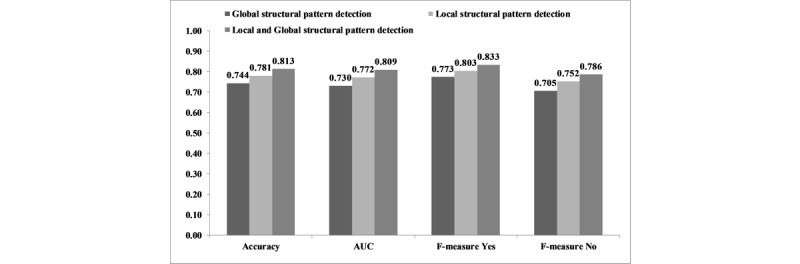
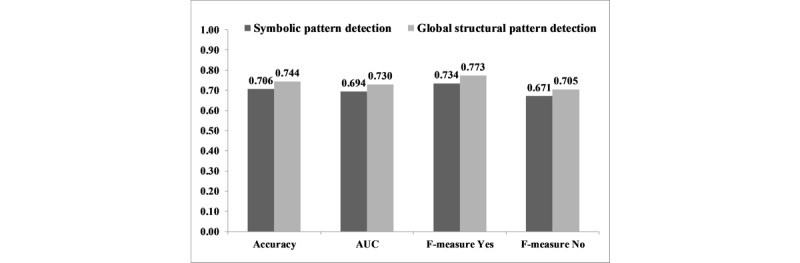
Random forest was the best classifier using structural temporal pattern detection. The accuracy of the classifier with local and global trend features was significantly higher than that while using symbolic temporal pattern detection and the last recorded value (81.3% vs 70.6% vs 58.1%; P<.001). Excluding local or global features reduced the accuracy to 74.4% or 78.1%, respectively (P<.001).
Classifiers using features obtained from structural temporal pattern detection significantly improved the prediction of AKI onset in ICU patients over two baselines based on common previous approaches. The proposed method is a generalizable approach to predict AEs in critical care that may be used to help clinicians intervene in a timely manner to prevent or mitigate AEs.
入住重症监护病房(ICU)的患者中有超过20%会发生不良事件(AE)。以前没有研究利用患者数据,通过其结构时间模式(即趋势)来提取时间特征。
本研究旨在通过使用捕获全局和局部时间趋势的结构时间模式检测来改进AE预测方法,并在急性肾损伤(AKI)检测中证明这些改进。
使用包含22542名患者的重症监护医学信息数据库(Medical Information Mart for Intensive Care)数据集,我们使用结构模式检测方法提取全局和局部趋势以预测AKI(即二元预测)。使用最先进的模型,基于由生命体征和实验室检查结果组成的17个输入特征构建分类器;选择最优分类器与以前的方法进行比较。将具有结构模式检测特征的分类器与两个基线分类器进行比较,这两个基线分类器使用文献中常用的不同时间特征提取方法:(1)符号时间模式检测,这是多变量时间序列分类最常用的方法;(2)预测点之前的最后记录值,这是AKI预测文献中提取时间数据最常用的方法。此外,我们评估了全局和局部趋势的个体贡献。分类器性能通过准确性(主要结果)、曲线下面积和F值来衡量。对于所有实验,我们采用20折交叉验证。
随机森林是使用结构时间模式检测的最佳分类器。具有局部和全局趋势特征的分类器的准确性显著高于使用符号时间模式检测和最后记录值时的准确性(81.3%对70.6%对58.1%;P<0.001)。排除局部或全局特征分别将准确性降低到74.4%或78.1%(P<0.001)。
与基于以前常用方法的两个基线相比,使用从结构时间模式检测获得的特征的分类器显著改善了ICU患者AKI发作的预测。所提出的方法是一种可推广的预测危重症中AE的方法,可用于帮助临床医生及时进行干预以预防或减轻AE。