Department of Family Medicine, Queen's University, 220 Bagot Street, Kingston, ON K7L 5E9, Canada.
BMC Complement Altern Med. 2012 Feb 28;12:11. doi: 10.1186/1472-6882-12-11.
Tobacco smoking is still a worldwide health risk. Current pharmacotherapies have at best, a success rate of no more than 50%. Auricular (ear) acupressure has been purported to be beneficial in achieving smoking cessation in some studies, while in others has been deemed insignificant. We hereby describe the protocol for a three-arm randomised controlled trial to examine the possible benefits of self-administered acupressure for smoking cessation.
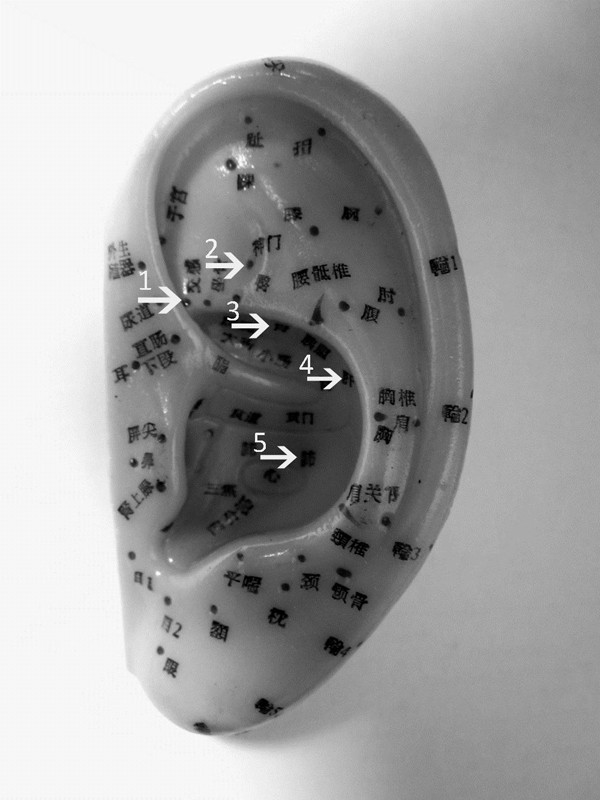
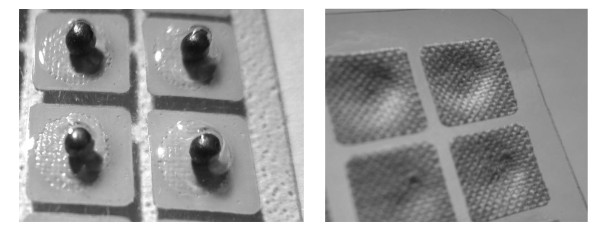
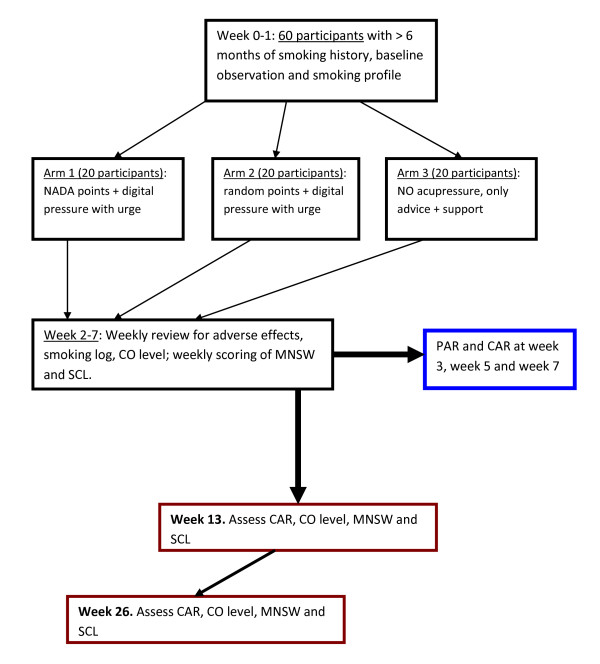
Sixty consenting participants with confirmed habit of tobacco smoking will be recruited and randomized into three arms to receive either auricular acupressure at five true acupoints (NADA protocol), auricular acupressure at five sham points, or no auricular acupressure at all. Participants having auricular acupressure will exert firm pressure to each acupoint bilaterally via the bead in the attached plasters whenever they feel the urge to smoke. The treatment phase will last for six weeks during which all participants will be assessed weekly to review their smoking log, state of abstinence, end-exhalation carbon monoxide levels and possible adverse effects including withdrawal reactions and stress levels. At any time, a successful quit date will be defined with continuous abstinence for the following consecutive 7 days. From then on, participants will be evaluated individually for continuous abstinence rate (CAR), end-exhalation carbon monoxide levels and adverse effects of stress and withdrawal at specified intervals up to 26 weeks. Expectancy of treatment will be assessed with a four-item Borkovec and Nau self-assessment credibility scale during and after intervention.
We incorporate validated outcome measures of smoking cessation into our randomised controlled trial design with the objectives to evaluate the feasibility and possible benefits of self-administered auricular acupressure as a non-invasive alternative to pharmacotherapy for smoking cessation.
ClinicalTrials.gov: NCT01389622 (registered Jul 7 2011).
吸烟仍是全球健康风险。目前的药物疗法成功率最高不超过 50%。一些研究表明,耳压(耳部)疗法对戒烟有益,而另一些研究则认为其效果不显著。我们在此描述了一项三臂随机对照试验的方案,以检验自我实施耳压疗法戒烟的可能益处。
将招募 60 名经证实有吸烟习惯的同意参与者,并将他们随机分为三组,分别接受真穴位耳压(NADA 方案)、假穴位耳压或不进行任何耳压。有耳压的参与者会在感到吸烟欲望时,通过贴片中的珠子双侧按压每个穴位。治疗阶段将持续 6 周,在此期间,所有参与者每周都将接受评估,以检查他们的吸烟记录、戒断状态、呼气末一氧化碳水平以及可能的不良反应,包括戒断反应和压力水平。在任何时候,成功的戒烟日期将被定义为连续 7 天完全戒断。从那时起,将在指定的间隔内对参与者进行个别评估,以确定连续戒断率(CAR)、呼气末一氧化碳水平以及应激和戒断的不良反应。在干预期间和之后,将使用 Borkovec 和 Nau 自我评估可信度量表评估治疗期望。
我们将经过验证的戒烟结果评估纳入随机对照试验设计中,目的是评估自我实施耳压作为药物疗法的替代疗法,用于戒烟的可行性和可能益处。
ClinicalTrials.gov:NCT01389622(2011 年 7 月 7 日注册)。