White Adrian R, Moody Russell C, Campbell John L
Primary Care Research Group, Peninsula Medical School, Universities of Exeter and Plymouth, UK.
BMC Complement Altern Med. 2007 Mar 14;7:8. doi: 10.1186/1472-6882-7-8.
Tobacco smoking is a serious risk to health: several therapies are available to assist those who wish to stop. Smokers who approach publicly funded stop-smoking clinics in the UK are currently offered nicotine replacement therapy (NRT) or bupropion, and group behaviour therapy, for which there is evidence of effectiveness. Acupuncture and acupressure are also used to help smokers, though a systematic review of the evidence of their effectiveness was inconclusive. The aim of this pilot project was to determine the feasibility of a study to test acupressure as an adjunct to one anti-smoking treatment currently offered, and to inform the design of the study.
An open randomised controlled pilot study was conducted within the six week group programme offered by the Smoking Advice Service in Plymouth, UK. All participants received the usual treatment with NRT and group behavioural therapy, and were randomised into three groups: group A with two auricular acupressure beads, group B with one bead, and group C with no additional therapy. Participants were taught to press the beads when they experienced cravings. Beads were worn in one ear for four weeks, being replaced as necessary. The main outcome measures assessed in the pilot were success at quitting (expired CO < or = 9 ppm), the dose of NRT used, and the rating of withdrawal symptoms using the Mood and Symptoms Scale.
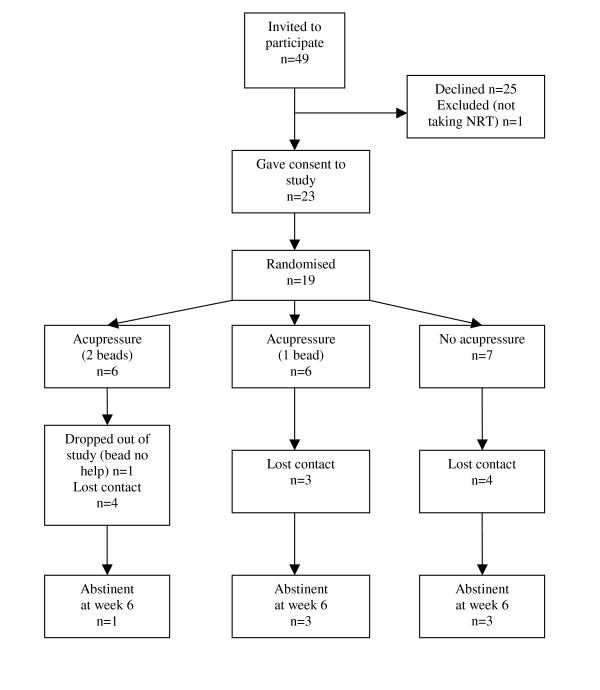
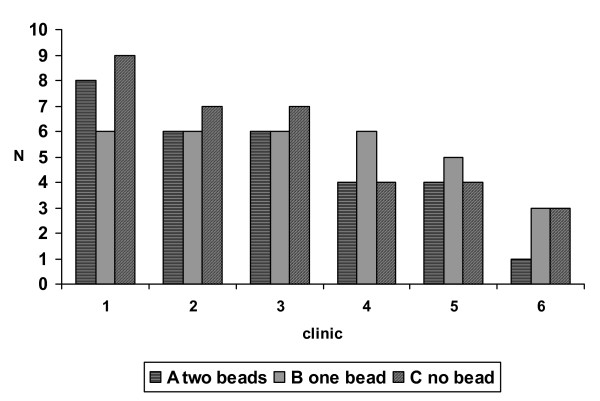
From 49 smokers attending four clinics, 24 volunteered to participate, 19 attended at least once after quitting, and seven remained to the final week. Participants who dropped out reported significantly fewer previous quit attempts, but no other significant differences. Participants reported stimulating the beads as expected during the initial days after quitting, but most soon reduced the frequency of stimulation. The discomfort caused by the beads was minor, and there were no significant side effects. There were technical problems with adhesiveness of the dressing. Reporting of NRT consumption was poor, with much missing data, but reporting of ratings of withdrawal symptom scores was nearly complete. However, these showed no significant changes or differences between groups for any week.
Any effects of acupressure on smoking withdrawal, as an adjunct to the use of NRT and behavioural intervention, are unlikely to be detectable by the methods used here and further preliminary studies are required before the hypothesis can be tested.
吸烟对健康构成严重风险:有多种疗法可帮助那些希望戒烟的人。在英国,前往公共资助的戒烟诊所的吸烟者目前可获得尼古丁替代疗法(NRT)或安非他酮,以及有证据表明有效的团体行为疗法。针灸和指压也被用于帮助吸烟者,不过对其有效性证据的系统评价尚无定论。这个试点项目的目的是确定一项研究的可行性,该研究将测试指压作为目前提供的一种戒烟治疗的辅助手段,并为研究设计提供信息。
在英国普利茅斯吸烟咨询服务机构提供的为期六周的团体项目中进行了一项开放随机对照试点研究。所有参与者都接受了NRT和团体行为疗法的常规治疗,并被随机分为三组:A组佩戴两颗耳穴指压珠,B组佩戴一颗珠,C组不接受额外治疗。参与者在有吸烟欲望时被教导按压珠子。珠子在一只耳朵上佩戴四周,必要时进行更换。试点中评估的主要结局指标包括戒烟成功(呼出一氧化碳≤9ppm)、使用的NRT剂量,以及使用情绪和症状量表对戒断症状的评分。
在四个诊所就诊的49名吸烟者中,24人自愿参与,19人在戒烟后至少就诊一次,7人坚持到最后一周。退出的参与者报告之前的戒烟尝试明显较少,但没有其他显著差异。参与者报告在戒烟后的最初几天按预期刺激珠子,但大多数人很快就减少了刺激频率。珠子引起的不适较小,且没有明显的副作用。敷料的粘性存在技术问题。NRT消耗量的报告情况不佳,有大量数据缺失,但戒断症状评分的报告几乎完整。然而,这些结果显示在任何一周内,各组之间均无显著变化或差异。
作为NRT使用和行为干预的辅助手段,指压对戒烟的任何影响不太可能通过此处使用的方法检测到,在该假设得到检验之前,需要进一步的初步研究。