Cancer Research Centre and Department of Molecular Biology, Medical Biochemistry and Pathology of Laval University, CHUQ Research Centre, Pavillon St Patrick, 9 rue McMahon, Québec, G1R 3S3 Québec, Canada.
Nucleic Acids Res. 2012 Jul;40(12):5357-67. doi: 10.1093/nar/gks198. Epub 2012 Mar 1.
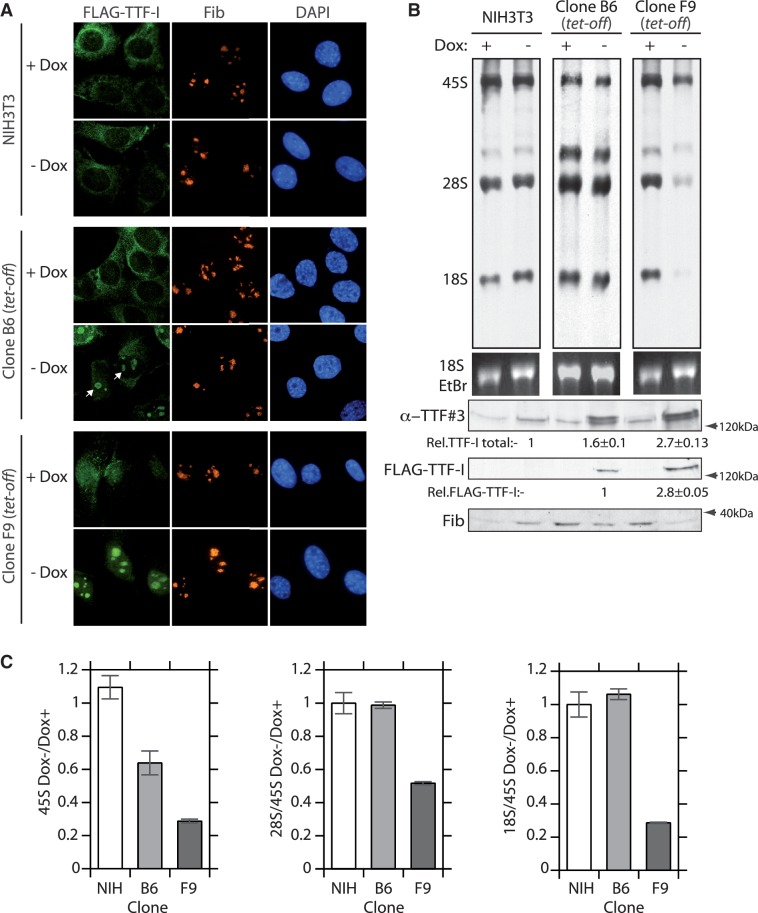
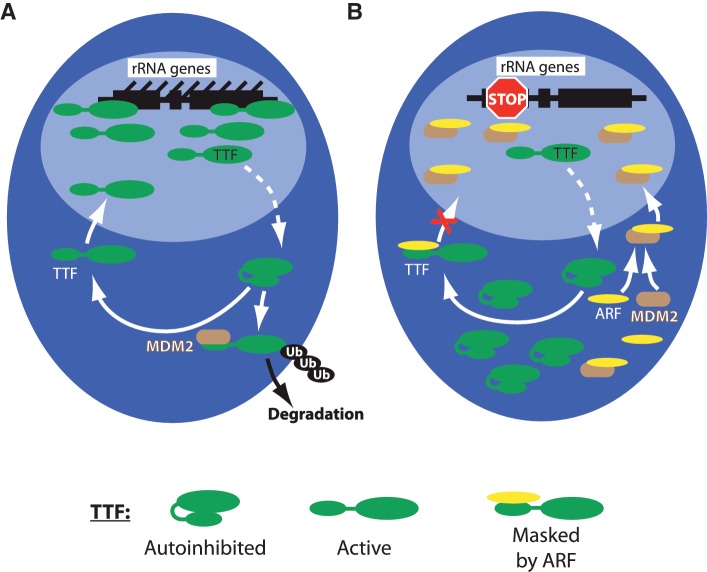
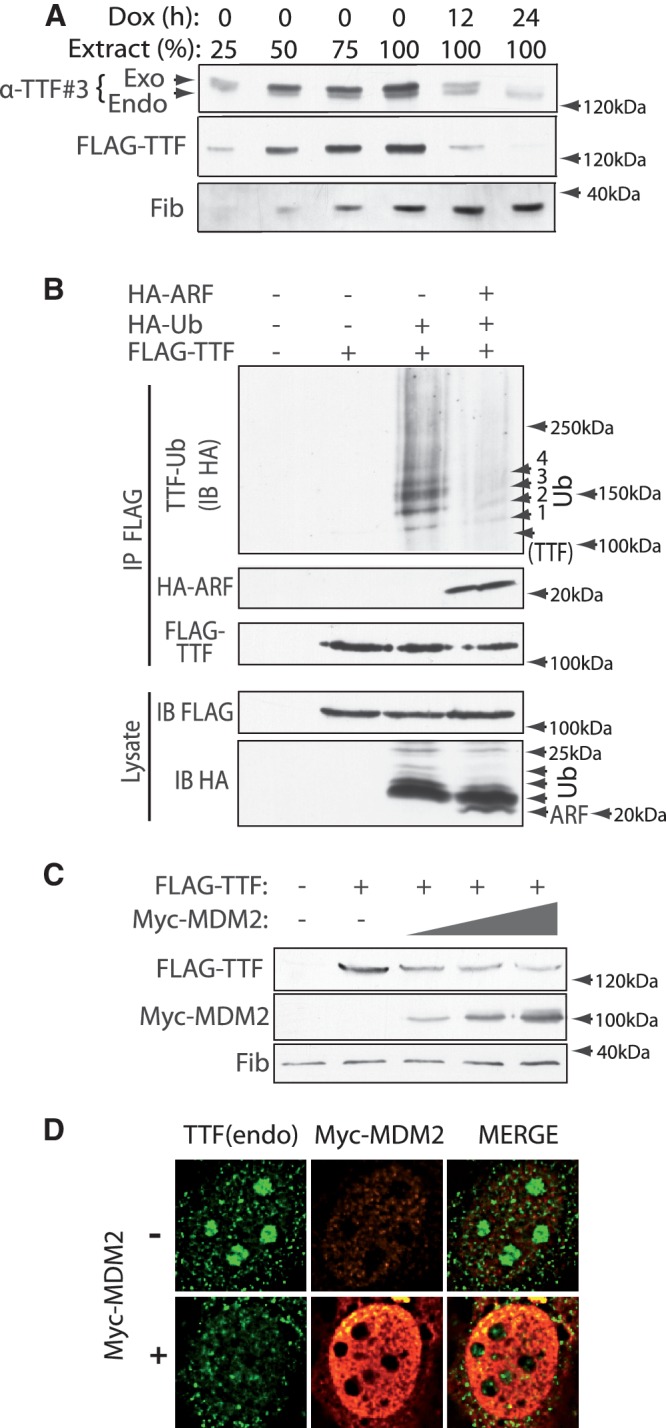
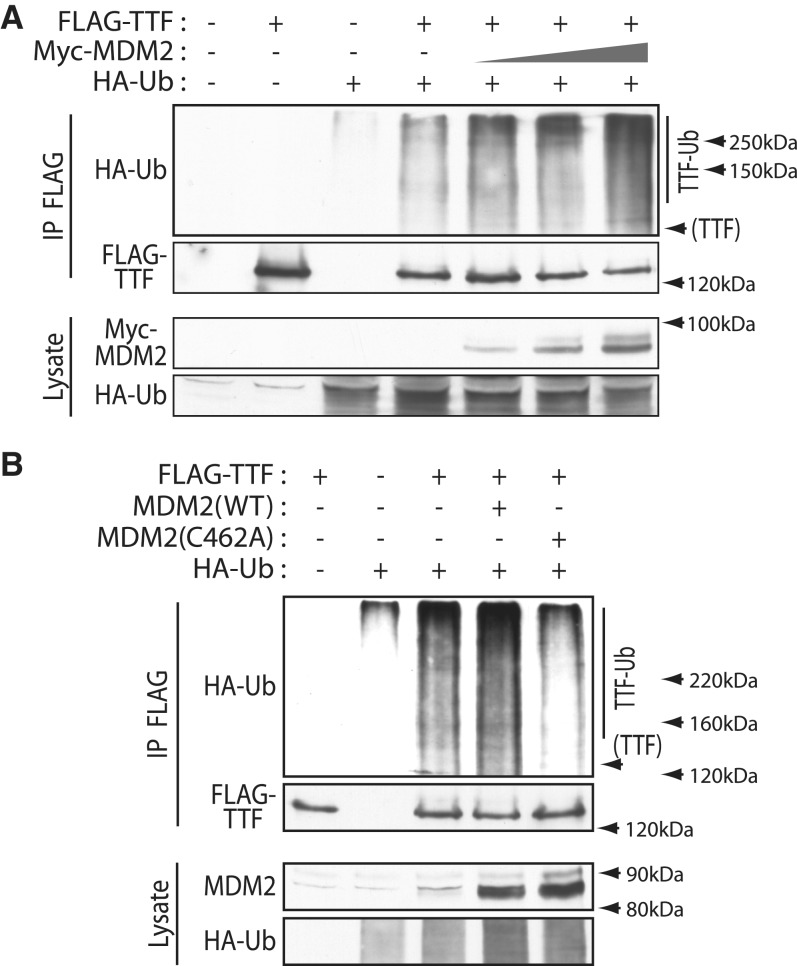
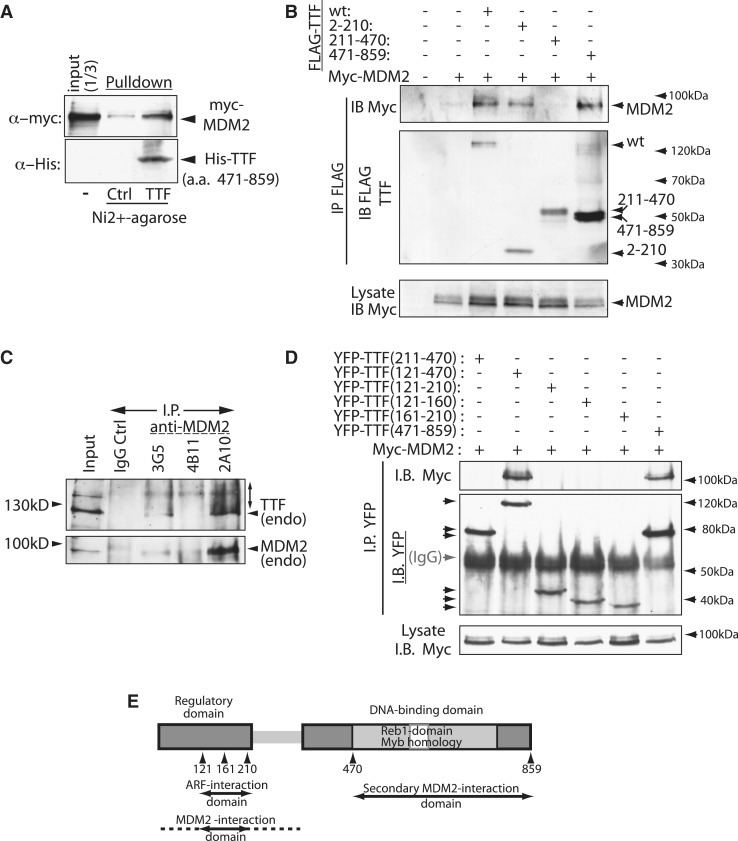
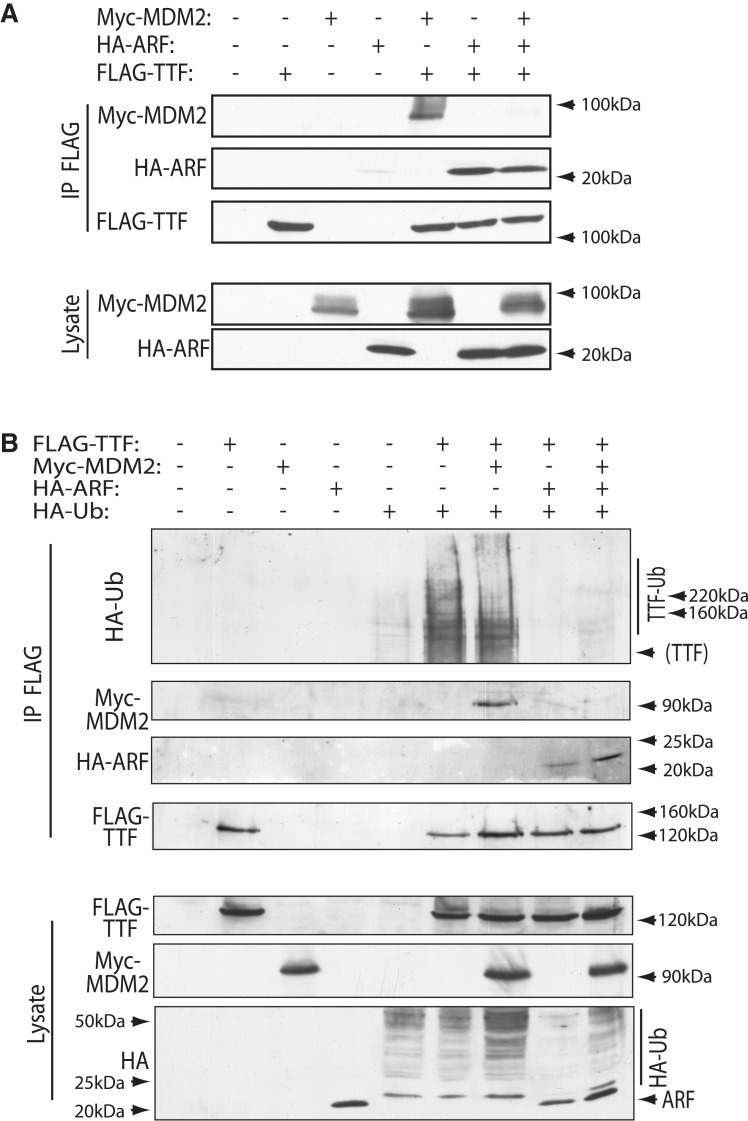
The ARF tumour suppressor stabilizes p53 by negatively regulating the E3 ubiquitin ligase MDM2 to promote cell cycle arrest and cell death. However, ARF is also able to arrest cell proliferation by inhibiting ribosome biogenesis. In greater part this is achieved by targeting the transcription termination factor I (TTF-I) for nucleolar export, leading to an inhibition of both ribosomal RNA synthesis and processing. We now show that in the absence of ARF, TTF-I is ubiquitinylated by MDM2. MDM2 interacts directly with TTF-I and regulates its cellular abundance by targeting it for degradation by the proteasome. Enhanced TTF-I levels inhibit ribosome biogenesis by suppressing ribosomal RNA synthesis and processing, strongly suggesting that exact TTF-I levels are critical for efficient ribosome biogenesis. We further show that concomitant with its ability to displace TTF-I from the nucleolus, ARF inhibits MDM2 ubiquitinylation of TTF-I by competitively binding to a site overlapping the MDM2 interaction site. Thus, both the sub-nuclear localization and the abundance of TTF-I are key regulators of ribosome biogenesis.
ARF 肿瘤抑制因子通过负向调节 E3 泛素连接酶 MDM2 稳定 p53,从而促进细胞周期停滞和细胞死亡。然而,ARF 也能够通过抑制核糖体生物发生来阻止细胞增殖。在很大程度上,这是通过将转录终止因子 I(TTF-I)靶向核仁输出来实现的,导致核糖体 RNA 合成和加工都受到抑制。我们现在表明,在没有 ARF 的情况下,TTF-I 被 MDM2 泛素化。MDM2 与 TTF-I 直接相互作用,并通过将其靶向蛋白酶体降解来调节其细胞丰度。增强的 TTF-I 水平通过抑制核糖体 RNA 合成和加工来抑制核糖体生物发生,强烈表明准确的 TTF-I 水平对于有效的核糖体生物发生至关重要。我们进一步表明,与 ARF 从核仁中置换 TTF-I 的能力一致,ARF 通过与重叠 MDM2 相互作用位点的位点竞争结合来抑制 MDM2 对 TTF-I 的泛素化。因此,TTF-I 的亚核定位和丰度都是核糖体生物发生的关键调节剂。