King's Health Partners Academic Health Sciences Centre, London, United Kingdom.
PLoS One. 2012;7(2):e31763. doi: 10.1371/journal.pone.0031763. Epub 2012 Feb 22.
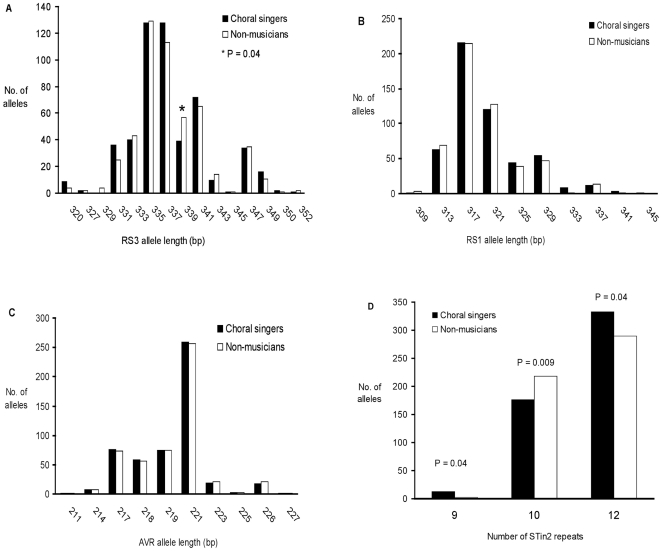
Amateur choral singing is a common pastime and worthy of study, possibly conferring benefits to health and social behaviour. Participants might be expected to possess musical ability and share some behavioural characteristics. Polymorphisms in genes concerned with serotonergic neurotransmission are associated with both behaviour and musical aptitude. Those investigated previously include the variable number tandem repeats RS1, RS3 and AVR in the AVPR1A (arginine vasopressin receptor 1a) gene and STin2 in the SLC6A4 (solute carrier family 6 [neurotransmitter transporter, serotonin], member 4) gene, as well as the SLC6A4 promoter region polymorphism, 5-HTTLPR. We conducted a genetic association study on 523 participants to establish whether alleles at these polymorphisms occur more commonly in choral singers than in those not regularly participating in organised musical activity (non-musicians). We also analysed tagging single nucleotide polymorphisms (SNPs) for AVPR1A and SLC6A4 to determine whether other variants in these genes were associated with singer/non-musician status. At the STin2 polymorphism, overall association with singer/non-musician status was evident at P = 0.006. The 9-repeat (P = 0.04) and 12-repeat (P = 0.04) alleles were more common in singers and the 10-repeat allele less so (P = 0.009). Odds ratios were 0.73 (95% CI 0.57-0.94) for the 10-repeat allele and 2.47 (95% CI 0.88-6.94) for the rarer 9-repeat allele. No overall association was detected at P<0.05 between any other polymorphism and singer/non-musician status. Our null findings with respect to RS3, RS1 and AVR, polymorphisms associated with musical ability by other authors, suggest that choir membership may depend partly on factors other than musical ability. In a related musical project involving one participating choir, a new 40-part unaccompanied choral work, "Allele", was composed and broadcast on national radio. In the piece, each singer's part incorporated their personal RS3 genotype.
业余合唱是一种常见的消遣方式,值得研究,可能对健康和社交行为有益。参与者可能需要具备音乐能力并具有一些共同的行为特征。与 5-羟色胺能神经传递有关的基因多态性与行为和音乐能力都有关。之前研究过的包括 AVPR1A(精氨酸加压素受体 1a)基因中的可变数串联重复 RS1、RS3 和 AVR 以及 SLC6A4(溶质载体家族 6 [神经递质转运体,血清素],成员 4)基因中的 STin2 以及 SLC6A4 启动子区域多态性 5-HTTLPR。我们对 523 名参与者进行了一项遗传关联研究,以确定这些多态性的等位基因是否更常见于合唱歌手而不是那些不经常参加有组织音乐活动的人(非音乐家)。我们还分析了 AVPR1A 和 SLC6A4 的标记单核苷酸多态性(SNP),以确定这些基因中的其他变体是否与歌手/非音乐家状态相关。在 STin2 多态性中,总体上与歌手/非音乐家状态的关联在 P = 0.006 时明显。9 重复(P = 0.04)和 12 重复(P = 0.04)等位基因在歌手中更为常见,而 10 重复等位基因则较少(P = 0.009)。10 重复等位基因的优势比为 0.73(95%CI 0.57-0.94),而较少见的 9 重复等位基因的优势比为 2.47(95%CI 0.88-6.94)。在 P<0.05 时,没有其他多态性与歌手/非音乐家状态之间存在总体关联。我们对其他作者认为与音乐能力相关的 RS3、RS1 和 AVR 多态性的无效发现表明,合唱团成员可能部分取决于音乐能力以外的因素。在一个涉及一个合唱团的相关音乐项目中,创作并在国家广播电台播出了一首新的 40 声部无伴奏合唱作品“Allele”。在这首作品中,每个歌手的部分都融入了他们个人的 RS3 基因型。