Unitat de Biofísica i Bioenginyeria, Facultat de Medicina, Universitat de Barcelona, Barcelona, Spain.
PLoS One. 2012;7(2):e32261. doi: 10.1371/journal.pone.0032261. Epub 2012 Feb 23.
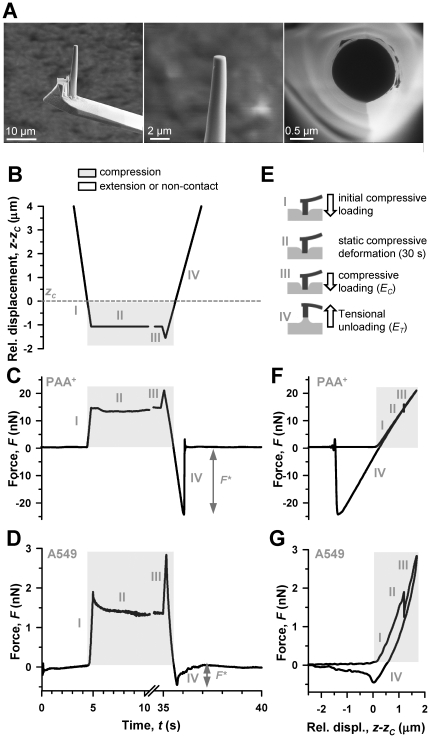
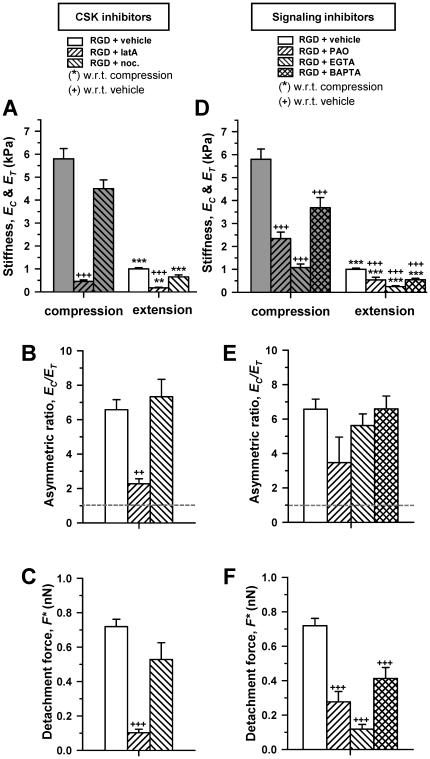
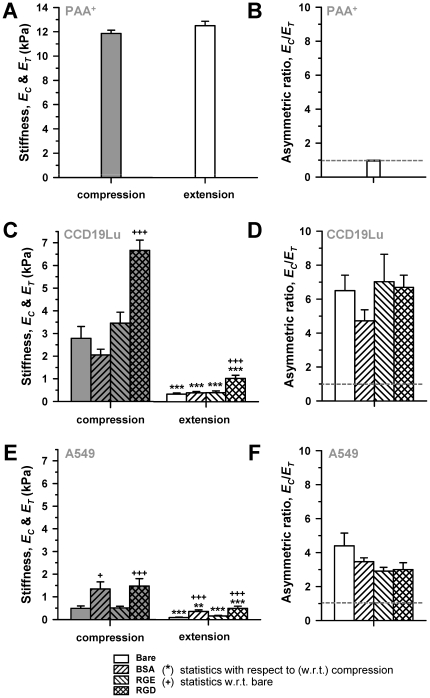
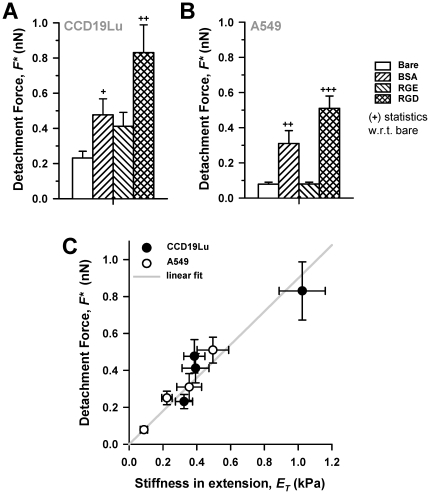
Cells from lung and other tissues are subjected to forces of opposing directions that are largely transmitted through integrin-mediated adhesions. How cells respond to force bidirectionality remains ill defined. To address this question, we nanofabricated flat-ended cylindrical Atomic Force Microscopy (AFM) tips with ~1 µm(2) cross-section area. Tips were uncoated or coated with either integrin-specific (RGD) or non-specific (RGE/BSA) molecules, brought into contact with lung epithelial cells or fibroblasts for 30 s to form focal adhesion precursors, and used to probe cell resistance to deformation in compression and extension. We found that cell resistance to compression was globally higher than to extension regardless of the tip coating. In contrast, both tip-cell adhesion strength and resistance to compression and extension were the highest when probed at integrin-specific adhesions. These integrin-specific mechanoresponses required an intact actin cytoskeleton, and were dependent on tyrosine phosphatases and Ca(2+) signaling. Cell asymmetric mechanoresponse to compression and extension remained after 5 minutes of tip-cell adhesion, revealing that asymmetric resistance to force directionality is an intrinsic property of lung cells, as in most soft tissues. Our findings provide new insights on how lung cells probe the mechanochemical properties of the microenvironment, an important process for migration, repair and tissue homeostasis.
来自肺和其他组织的细胞受到相反方向的力的作用,这些力主要通过整合素介导的黏附传递。细胞如何响应力的双向性仍不清楚。为了解决这个问题,我们使用原子力显微镜(AFM)制造了具有约 1 µm² 截面面积的平头圆柱形纳米级尖端。尖端未涂层或涂有整合素特异性(RGD)或非特异性(RGE/BSA)分子,与肺上皮细胞或成纤维细胞接触 30 秒以形成焦点黏附前体,然后用于探测细胞在压缩和拉伸过程中的变形阻力。我们发现,无论尖端涂层如何,细胞对压缩的阻力普遍高于对拉伸的阻力。相比之下,当在整合素特异性黏附中探测时,尖端-细胞黏附强度以及对压缩和拉伸的阻力最高。这些整合素特异性机械响应需要完整的肌动球蛋白细胞骨架,并且依赖于酪氨酸磷酸酶和 Ca²⁺信号。在尖端-细胞黏附 5 分钟后,细胞对压缩和拉伸的不对称机械响应仍然存在,这表明细胞对力方向的不对称阻力是肺细胞的固有特性,就像在大多数软组织中一样。我们的发现提供了新的见解,说明肺细胞如何探测微环境的机械化学特性,这是迁移、修复和组织动态平衡的重要过程。