
p300 和 PCAF 在 microRNA 200c/141 转录和上皮特性调控中的合作。
Cooperation of p300 and PCAF in the control of microRNA 200c/141 transcription and epithelial characteristics.
机构信息
Thomas E Starzl Transplantation Institute, University of Pittsburgh Medical Center, Pittsburgh, Pennsylvania, United States of America.
出版信息
PLoS One. 2012;7(2):e32449. doi: 10.1371/journal.pone.0032449. Epub 2012 Feb 22.
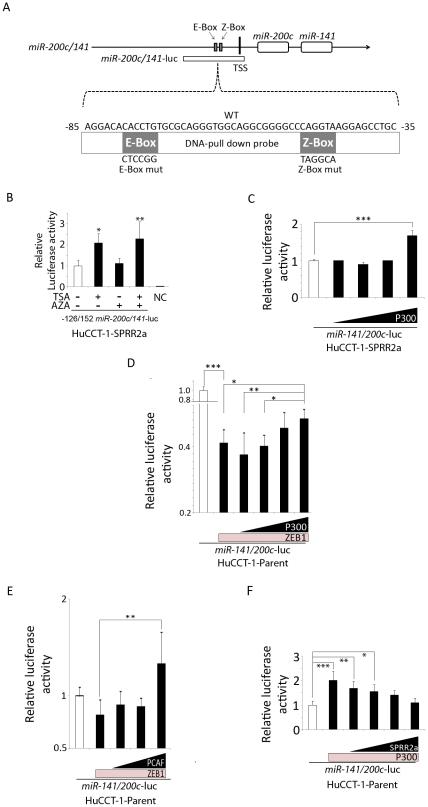
Epithelial to mesenchymal transition (EMT) not only occurs during embryonic development and in response to injury, but is an important element in cancer progression. EMT and its reverse process, mesenchymal to epithelial transition (MET) is controlled by a network of transcriptional regulators and can be influenced by posttranscriptional and posttranslational modifications. EMT/MET involves many effectors that can activate and repress these transitions, often yielding a spectrum of cell phenotypes. Recent studies have shown that the miR-200 family and the transcriptional suppressor ZEB1 are important contributors to EMT. Our previous data showed that forced expression of SPRR2a was a powerful inducer of EMT and supports the findings by others that SPRR gene members are highly upregulated during epithelial remodeling in a variety of organs. Here, using SPRR2a cells, we characterize the role of acetyltransferases on the microRNA-200c/141 promoter and their effect on the epithelial/mesenchymal status of the cells. We show that the deacetylase inhibitor TSA as well as P300 and PCAF can cause a shift towards epithelial characteristics in HUCCT-1-SPRR2a cells. We demonstrate that both P300 and PCAF act as cofactors for ZEB1, forming a P300/PCAF/ZEB1 complex on the miR200c/141 promoter. This binding results in lysine acetylation of ZEB1 and a release of ZEB1 suppression on miR-200c/141 transcription. Furthermore, disruption of P300 and PCAF interactions dramatically down regulates miR-200c/141 promoter activity, indicating a PCAF/P300 cooperative function in regulating the transcriptional suppressor/activator role of ZEB1. These data demonstrate a novel mechanism of miRNA regulation in mediating cell phenotype.
上皮-间充质转化(EMT)不仅发生在胚胎发育过程中,而且是对损伤的反应,还是癌症进展的重要因素。EMT 及其逆转过程,间充质-上皮转化(MET)受到转录调控因子网络的控制,并可受到转录后和翻译后修饰的影响。EMT/MET 涉及许多效应物,可激活和抑制这些转化,通常产生一系列细胞表型。最近的研究表明,miR-200 家族和转录抑制因子 ZEB1 是 EMT 的重要贡献者。我们之前的数据表明,SPRRA 表达的强制表达是 EMT 的有力诱导物,并支持其他人的发现,即 SPRR 基因成员在各种器官上皮重塑过程中高度上调。在这里,我们使用 SPRR2a 细胞,研究了乙酰转移酶在 microRNA-200c/141 启动子上的作用及其对细胞上皮/间充质状态的影响。我们表明,去乙酰化酶抑制剂 TSA 以及 P300 和 PCAF 可使 HUCCT-1-SPRR2a 细胞向上皮特征转变。我们证明,P300 和 PCAF 均可作为 ZEB1 的辅因子,在 miR200c/141 启动子上形成 P300/PCAF/ZEB1 复合物。这种结合导致 ZEB1 的赖氨酸乙酰化,并释放 ZEB1 对 miR-200c/141 转录的抑制。此外,破坏 P300 和 PCAF 相互作用会显著下调 miR-200c/141 启动子活性,表明 PCAF/P300 具有协同功能,可调节 ZEB1 的转录抑制/激活作用。这些数据表明了一种新的 miRNA 调节机制,可介导细胞表型。




 Zotero 插件