Pharmacy College, Universidade Federal do Rio de Janeiro, Ilha do Fundão, Rio de Janeiro, Brazil.
Food Nutr Res. 2012;56. doi: 10.3402/fnr.v56i0.15618. Epub 2012 Feb 29.
According to the World Health Organization (WHO), iron, iodine, and Vitamin A deficiencies are the most common forms of malnutrition, leading to severe public health consequences. The importance of iron and zinc in human nutrition and the number of children found to be deficient in these nutrients make further studies on retention in cooked grains and cooked bean broth important.
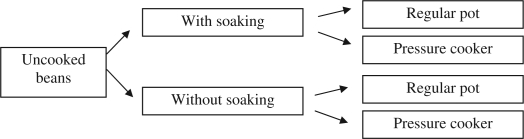
This work aimed to evaluate iron and zinc retention in six common bean (Phaseolus vulgaris L.) cultivars under the following conditions: raw beans, regular pot cooking, pressure cooking, with and without previous water soaking, and broth.
Determination of iron and zinc content in the raw, cooked bean grains and broth samples was carried out by Inductively Coupled Plasma (ICP) Optical Emission Spectrometry (Spectro Analytical Instrument - Spectroflame P). All experiments and analyses were carried out in triplicate.
Overall, regardless of the cooking method, with or without previous water soaking, the highest zinc concentration was found in the cooked bean grains. However, pressure cooking and previous water soaking diminished iron retention in the cooked grains, while increasing it in the bean broth.
The common bean was confirmed to be an excellent source of iron and zinc for human consumption, and it was suggested that beans should be consumed in a combined form, i.e. grain with bean broth.
根据世界卫生组织(WHO)的说法,铁、碘和维生素 A 缺乏是最常见的营养不良形式,导致严重的公共卫生后果。铁和锌在人类营养中的重要性以及发现儿童缺乏这些营养素的数量使得进一步研究在煮熟的谷物和煮熟的豆汤中的保留情况变得尤为重要。
本工作旨在评估六种普通豆(菜豆 Phaseolus vulgaris L.)品种在以下条件下的铁和锌保留情况:生豆、常规锅煮、高压锅煮、有无预先浸泡在水中以及汤。
采用电感耦合等离子体(ICP)光学发射光谱法(Spectro Analytical Instrument-Spectroflame P)对生豆粒、熟豆粒和汤样中铁和锌的含量进行测定。所有实验和分析均重复三次进行。
总体而言,无论烹饪方法如何,有无预先浸泡在水中,锌的浓度在煮熟的豆粒中最高。然而,高压锅煮和预先浸泡在水中会降低熟豆粒中铁的保留率,同时增加豆汤中的铁含量。
普通豆被证实是人类食用铁和锌的极好来源,建议将豆粒与豆汤一起食用。