State Key Laboratory for Liver Research, Department of Surgery, LKS Faculty of Medicine, The University of Hong Kong, Hong Kong Special Administrative Regions.
PLoS One. 2012;7(2):e31655. doi: 10.1371/journal.pone.0031655. Epub 2012 Feb 28.
Hepatocellular carcinoma (HCC) is highly malignant and metastatic. Currently, there is no effective chemotherapy for patients with advanced HCC leading to an urgent need to seek for novel therapeutic options. We aimed to investigate the effect of a garlic derivative, S-allylcysteine (SAC), on the proliferation and metastasis of HCC.
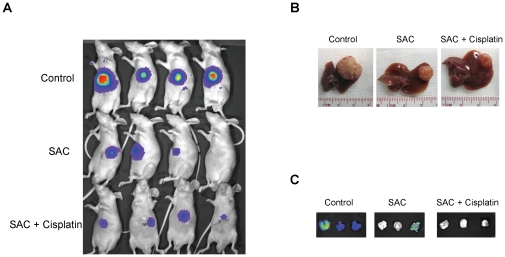
METHODOLOGY/PRINCIPAL FINDINGS: A series of in vitro experiments including MTT, colony-forming, wound-healing, invasion, apoptosis and cell cycle assays were performed to examine the anti-proliferative and anti-metastatic effects of SAC on a metastatic HCC cell line MHCC97L. The therapeutic values of SAC single and combined with cisplatin treatments were examined in an in vivo orthotopic xenograft liver tumor model. The result showed that the proliferation rate and colony-forming abilities of MHCC97L cells were suppressed by SAC together with significant suppression of the expressions of proliferation markers, Ki-67 and proliferating cell nuclear antigen (PCNA). Moreover, SAC hindered the migration and invasion of MHCC97L cells corresponding with up-regulation of E-cadherin and down-regulation of VEGF. Furthermore, SAC significantly induced apoptosis and necrosis of MHCC97L cells through suppressing Bcl-xL and Bcl-2 as well as activating caspase-3 and caspase-9. In addition, SAC could significantly induce the S phase arrest of MHCC97L cells together with down-regulation of cdc25c, cdc2 and cyclin B1. In vivo xenograft liver tumor model demonstrated that SAC single or combined with cisplatin treatment inhibited the progression and metastasis of HCC tumor.
CONCLUSIONS/SIGNIFICANCE: Our data demonstrate the anti-proliferative and anti-metastatic effects of SAC on HCC cells and suggest that SAC may be a potential therapeutic agent for the treatment of HCC patients.
肝细胞癌(HCC)恶性程度高,转移性强。目前,晚期 HCC 患者尚无有效的化疗方法,因此迫切需要寻求新的治疗选择。本研究旨在探讨大蒜衍生化合物 S-烯丙基半胱氨酸(SAC)对 HCC 增殖和转移的影响。
方法/主要发现:通过 MTT、集落形成、划痕愈合、侵袭、凋亡和细胞周期分析等一系列体外实验,研究 SAC 对转移性 HCC 细胞系 MHCC97L 的抗增殖和抗转移作用。在体内原位异种移植肝肿瘤模型中,研究了 SAC 单药及与顺铂联合治疗的疗效。结果表明,SAC 可抑制 MHCC97L 细胞的增殖率和集落形成能力,并显著抑制增殖标志物 Ki-67 和增殖细胞核抗原(PCNA)的表达。此外,SAC 可抑制 MHCC97L 细胞的迁移和侵袭,同时上调 E-钙黏蛋白和下调 VEGF。此外,SAC 通过抑制 Bcl-xL 和 Bcl-2 以及激活 caspase-3 和 caspase-9,显著诱导 MHCC97L 细胞凋亡和坏死。此外,SAC 可显著诱导 MHCC97L 细胞 S 期阻滞,下调 cdc25c、cdc2 和 cyclin B1。体内异种移植肝肿瘤模型表明,SAC 单药或与顺铂联合治疗可抑制 HCC 肿瘤的进展和转移。
本研究数据表明 SAC 对 HCC 细胞具有抗增殖和抗转移作用,提示 SAC 可能是治疗 HCC 患者的潜在治疗药物。