Department of Neuroscience and Imaging, University "G, d'Annunzio", Via dei Vestini 31, 66100 Chieti, Italy.
BMC Neurol. 2012 Mar 5;12:7. doi: 10.1186/1471-2377-12-7.
Achieving good adherence to self-injected treatments for multiple sclerosis can be difficult. Injection devices may help to overcome some of the injection-related barriers to adherence that can be experienced by patients. We sought to assess short-term adherence to, and tolerability of, interferon (IFN) β-1a administered via electronic autoinjection device in patients with relapsing-remitting multiple sclerosis (RRMS).
BRIDGE (RebiSmart to self-inject Rebif serum-free formulation in a multidose cartridge) was a 12-week, multicentre, open-label, single-arm, observational, Phase IV study in which patients self-administered IFN β-1a (titrated to 44 μg), subcutaneously (sc), three times weekly, via electronic autoinjection device. Patients were assessed at baseline and 4-weekly intervals to Week 12 or early termination (ET) for: physical examinations; diary card completion (baseline, Weeks 4, 8 only); neurological examinations (baseline, Week 12/ET only); MS Treatment Concern Questionnaire (MSTCQ; Weeks 4, 8, 12 only); Convenience Questionnaire (Week 12 only); Hospital Anxiety and Depression Scale (HADS); and Paced Auditory Serial Addition Task (PASAT; baseline only). Adherence was defined as administration of ≥ 80% of scheduled injections, recorded by the autoinjection device.
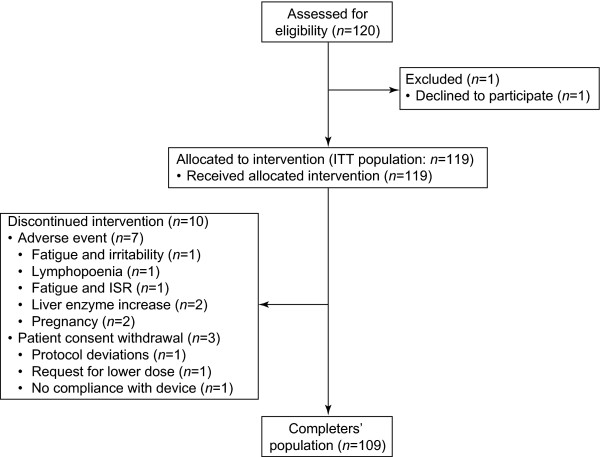
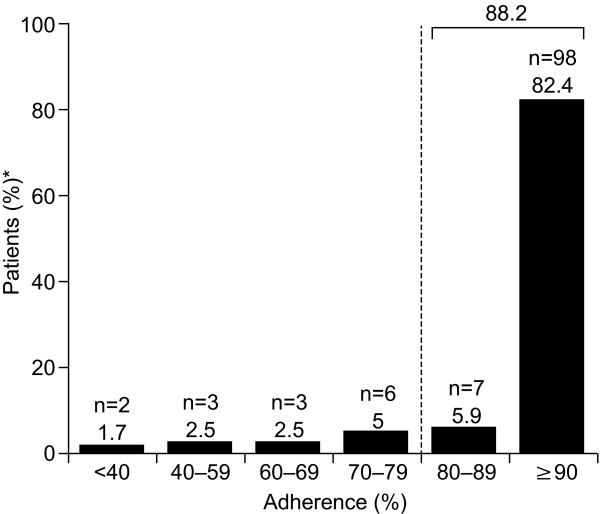
Overall, 88.2% (105/119; intent-to-treat population) of patients were adherent; 67.2% (80/119) administered all scheduled injections. Medical reasons accounted for 35.6% (31/87) of missed injections, forgetfulness for 20.6% (18/87). Adherence did not correlate with baseline Expanded Disability Status Scale (P = 0.821) or PASAT (P = 0.952) scores, or pre-study therapy (P = 0.303). No significant changes (baseline-Week 12) in mean HADS depression (P = 0.482) or anxiety (P = 0.156) scores were observed. 'Overall convenience' was the most important reported benefit of the autoinjection device. Device features associated with handling and ease of use were highly rated. Mean MSTCQ scores for 'flu-like' symptoms (P = 0.022) and global side effects (P = 0.002) significantly improved from Week 4-12. Mean MSTCQ scores for pain at injection site and injection pain increased from Week 4-12 (P < 0.001). Adverse events were mild/moderate. No new safety signals were identified.
Convenience and ease of use of the autoinjection device may improve adherence and, therefore, outcomes, in patients with RRMS receiving sc IFN β-1a.
EU Clinical Trials Register (EU-CTR; http://www.clinicaltrialsregister.eu): 2009-013333-24.
多发性硬化症患者自行注射治疗的依从性难以达到理想水平。注射装置可能有助于克服一些与注射相关的障碍,这些障碍可能会影响患者的依从性。我们旨在评估接受干扰素(IFN)β-1a 皮下注射治疗的复发缓解型多发性硬化症(RRMS)患者短期的依从性和耐受性。
BRIDGE(RebiSmart 将 Rebif 无血清制剂自动注入多剂量药筒)是一项为期 12 周、多中心、开放标签、单臂、观察性、IV 期研究,患者通过电子自动注射装置皮下(sc)每周三次自行注射 IFN β-1a(滴定至 44μg)。在基线和第 4、8、12 周(或提前终止(ET))评估患者的以下项目:体格检查;日记卡完成情况(基线,仅第 4、8 周);神经检查(基线,仅第 12 周/ET);多发性硬化症治疗关注问卷(MSTCQ;仅第 4、8、12 周);便利性问卷(仅第 12 周);医院焦虑和抑郁量表(HADS);和听觉连续加法测试(PASAT;仅基线)。依从性定义为自动注射装置记录的≥ 80%计划注射次数。
总体而言,119 例(意向治疗人群)患者中,88.2%(105 例)患者依从性良好;67.2%(80 例)患者完成了所有计划注射。医疗原因导致 35.6%(31 例/87 例)漏注,遗忘导致 20.6%(18 例/87 例)漏注。依从性与基线扩展残疾状况量表(P = 0.821)或 PASAT(P = 0.952)评分或预研究治疗(P = 0.303)无关。未观察到平均 HADS 抑郁(P = 0.482)或焦虑(P = 0.156)评分在基线至第 12 周之间有显著变化。“总体便利性”是自动注射装置最重要的报告益处。与处理和易用性相关的设备功能得到了高度评价。从第 4 周到第 12 周,与流感样症状(P = 0.022)和全身副作用(P = 0.002)相关的 MSTCQ 评分显著改善。从第 4 周到第 12 周,注射部位疼痛和注射疼痛的 MSTCQ 评分均升高(P < 0.001)。不良事件为轻度/中度。未发现新的安全信号。
使用自动注射装置的便利性和易用性可能会提高 RRMS 患者接受 sc IFN β-1a 治疗的依从性,从而改善治疗结果。
欧盟临床试验注册处(EU-CTR;http://www.clinicaltrialsregister.eu):2009-013333-24。