Department of Neurology, University of British Columbia, Vancouver, BC, Canada.
BMC Neurol. 2010 Apr 30;10:28. doi: 10.1186/1471-2377-10-28.
Multiple sclerosis (MS) currently requires long-term treatment with disease-modifying drugs, administered parenterally up to once daily. The need for regular self-injection can be a barrier to treatment for many patients. Autoinjectors can help patients overcome problems or concerns with self-injection and could, therefore, improve treatment adherence. This study was performed to assess the suitability of a new electronic device for the subcutaneous (sc) administration of interferon (IFN) beta-1a, 44 mcg three times weekly, for relapsing MS.
In this Phase IIIb, multicentre, single-arm study, patients with relapsing MS who had been consistently self-injecting sc IFN beta-1a using an autoinjector for at least 6 weeks were taught to use the new device and self-administered treatment for 12 weeks thereafter. Patient-rated suitability of the device was assessed at the end of Week 12 using the Patient User Trial Questionnaire. Patient satisfaction with, and evaluation of, the injection process was assessed using the MS Treatment Concern Questionnaire. Trainers evaluated the device using the Trainer User Trial Questionnaire.
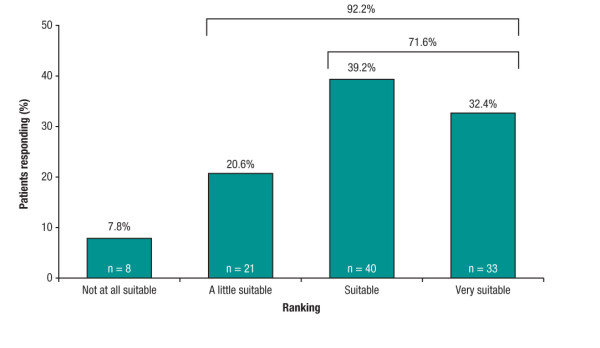
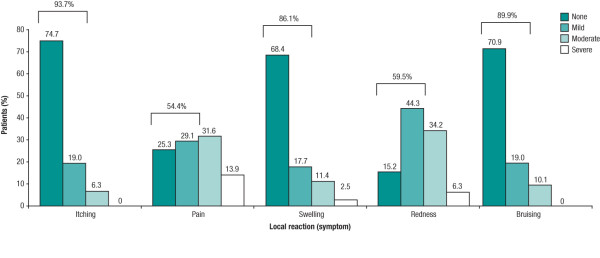
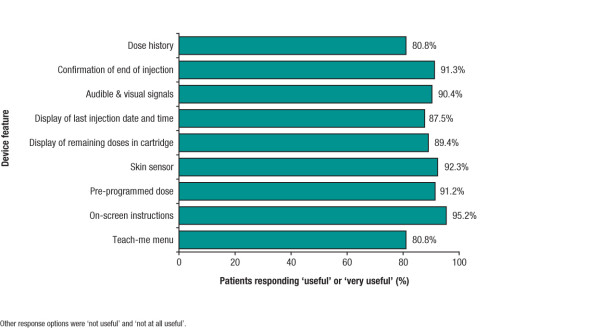
At Week 12, 71.6% (73/102) of patients considered the device 'very suitable' or 'suitable' for self-injection; 92.2% (94/102) reported some degree of suitability and only 7.8% (8/102) found the device 'not at all suitable'. At Weeks 4, 8 and 12, most patients reported that injection preparation and clean-up, performing injections and ease of device use in the previous 4 weeks compared favourably with, or was equivalent to, their previous experience of self-injection. Injection-related pain, injection reactions and 'flu-like' symptoms remained stable over the 12 weeks. Each device feature was rated 'very useful' or 'useful' by at least 80% of patients. All trainers and 95.2% (99/104) of patients found device functions 'very easy' or 'easy' to use. Overall convenience was considered the most important benefit of the device.
Most patients considered the new electronic injection device suitable for the sc injection of IFN beta-1a. They found the device easy to use with useful features, and reported benefits such as overall convenience. The device may, therefore, increase treatment adherence in patients with MS, particularly those with injection-related issues.
NCT00735007.
多发性硬化症(MS)目前需要长期使用疾病修正药物治疗,每周最多进行一次皮下注射。对于许多患者来说,定期自我注射可能是治疗的障碍。自动注射器可以帮助患者克服自我注射的问题或顾虑,因此可以提高治疗的依从性。本研究旨在评估一种新的电子设备在皮下(sc)给予干扰素(IFN)β-1a 44mcg,每周三次治疗复发性多发性硬化症的适用性。
在这项 IIIb 期、多中心、单臂研究中,连续 6 周使用自动注射器自我皮下注射 IFNβ-1a 的复发性多发性硬化症患者接受培训,学习使用新设备,并在此后 12 周内自行治疗。在第 12 周结束时,使用患者用户试用问卷评估患者对设备的自我注射适宜性。使用多发性硬化症治疗顾虑问卷评估患者对注射过程的满意度和评价。培训师使用培训师用户试用问卷评估设备。
在第 12 周时,71.6%(73/102)的患者认为该设备非常适合或适合自我注射;92.2%(94/102)报告有一定程度的适宜性,只有 7.8%(8/102)认为该设备完全不适合。在第 4、8 和 12 周时,大多数患者报告说,与他们以前的自我注射经验相比,注射准备和清理、进行注射以及设备使用的便利性都比较好,或者是相当的。注射相关疼痛、注射反应和流感样症状在 12 周内保持稳定。每个设备特性都至少有 80%的患者评为非常有用或有用。所有培训师和 95.2%(99/104)的患者认为设备功能非常容易或容易使用。总体便利性被认为是该设备最重要的益处。
大多数患者认为新的电子注射设备适合皮下注射 IFNβ-1a。他们发现该设备易于使用,具有有用的功能,并报告了总体便利性等益处。因此,该设备可能会提高多发性硬化症患者的治疗依从性,尤其是那些有注射相关问题的患者。
NCT00735007。