University of California, San Francisco, San Francisco, California 94143-0119, USA.
Ann Intern Med. 2012 Mar 6;156(5):360-6. doi: 10.7326/0003-4819-156-5-201203060-00008.
Little is known about why surrogate decision makers for patients with advanced illness often have overly optimistic expectations about prognosis.
To determine how surrogates interpret prognostic statements and to explore factors influencing surrogates' interpretations of grim prognostic information.
Multicenter, mixed-methods study.
Intensive care units of 3 hospitals in San Francisco, California.
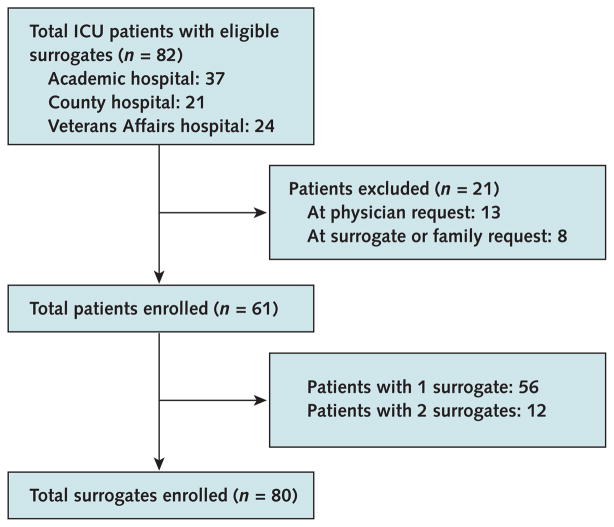
80 surrogates of critically ill patients.
Participants recorded their interpretation of 16 prognostic statements using a standard probability scale. Generalized estimating equations were used to determine whether participants interpreted statements more optimistically as the expressed probability of survival decreased. Fifteen surrogates whose responses exhibited this trend participated in a semistructured interview.
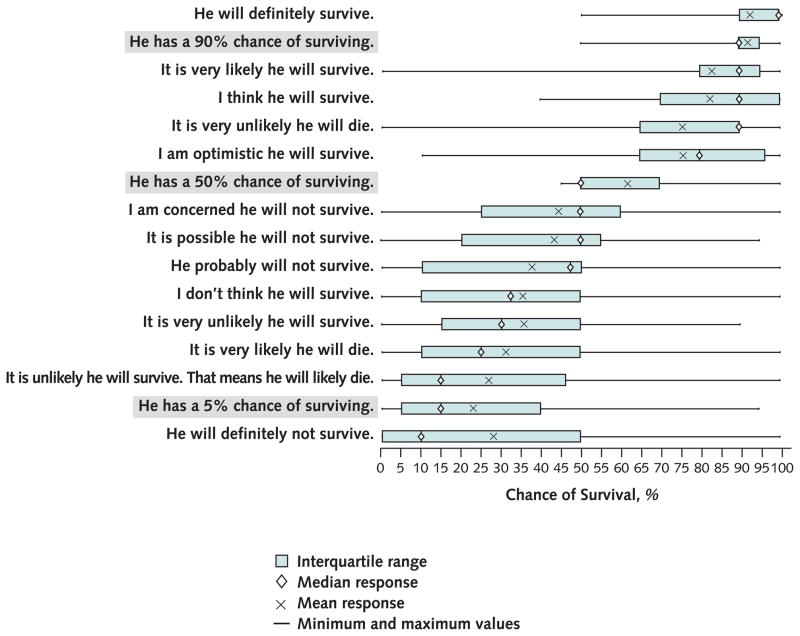
Participants' interpretations of prognostic statements expressing a low risk for death were relatively accurate, but interpretations of statements conveying a high risk for death were more optimistic than the actual meaning (P < 0.001; generalized estimating equation model). Interpretations of the statement "90% chance of surviving" did not differ from the actual meaning, but interpretations of "5% chance of surviving" were more optimistic and showed substantial variability (median, 90% [interquartile range, 90% to 95%; P = 0.11] vs. 15% [interquartile range, 5% to 40%; P < 0.001], respectively). Two main themes from the interviews explained this trend: surrogates' need to register optimism in the face of a poor prognosis and surrogates' belief that patient attributes unknown to the physician would lead to better-than-predicted outcomes.
Surrogates' interpretations were elicited in an experimental setting rather than during actual clinician-surrogate conversations.
Inaccurate interpretations of physicians' prognostications by surrogates arise partly from optimistic biases rather than simply from misunderstandings.
National Heart, Lung, and Blood Institute.
对于为什么患有晚期疾病的患者的代理人常常对预后有过于乐观的期望,人们知之甚少。
确定代理人如何解释预后陈述,并探讨影响代理人对严峻预后信息的解释的因素。
多中心、混合方法研究。
加利福尼亚州旧金山的 3 家医院的重症监护病房。
80 名危重病患者的代理人。
参与者使用标准概率量表记录他们对 16 个预后陈述的解释。使用广义估计方程来确定代理人是否将陈述解释为随着生存率下降而变得更加乐观。15 名对这一趋势做出回应的代理人参加了半结构化访谈。
代理人对表示死亡风险低的预后陈述的解释相对准确,但对表示死亡风险高的陈述的解释则过于乐观,与实际意义不符(P<0.001;广义估计方程模型)。对“90%的存活机会”这一陈述的解释与实际意义并无差异,但对“5%的存活机会”的解释则更为乐观,并且存在很大的差异(中位数,90%[四分位距,90%至 95%;P=0.11]与 15%[四分位距,5%至 40%;P<0.001])。访谈中的两个主要主题解释了这一趋势:代理人在面对不良预后时需要表现出乐观情绪,以及代理人认为医生不知道的患者特征将导致比预测更好的结果。
代理人在实验环境中而不是在实际的临床医生-代理人对话中做出解释。
代理人对医生预测的不准确解释部分源于乐观偏见,而不仅仅是误解。
美国国立卫生研究院心肺血液研究所。