School of Biological Sciences, University of Northern Colorado, Greeley, Colorado, United States of America.
PLoS One. 2012;7(2):e32074. doi: 10.1371/journal.pone.0032074. Epub 2012 Feb 29.
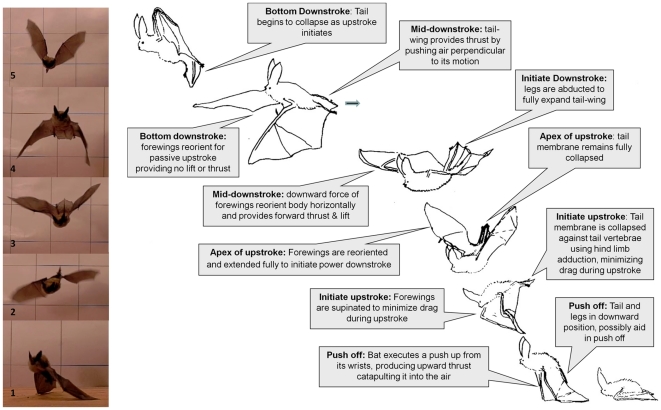
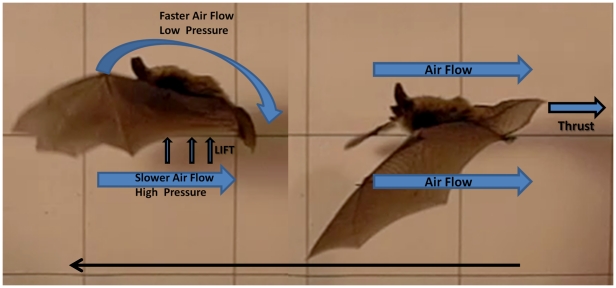
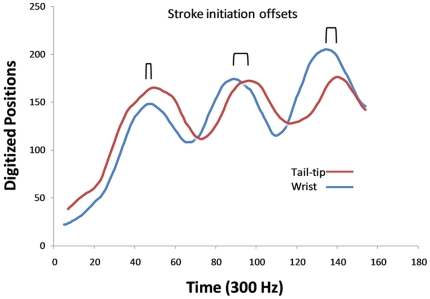
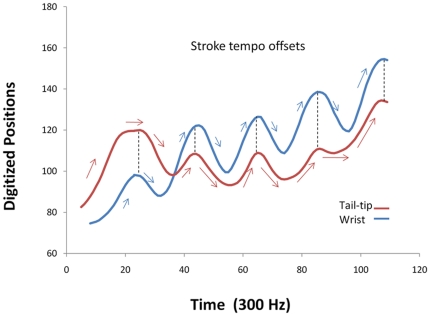
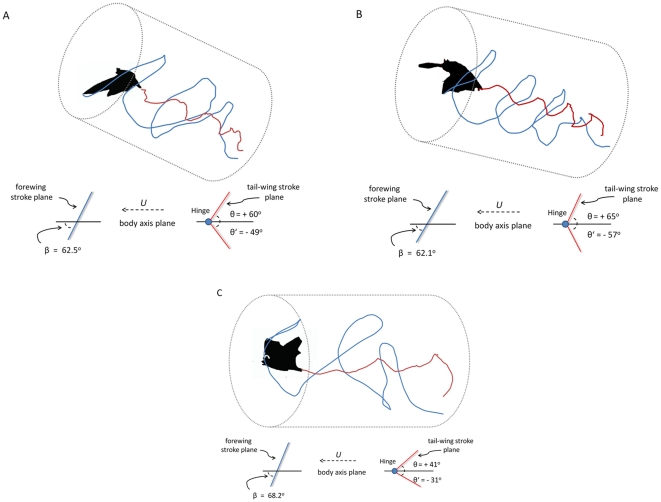
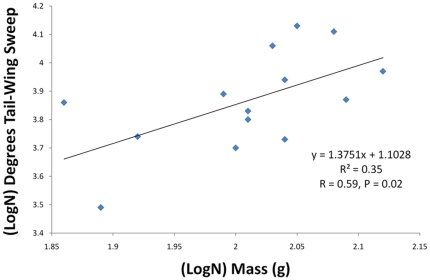
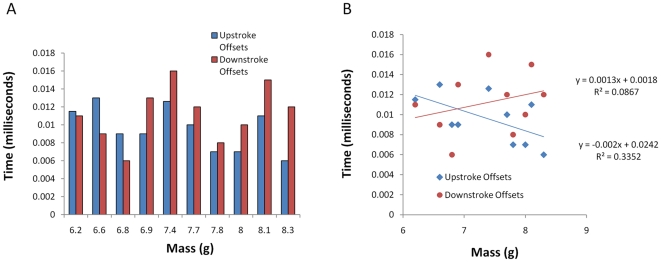
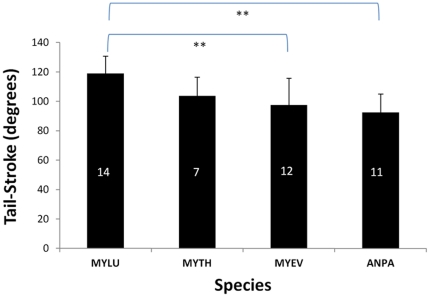
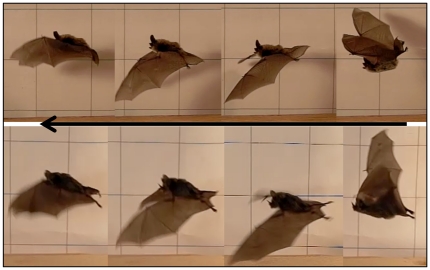
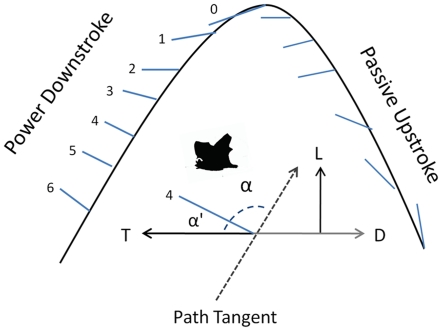
Historically, studies concerning bat flight have focused primarily on the wings. By analyzing high-speed video taken on 48 individuals of five species of vespertilionid bats, we show that the capacity to flap the tail-membrane (uropatagium) in order to generate thrust and lift during takeoffs and minimal-speed flight (<1 m (s-1)) was largely underestimated. Indeed, bats flapped the tail-membrane by extensive dorso-ventral fanning motions covering as much as 135 degrees of arc consistent with thrust generation by air displacement. The degree of dorsal extension of the tail-membrane, and thus the potential amount of thrust generated during platform launches, was significantly correlated with body mass (P = 0.02). Adduction of the hind limbs during upstrokes collapsed the tail-membrane thereby reducing its surface area and minimizing negative lift forces. Abduction of the hind limbs during the downstroke fully expanded the tail-membrane as it was swept ventrally. The flapping kinematics of the tail-membrane is thus consistent with expectations for an airfoil. Timing offsets between the wings and tail-membrane during downstrokes was as much as 50%, suggesting that the tail-membrane was providing thrust and perhaps lift when the wings were retracting through the upstoke phase of the wing-beat cycle. The extent to which the tail-membrane was used during takeoffs differed significantly among four vespertilionid species (P = 0.01) and aligned with predictions derived from bat ecomorphology. The extensive fanning motion of the tail membrane by vespertilionid bats has not been reported for other flying vertebrates.
从历史上看,有关蝙蝠飞行的研究主要集中在翅膀上。通过分析 5 种蝙蝠科蝙蝠的 48 只个体的高速视频,我们表明,蝙蝠在起飞和最小速度飞行(<1 m/s)期间通过拍打尾巴膜(尾膜)来产生推力和升力的能力被大大低估了。事实上,蝙蝠通过广泛的背腹扇动运动拍打尾巴膜,扇动幅度高达 135 度弧,与空气位移产生的推力一致。尾巴膜的背部伸展程度,以及在平台起飞期间产生的潜在推力量,与体重显著相关(P=0.02)。后腿在上升冲程中的内收使尾巴膜折叠,从而减小了其表面积并最小化了负升力。后腿在下降冲程中的外展使尾巴膜完全展开,因为它被向下扫过。尾巴膜的拍打运动学与对翼型的预期一致。翅膀和尾巴膜在下降冲程中的时间差可达 50%,这表明当翅膀在翅膀拍打周期的上升冲程中缩回时,尾巴膜可能在提供推力和升力。尾巴膜在起飞过程中的使用程度在四种蝙蝠科物种之间有显著差异(P=0.01),与蝙蝠生态形态学得出的预测一致。蝙蝠科蝙蝠尾巴膜的广泛扇动运动在其他飞行脊椎动物中尚未报道过。