Centre for Haemato-Oncology, Barts Cancer Institute, Barts and The London School of Medicine and Dentistry, Queen Mary University of London, London, United Kingdom.
PLoS One. 2012;7(2):e32584. doi: 10.1371/journal.pone.0032584. Epub 2012 Feb 29.
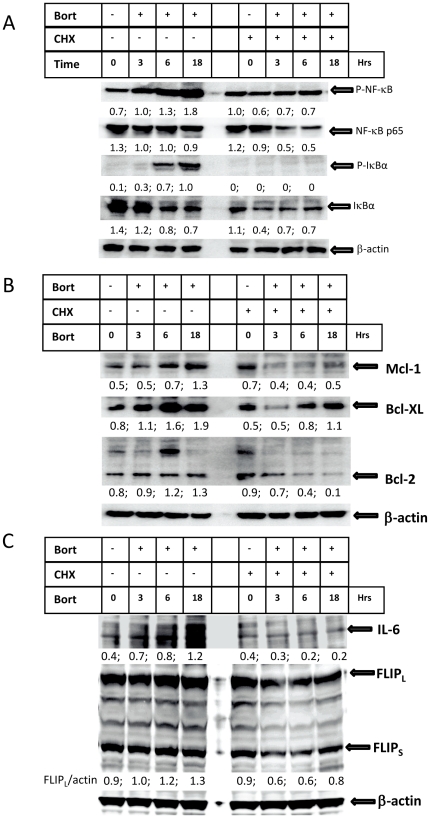
Here we show that bortezomib induces effective proteasome inhibition and accumulation of poly-ubiquitinated proteins in diffuse large B-cell lymphoma (DLBCL) cells. This leads to induction of endoplasmic reticulum (ER) stress as demonstrated by accumulation of the protein CHOP, as well as autophagy, as demonstrated by accumulation of LC3-II proteins. Our data suggest that recruitment of both ubiquitinated proteins and LC3-II by p62 directs ubiquitinated proteins, including I-κBα, to the autophagosome. Degradation of I-κBα results in increased NF-κB nuclear translocation and transcription activity. Since bortezomib treatment promoted I-κBα phosphorylation, ubiquitination and degradation, this suggests that the route of I-κBα degradation was not via the ubiquitin-proteasome degradation system. The autophagy inhibitor chloroquine (CQ) significantly inhibited bortezomib-induced I-κBα degradation, increased complex formation with NF-κB and reduced NF-κB nuclear translocation and DNA binding activity. Importantly, the combination of proteasome and autophagy inhibitors showed synergy in killing DLBCL cells. In summary, bortezomib-induced autophagy confers relative DLBCL cell drug resistance by eliminating I-κBα. Inhibition of both autophagy and the proteasome has great potential to kill apoptosis-resistant lymphoma cells.
在这里,我们证明硼替佐米可诱导弥漫性大 B 细胞淋巴瘤(DLBCL)细胞中有效蛋白酶体抑制和多泛素化蛋白的积累。这会导致内质网(ER)应激的诱导,如 CHOP 蛋白的积累所证明的那样,以及自噬,如 LC3-II 蛋白的积累所证明的那样。我们的数据表明,p62 募集的泛素化蛋白和 LC3-II 将泛素化蛋白,包括 I-κBα,引导至自噬体。I-κBα 的降解导致 NF-κB 核易位和转录活性增加。由于硼替佐米处理促进了 I-κBα 的磷酸化、泛素化和降解,这表明 I-κBα 的降解途径不是通过泛素-蛋白酶体降解系统。自噬抑制剂氯喹(CQ)显著抑制硼替佐米诱导的 I-κBα 降解,增加了与 NF-κB 的复合物形成,减少了 NF-κB 的核易位和 DNA 结合活性。重要的是,蛋白酶体和自噬抑制剂的联合使用在杀伤 DLBCL 细胞方面表现出协同作用。总之,硼替佐米诱导的自噬通过消除 I-κBα 赋予相对的 DLBCL 细胞药物抗性。抑制自噬和蛋白酶体都有可能杀死抗凋亡的淋巴瘤细胞。