Abreu-Velez Ana Maria, Howard Michael S
Georgia Dermatopathology Associates, Atlanta, Georgia, USA.
N Am J Med Sci. 2012 Jan;4(1):1-8. doi: 10.4103/1947-2714.92892.
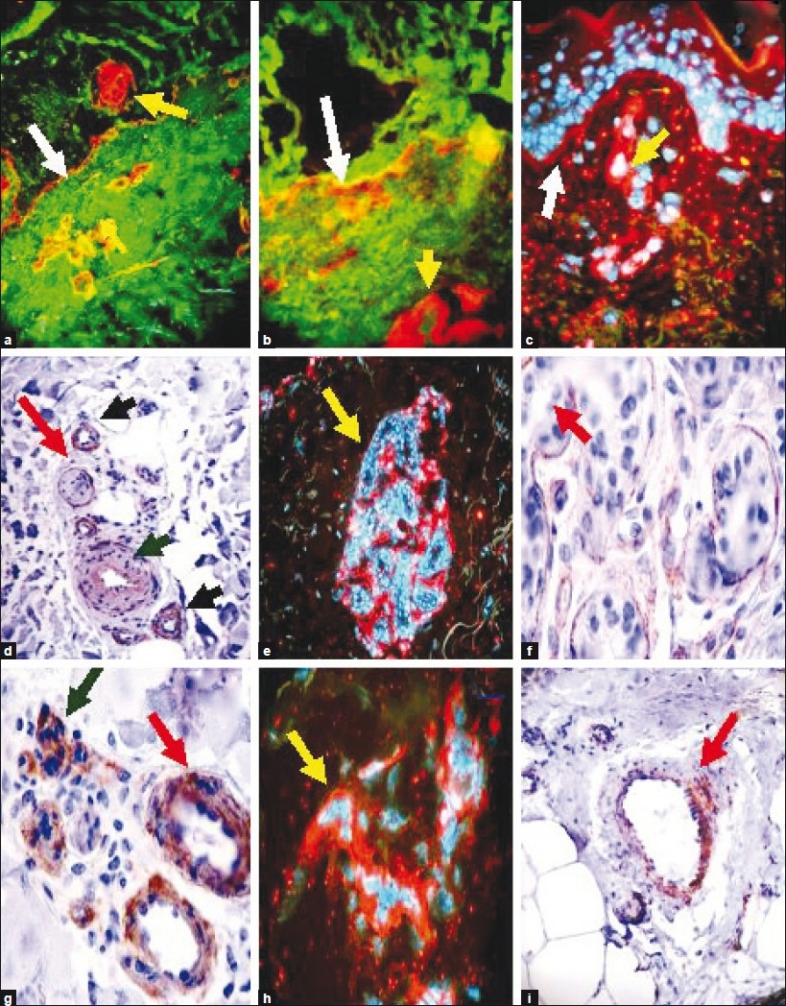
Type IV collagen is a type of collagen found primarily in the skin within the basement membrane zone. The type IV collagen C4 domain at the C-terminus is not removed in post-translational processing, and the fibers are thus link head-to-head, rather than in a parallel fashion. Also, type IV collagen lacks a glycine in every third amino-acid residue necessary for the tight collagen helix. Thus, the overall collagen-IV conformation is structurally more pliable and kinked, relative to other collagen subtypes. These structural features allow collagen IV to form sheets, which is the primary structural form found in the cutaneous basal lamina. There are six human genes associated with collagen IV, specifically COL4A1, COL4A2, COL4A3, COL4A4, COL4A5 and COL4A6. The aim of this review is to highlight the significance of this protein in normal skin, and in selected diseases.
The alpha 3 protein constituent of type IV collagen is thought to be the antigen implicated in Goodpasture's syndrome, wherein the immune system attacks the basement membranes of the renal glomeruli and pulmonary alveoli. In addition, mutations to the genes coding for type IV collagen lead to the Alport syndrome. Furthermore, autoantibodies directed against denatured human type IV collagen have been described in rheumatoid arthritis, scleroderma, and SLE. Structural studies of collagen IV have been utilized to differentiate between subepidermal blistering diseases, including bullous pemphigoid, acquired epidermolysis bullosa, anti-epiligrin cicatricial pemphigoid, and bullous lupus erythematosus. Collagen IV is also of importance in wound healing and in embryogenesis.
Pathological studies have demonstrated that minor structural differences in collagen IV can lead to distinct, clinically different diseases.
IV型胶原蛋白是一种主要存在于基底膜区皮肤中的胶原蛋白。IV型胶原蛋白C端的C4结构域在翻译后加工过程中不会被去除,因此其纤维以头对头的方式连接,而不是平行排列。此外,IV型胶原蛋白在形成紧密的胶原蛋白螺旋所需的每三个氨基酸残基中缺少一个甘氨酸。因此,相对于其他胶原蛋白亚型,IV型胶原蛋白的整体构象在结构上更柔韧且有扭结。这些结构特征使IV型胶原蛋白能够形成片状结构,这是皮肤基底层中发现的主要结构形式。有六个与IV型胶原蛋白相关的人类基因,分别是COL4A1、COL4A2、COL4A3、COL4A4、COL4A5和COL4A6。本综述的目的是强调这种蛋白质在正常皮肤和某些疾病中的重要性。
IV型胶原蛋白的α3蛋白成分被认为是与Goodpasture综合征相关的抗原,在该综合征中,免疫系统攻击肾小球和肺泡的基底膜。此外,编码IV型胶原蛋白的基因突变会导致阿尔波特综合征。此外,在类风湿性关节炎、硬皮病和系统性红斑狼疮中也发现了针对变性人IV型胶原蛋白的自身抗体。IV型胶原蛋白的结构研究已被用于区分表皮下大疱性疾病,包括大疱性类天疱疮、获得性大疱性表皮松解症、抗表皮整联蛋白瘢痕性类天疱疮和大疱性红斑狼疮。IV型胶原蛋白在伤口愈合和胚胎发育中也很重要。
病理研究表明,IV型胶原蛋白的微小结构差异可导致截然不同的临床疾病。