Degryse Amber L, Xu Xiaochuan C, Newman J Luke, Mitchell Daphne B, Tanjore Harikrishna, Polosukhin Vasiliy V, Jones Brittany R, McMahon Frank B, Gleaves Linda A, Phillips John A, Cogan Joy D, Blackwell Timothy S, Lawson William E
Department of Medicine, Division of Allergy, Pulmonary and Critical Care Medicine, Vanderbilt University School of Medicine, Nashville, Tennessee 37232-2650, USA.
Exp Lung Res. 2012 Apr;38(3):124-34. doi: 10.3109/01902148.2012.658148.
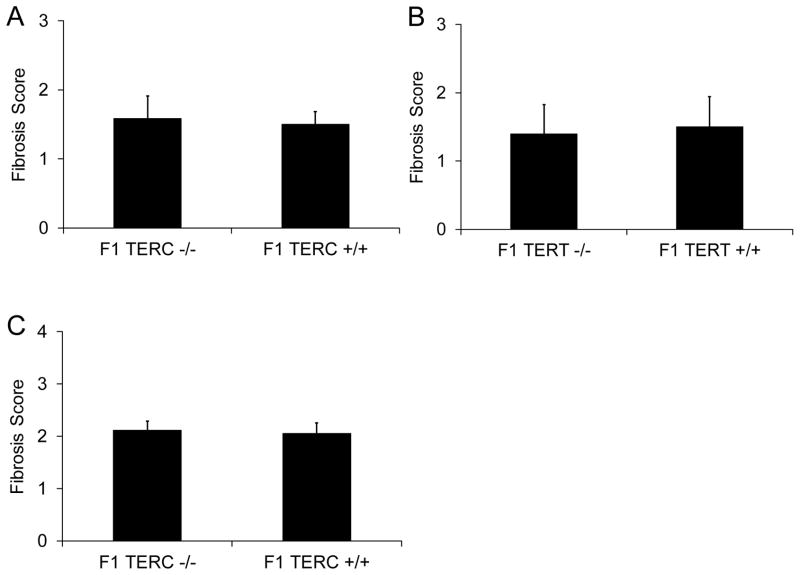
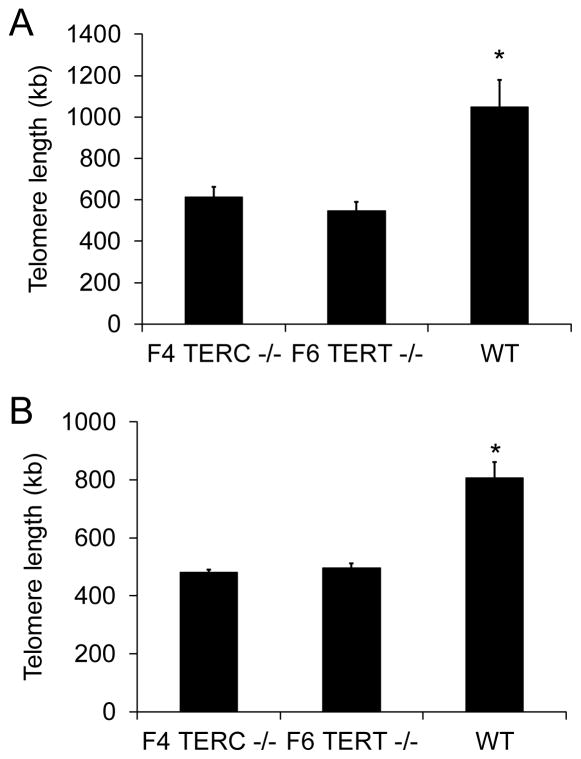
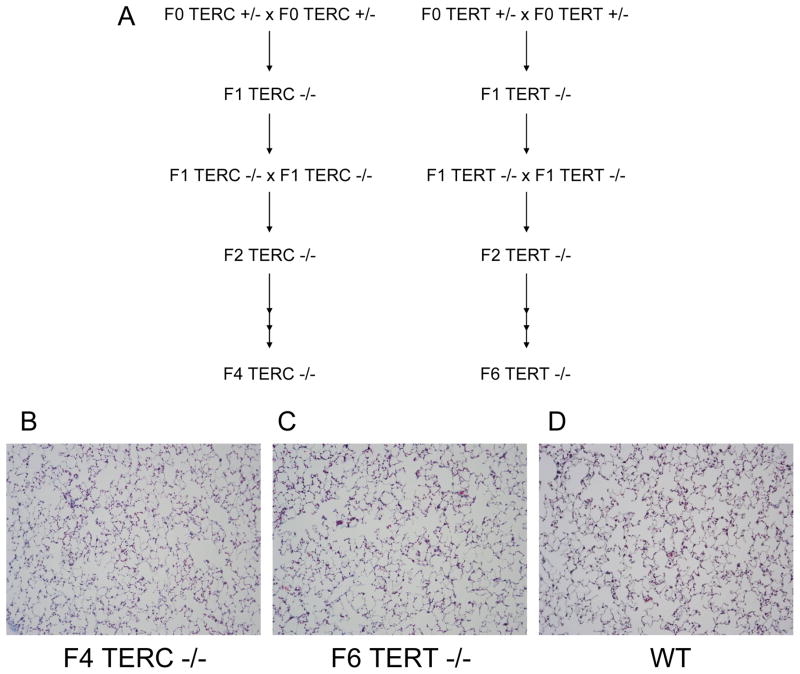
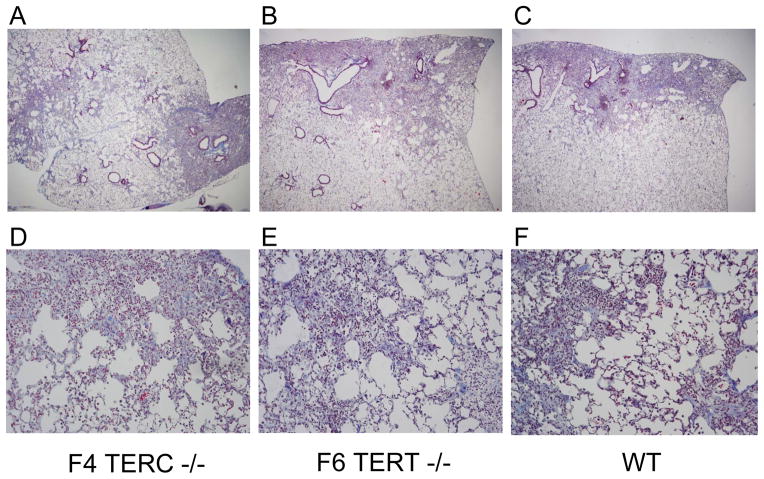
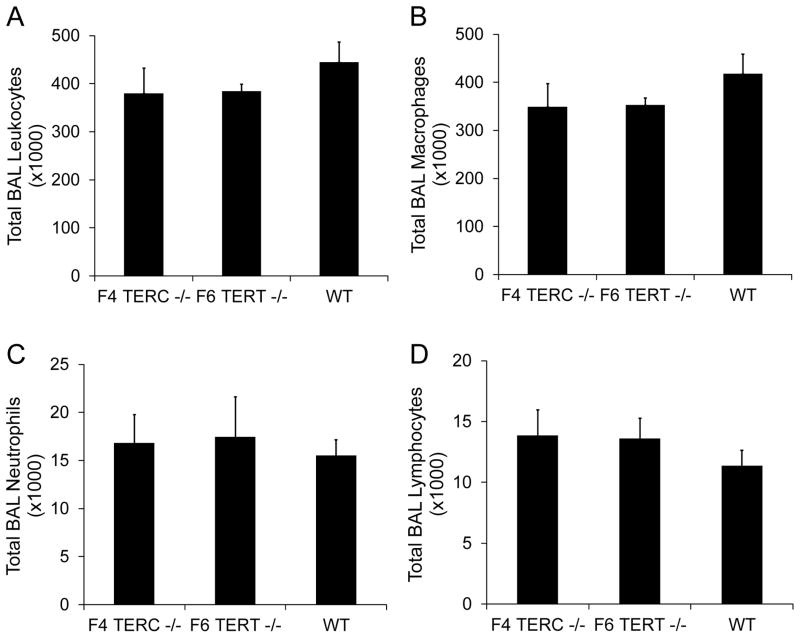
Idiopathic pulmonary fibrosis (IPF) is characterized by interstitial lung infiltrates, dyspnea, and progressive respiratory failure. Reports linking telomerase mutations to familial interstitial pneumonia (FIP) suggest that telomerase activity and telomere length maintenance are important in disease pathogenesis. To investigate the role of telomerase in lung fibrotic remodeling, intratracheal bleomycin was administered to mice deficient in telomerase reverse transcriptase (TERT) or telomerase RNA component (TERC) and to wild-type controls. TERT-deficient and TERC-deficient mice were interbred to the F6 and F4 generation, respectively, when they developed skin manifestations and infertility. Fibrosis was scored using a semiquantitative scale and total lung collagen was measured using a hydroxyprolinemicroplate assay. Telomere lengths were measured in peripheral blood leukocytes and isolated type II alveolar epithelial cells (AECs). Telomerase activity in type II AECs was measured using a real-time polymerase chain reaction (PCR)-based system. Following bleomycin, TERT-deficient and TERC-deficient mice developed an equivalent inflammatory response and similar lung fibrosis (by scoring of lung sections and total lung collagen content) compared to controls, a pattern seen in both early (F1) and later (F6 TERT and F4 TERC) generations. Telomere lengths were reduced in peripheral blood leukocytes and isolated type II AECs from F6 TERT-deficient and F4 TERC-deficient mice compared to controls. Telomerase deficiency in a murine model leads to telomere shortening, but does not predispose to enhanced bleomycin-induced lung fibrosis. Additional genetic or environmental factors may be necessary for development of fibrosis in the presence of telomerase deficiency.
特发性肺纤维化(IPF)的特征为间质性肺浸润、呼吸困难和进行性呼吸衰竭。将端粒酶突变与家族性间质性肺炎(FIP)联系起来的报告表明,端粒酶活性和端粒长度维持在疾病发病机制中很重要。为了研究端粒酶在肺纤维化重塑中的作用,将气管内博来霉素给予端粒酶逆转录酶(TERT)或端粒酶RNA组分(TERC)缺陷的小鼠以及野生型对照。当TERT缺陷和TERC缺陷小鼠出现皮肤表现和不育时,分别将它们杂交至F6和F4代。使用半定量量表对纤维化进行评分,并使用羟脯氨酸微孔板分析法测量总肺胶原蛋白。测量外周血白细胞和分离的II型肺泡上皮细胞(AEC)中的端粒长度。使用基于实时聚合酶链反应(PCR)的系统测量II型AEC中的端粒酶活性。给予博来霉素后,与对照相比,TERT缺陷和TERC缺陷小鼠出现了同等程度的炎症反应和相似的肺纤维化(通过肺切片评分和总肺胶原蛋白含量),在早期(F1)和后期(F6 TERT和F4 TERC)代中均可见此模式。与对照相比,来自F6 TERT缺陷和F4 TERC缺陷小鼠的外周血白细胞和分离的II型AEC中的端粒长度缩短。小鼠模型中的端粒酶缺陷导致端粒缩短,但不会易患博来霉素诱导的肺纤维化增强。在存在端粒酶缺陷的情况下,可能需要其他遗传或环境因素来发展纤维化。