Department of Pulmonary and Critical Care Medicine, The Affiliated Drum Tower Hospital of Nanjing University Medical School, Nanjing, Jiangsu, China.
Department of Critical Care Medicine, The Affiliated Wuxi People's Hospital of Nanjing Medical University, Wuxi, Jiangsu, China.
Cell Death Dis. 2022 May 4;13(5):435. doi: 10.1038/s41419-022-04886-7.
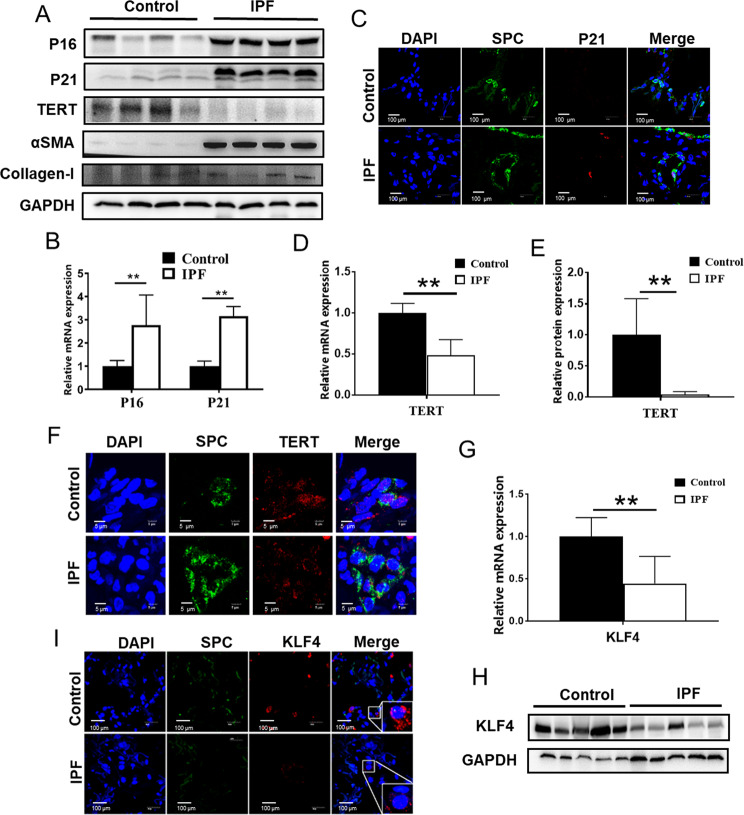
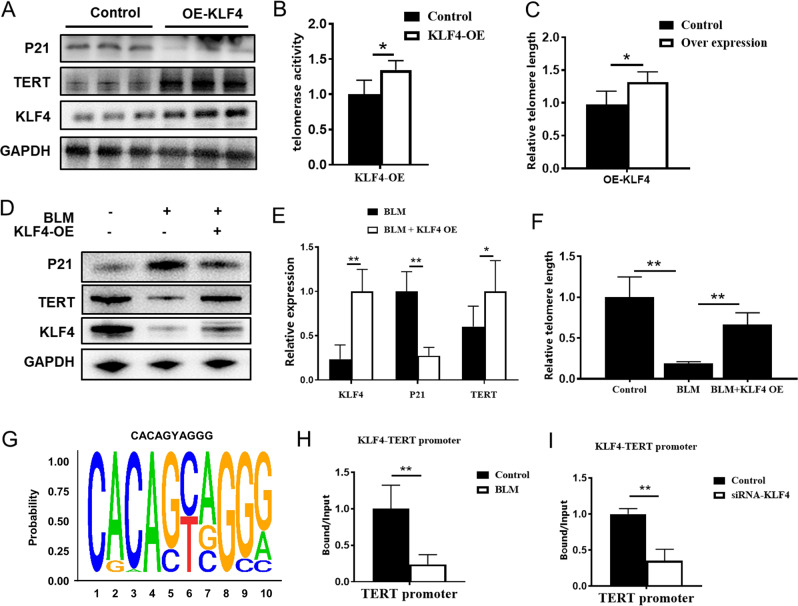
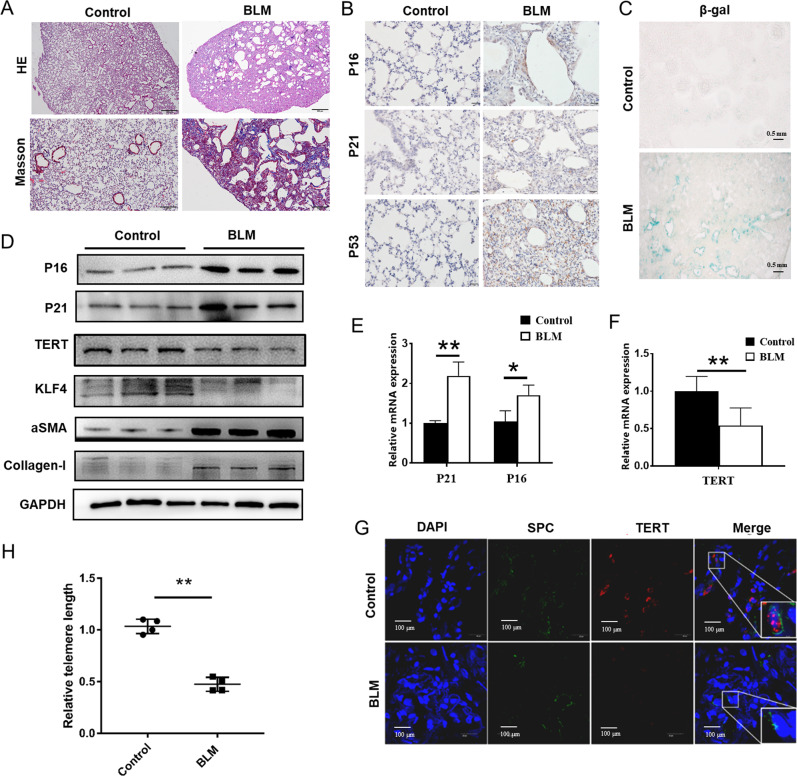
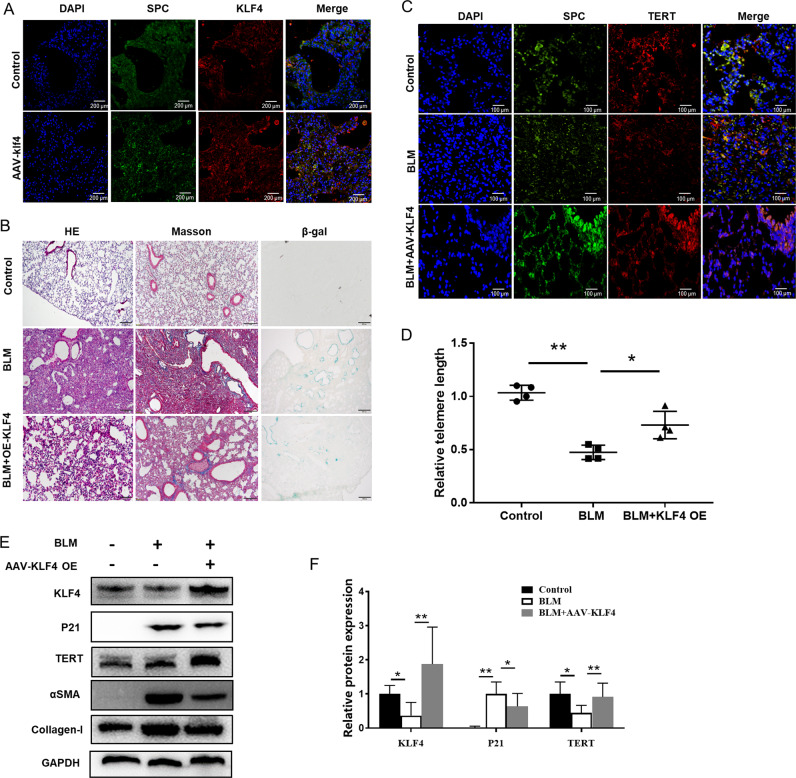
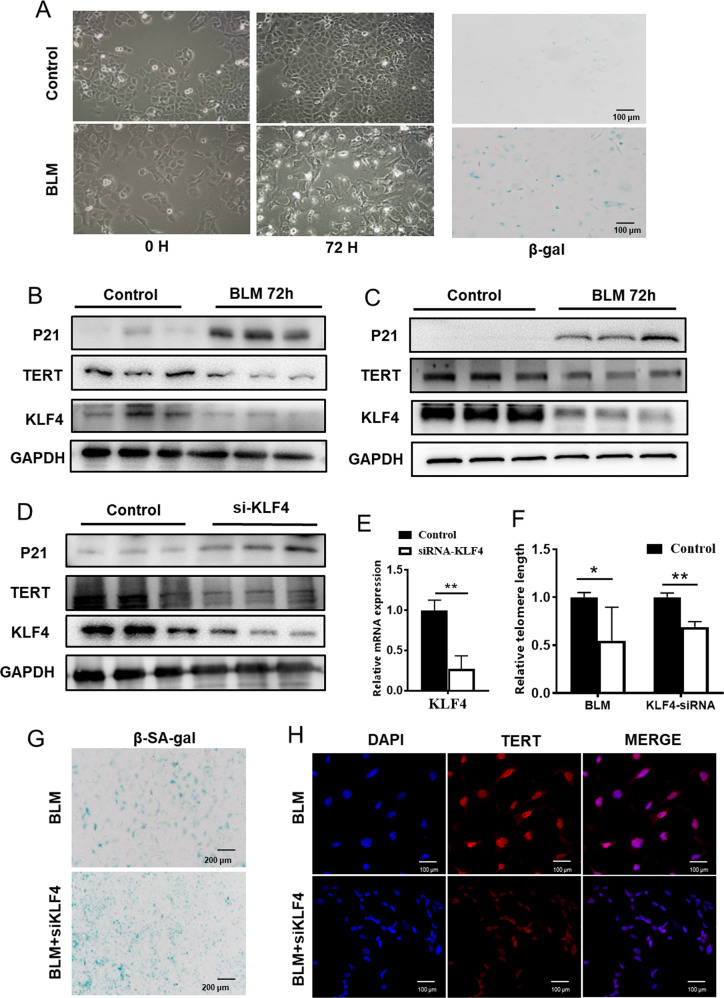
Idiopathic pulmonary fibrosis (IPF) was considered as a telomere-mediated disease. TERT and TERC correlated with telomere length. Although telomerase gene mutations were associated with IPF, majority patients did not carry mutations. The mechanism by which telomerase expression was regulated in IPF are still unclear. In this study, we aimed to delineate the mechanisms that how TERT protein expression were regulated in alveolar epithelial cells (AECs) in pulmonary fibrosis. Here, we found that P16, P21 and fibrosis markers (αSMA and Collagen-I) were prominently increased in lung tissues of IPF patients and bleomycin-induced mouse models, while the expression of KLF4 and TERT were decreased in AECs. In vivo experiments, AAV-6 vectors mediated KLF4 over-expression with specific SP-C promoter was constructed. Over-expression of KLF4 in AECs could protect TERT expression and suppress the development of pulmonary fibrosis in bleomycin-induced mouse models. In the mechanism exploration of TERT regulation, KLF4 and TERT were both down-regulated in bleomycin-induced senescent MLE-12 and BEAS-2B cells. Compared with control group, small-interfering RNA targeting KLF4 significantly reduced the TERT expression and telomerase activity, while overexpression of KLF4 can increased the expression of TERT and telomerase activity in senescent AECs. Furthermore, ChIP showed that KLF4 protein could bind to the TERT promoter region in MLE-12 cells, suggesting that KLF4 could implicate in pathogenesis of lung fibrosis through regulating TERT transcription in AECs. Taken together, this study identified that KLF4 might be a promising potential target for further understanding the mechanism and developing novel strategy for the treatment of lung fibrosis in IPF.
特发性肺纤维化(IPF)被认为是一种端粒介导的疾病。TERT 和 TERC 与端粒长度相关。虽然端粒酶基因突变与 IPF 相关,但大多数患者并未携带突变。IPF 中端粒酶表达调控的机制尚不清楚。在这项研究中,我们旨在阐明在肺纤维化中肺泡上皮细胞(AEC)中 TERT 蛋白表达是如何受到调控的机制。在这里,我们发现 P16、P21 和纤维化标志物(αSMA 和 Collagen-I)在 IPF 患者和博来霉素诱导的小鼠模型的肺组织中明显增加,而 KLF4 和 TERT 的表达在 AEC 中减少。在体内实验中,构建了携带特异性 SP-C 启动子的 AAV-6 载体介导的 KLF4 过表达。AEC 中 KLF4 的过表达可以保护 TERT 的表达,并抑制博来霉素诱导的小鼠模型中肺纤维化的发展。在 TERT 调控机制的探索中,KLF4 和 TERT 在博来霉素诱导的衰老 MLE-12 和 BEAS-2B 细胞中均下调。与对照组相比,靶向 KLF4 的小干扰 RNA 显著降低了 TERT 的表达和端粒酶活性,而过表达 KLF4 可以增加衰老 AEC 中 TERT 的表达和端粒酶活性。此外,ChIP 显示 KLF4 蛋白可以结合 MLE-12 细胞中的 TERT 启动子区域,表明 KLF4 可以通过调节 AEC 中的 TERT 转录参与肺纤维化的发病机制。综上所述,这项研究确定 KLF4 可能是进一步了解 IPF 中肺纤维化发病机制和开发新型治疗策略的有前途的潜在靶点。