Department of Neuropsychiatry, Konkuk University Hospital, Seoul, Korea.
Psychiatry Investig. 2012 Mar;9(1):65-72. doi: 10.4306/pi.2012.9.1.65. Epub 2012 Jan 25.
This study aims to analyze how much heart rate variability (HRV) indices discriminatively respond to age and severity of sleep apnea in the obstructive sleep apnea syndrome (OSAS).
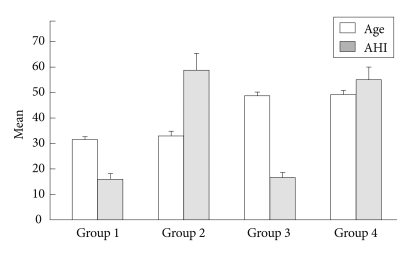
176 male OSAS patients were classified into four groups according to their age and apnea-hypopnea index (AHI). The HRV indices were compared via analysis of covariance (ANCOVA). In particular, the partial correlation method was performed to identify the most statistically significant HRV indices in the time and frequency domains. Stepwise multiple linear regressions were further executed to examine the effects of age, AHI, body mass index (BMI), systolic blood pressure (SBP), diastolic blood pressure (DBP), and sleep parameters on the significant HRV indices.
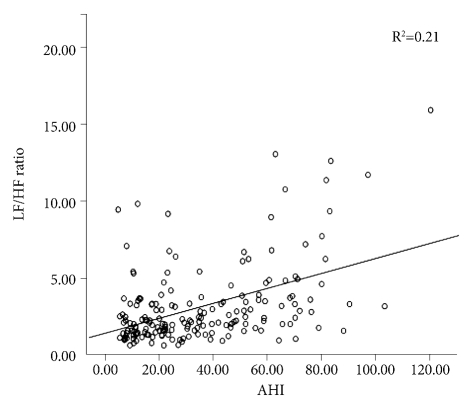
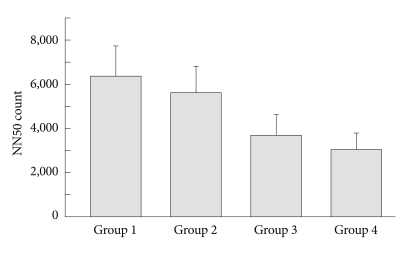
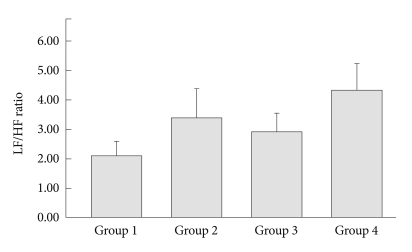
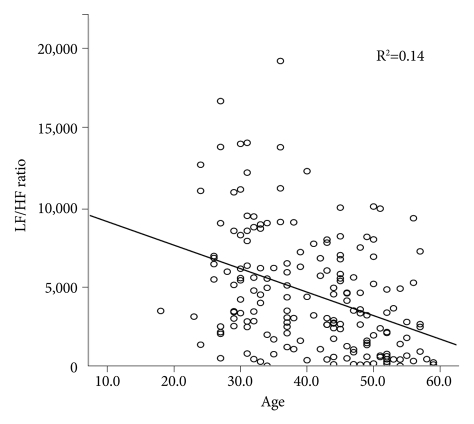
The partial correlation analysis yielded the NN50 count (defined as the number of adjacent R-wave to R-wave intervals differing by more than 50 ms) and low frequency/high frequency (LF/HF) ratio to be two most statistically significant HRV indices in both time and frequency domains. The two indices showed significant differences between the groups. The NN50 count was affected by age (p<0.001) and DBP (p=0.039), while the LF/HF ratio was affected by AHI (p<0.001), the amount of Stage 2 sleep (p=0.005), and age (p=0.021) in the order named in the regression analysis.
The NN50 count more sensitively responded to age than to AHI, suggesting that the index is mainly associated with an age-related parasympathetic system. On the contrary, the LF/HF ratio responded to AHI more sensitively than to age, suggesting that it is mainly associated with a sympathetic tone likely reflecting the severity of sleep apnea.
本研究旨在分析心率变异性(HRV)指数在多大程度上能区分阻塞性睡眠呼吸暂停综合征(OSAS)患者的年龄和睡眠呼吸暂停严重程度。
根据年龄和呼吸暂停低通气指数(AHI),将 176 名男性 OSAS 患者分为四组。通过协方差分析(ANCOVA)比较 HRV 指数。特别地,采用偏相关分析方法确定时域和频域中最具统计学意义的 HRV 指数。进一步进行逐步多元线性回归分析,以检验年龄、AHI、体重指数(BMI)、收缩压(SBP)、舒张压(DBP)和睡眠参数对有统计学意义的 HRV 指数的影响。
偏相关分析得出,NN50 计数(定义为连续 R 波之间的时间间隔相差超过 50 毫秒的 R 波数)和低频/高频(LF/HF)比值是时域和频域中两个最具统计学意义的 HRV 指数。这两个指数在各组之间存在显著差异。NN50 计数受年龄(p<0.001)和 DBP(p=0.039)的影响,而 LF/HF 比值受 AHI(p<0.001)、2 期睡眠量(p=0.005)和年龄(p=0.021)的影响,按上述顺序进行回归分析。
NN50 计数对年龄的反应比 AHI 更敏感,提示该指数主要与年龄相关的副交感神经系统有关。相反,LF/HF 比值对 AHI 的反应比年龄更敏感,提示它主要与反映睡眠呼吸暂停严重程度的交感神经张力有关。